Junte-se a nós em uma viagem ao mundo dos livros!
Adicionar este livro à prateleira
Grey
Deixe um novo comentário Default profile 50px
Grey
Assine para ler o livro completo ou leia as primeiras páginas de graça!
All characters reduced
Cultural Honor Metrics - cover
LER

Cultural Honor Metrics

Glen Perslow

Tradutor A AI

Editora: Publifye

  • 0
  • 0
  • 0

Sinopse

Cultural Honor Metrics explores how societies measure honor and social value, revealing the profound impact of these "honor metrics" on individual behavior and social structures. The book argues that while specific expressions of honor differ across cultures, the underlying psychological and social functions remain surprisingly consistent. For instance, the book highlights how honor systems can simultaneously promote social cohesion and contribute to conflict, a duality rooted in the enforcement of social norms.

 
The book systematically progresses from defining honor and social value to examining their manifestations in both small-scale and large-scale societies, including case studies from Latin America and East Asia. It delves into the psychological dimensions of honor, exploring how individuals internalize honor codes and the effects on self-esteem and identity.

 
A key feature is its development of a framework for systematically quantifying honor values, enabling cross-cultural comparisons and analysis. This innovative approach offers valuable insights for academics and policymakers interested in understanding and addressing cultural conflicts.
Disponível desde: 21/02/2025.
Comprimento de impressão: 63 páginas.

Outros livros que poderiam interessá-lo

  • Jean-Michel Basquiat: A short biography - 5 Minutes: Short on time – long on info! - cover

    Jean-Michel Basquiat: A short...

    5 Minutes, 5 Minute Biographies,...

    • 0
    • 0
    • 0
    Jean-Michel Basquiat, American artist extraordinaire: Life and work in a short biography! Everything you need to know, brief and concise. Infotainment, education and entertainment at its best!
    Ver livro
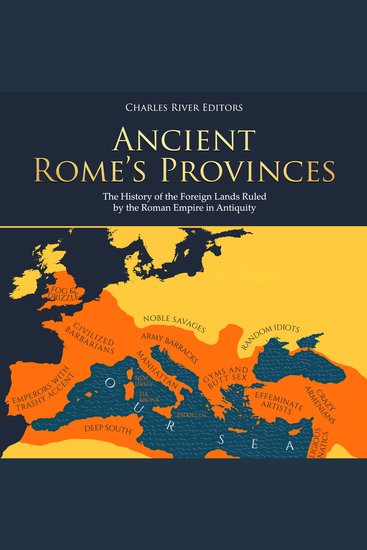
  • Ancient Rome’s Provinces: The History of the Foreign Lands Ruled by the Roman Empire in Antiquity - cover

    Ancient Rome’s Provinces: The...

    Editors Charles River

    • 0
    • 0
    • 0
    It can be argued that Roman culture was, indeed, Graeco-Roman rather than Roman. It was the Greek language that served as the lingua franca in the Eastern Empire and much of the west including Italy. Many Greek intellectuals, including Galen, were based in Rome and the Roman aristocracy more and more came to embrace Greek literature and philosophy. Homer’s epics inspired Virgil’s Aeneid and Seneca wrote in Greek. Earlier, Scipio Africanus (236 – 183 B.C.), the epitome of the Roman martial hero, studied Greek philosophy and regarded Greek culture as the benchmark against which all others had to be judged. The Roman poet and philosopher Horace studied in Athens during the Principate and, in common with many of his class, saw that city as the intellectual centre of the world. 
    In the minds of most people today, Gaul equates to modern France. However, the vast geographical area that Caesar named Gaul, in fact, was made up of a number of very distinct regions and covered, in addition to modern-day France, Belgium, Luxembourg, parts of the Netherlands, Germany, Switzerland and Northern Italy. The Romans called the northern area of the Italian peninsula, which is now part of modern Italy, Cisalpine Gaul, or Gaul on this side of the Alps. Early Romans did not even consider this region as part of Italy and repeated incursions southwards, and the sacking of Rome itself in 390 B.C., resulted in Rome taking full control of the area in 221 B.C. and thoroughly Romanizing it to the extent that even the Celtic language totally disappeared and was replaced by Latin. The region was initially a province but by the beginning of the 1st century B.C., it had become fully integrated into the Roman heartland and became an administrative region of Italy rather than a province. 
    Ver livro
  • Religious Freedom and Populism - The Appropriation of a Human Right and How to Counter It - cover

    Religious Freedom and Populism -...

    Bernd Hirschberger, Katja Voges

    • 0
    • 0
    • 0
    Populism is a growing threat to human rights. They are appropriated, distorted, turned into empty words or even their opposite. The contributors to this volume examine these practices using the example of freedom of religion or belief, a human right that has become a particular target of right-wing populists and extremists worldwide. The contributions not only show the rhetorical patterns of appropriation and distortion, but also demonstrate for various countries which social dynamics favor the appropriation in each case and propose how to strengthen human rights and the culture of debate in democratic societies.
    Ver livro
  • Imperfect Leadership in Action - A practical book for school leaders who know they don't know it all - cover

    Imperfect Leadership in Action -...

    Steve Munby, Marie-Claire...

    • 0
    • 0
    • 0
    Foreword by Andy Hargreaves.Hero headship is out. Imperfect leadership is in. This book is designed to help leaders develop and embrace an imperfect leadership mindset as a foundation for growth and development. In his first book, Imperfect Leadership: A book for leaders who know they don't know it all, Steve Munby uses the word 'imperfect' to describe his own leadership style. This is not something he apologises for; he feels imperfect leadership should be celebrated. Too often we are given examples of leaders who are put on some kind of pedestal, lauded as superheroes who have it all worked out and are so good at what they do that nobody else can come close. But imperfect leadership is the antidote to this flawed perception. In Imperfect Leadership in Action, Steve has teamed up with Marie-Claire Bretherton to delve in more detail into a broad range of themes under the umbrella of imperfect leadership. Writing with sparkling clarity, the authors explore the approach's key principles and share engaging exercises and inspiring case studies which give voice to a wide range of experiences from across the education sector.The central message is that we can use our imperfections as a springboard for leadership development by asking for help, investing in self-reflection, focusing on building teams - and by trying to be a better version of ourselves tomorrow than we were today.The book provides numerous prompts for self-reflection, and also includes a chapter on leading in times of change (such as the COVID-19 lockdowns) and how the principles of imperfect leadership turn out to be equally applicable in times of crisis.Suitable for all those in or aspiring to leadership positions in education.
    Ver livro
  • The Age of Gladiators - Savagery and Spectacle in Ancient Rome - cover

    The Age of Gladiators - Savagery...

    Anônimo

    • 0
    • 0
    • 0
    This was Rome, a city of bloodshed and laughter, of food and starvation. But why was so much wealth, time and trouble lavished on free entertainments? 
     
    The Age of the Gladiators explores many savage spectacles of Ancient Rome, many of which have become proverbial for their cruelty, bloodlust and glory. From Gladiator fights in grand amphitheaters to chariot racing at the Circus Maximus, Romans had their pick of extreme spectator sports. 
     
    Rupert Matthews explores the development of these customs, from religious rites into opportunities to bolster political esteem. Were Romans truly free citizens, governed by a fair democracy? And if not, what part did these free entertainments play in the political chess game? This fascinating book reveals all.
    Ver livro
  • Starting from Scratch - The Life-Changing Lessons of Aeneas - cover

    Starting from Scratch - The...

    Andrea Marcolongo

    • 0
    • 0
    • 0
    With an “inimitable voice combined with flawless erudition,” this new analysis of the Aeneid “illuminates its subject with a modern light” (Le Monde). 
     
    From the bestselling author of The Ingenious Language comes a meditation on rebuilding, recovery, and renewal that is also a fascinating portrait of antiquity’s most complex and surprisingly modern hero. 
     
    In times of peace and prosperity, one can turn to Homer to learn valuable life lessons, to experience the thrills and terrors of war, and to read about hair-raising adventures in distant lands. But when things do not go as planned, when we unexpectedly find ourselves at the center of an epoch-defining upheaval, then, writes Andrea Marcolongo, we must look to Virgil’s Aeneas for an example of adaptability and resilience. 
     
    In Marcolongo’s fresh, nuanced portrayal, Virgil’s Aeneas emerges as a multiform, deeply human hero, striking in his vulnerability and capacity for empathy. His journey of rebirth and rebuilding, from the ruins of Troy to the shores of Italy, teaches us that when all seems lost, with hope, perseverance, and a little bit of luck, we can seek and find new beginnings. 
     
    “Marcolongo is today’s Montaigne . . . There is wisdom and grace here to last the ages.” —André Aciman, New York Times–bestselling author of Call Me by Your Name, now a major motion picture 
     
    “A deep look at our all-too-human fragility . . . An impassioned and enthralling book.” —Bon Culture (Italy) 
     
    “Through her personal reacquaintance with [the Aeneid] at a time of great distress, Andrea Marcolongo has brought it, as it were, back into the conversation and outside the confines of academia . . . An excellent translation by Will Schutt brilliantly serves Andrea Marcolongo’s passionate endorsement of a work of literature written two millennia ago.” —Reading in Translation 
     
    “Andrea Marcolongo has brought us a book from the future.” —La Stampa (Italy)
    Ver livro