Join us on a literary world trip!
Add this book to bookshelf
Grey
Write a new comment Default profile 50px
Grey
Subscribe to read the full book or read the first pages for free!
All characters reduced
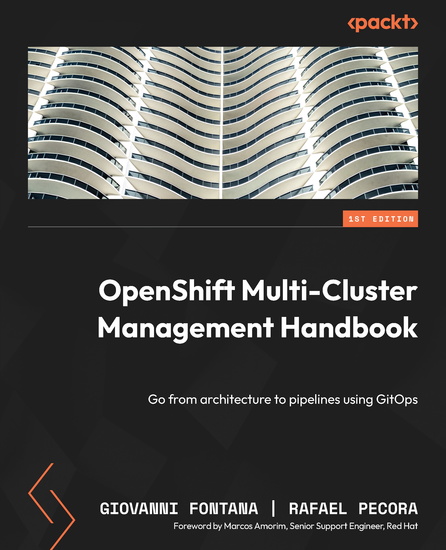
OpenShift Multi-Cluster Management Handbook - Go from architecture to pipelines using GitOps - cover

OpenShift Multi-Cluster Management Handbook - Go from architecture to pipelines using GitOps

Giovanni Fontana, Rafael Pecora

Publisher: Packt Publishing

  • 0
  • 1
  • 0

Summary

Discover best practices for designing and scaling robust OpenShift clusters’ architecture for different workloads Manage multiple clusters on-premise or in the cloud using multi-cluster management tools to keep them secure and compliant Implement multi-cluster CI/CD on OpenShift using GitOpsKey FeaturesDiscover best practices to design robust OpenShift architecture and scale them to different workloadsUnderstand the minimal collection of topics you should consider in your container security strategyImplement multi-cluster CI/CD on OpenShift using GitOpsBook DescriptionFor IT professionals working with Red Hat OpenShift Container Platform, the key to maximizing efficiency is understanding the powerful and resilient options to maintain the software development platform with minimal effort. OpenShift Multi-Cluster Management Handbook is a deep dive into the technology, containing knowledge essential for anyone who wants to work with OpenShift. This book starts by covering the architectural concepts and definitions necessary for deploying OpenShift clusters. It then takes you through designing Red Hat OpenShift for hybrid and multi-cloud infrastructure, showing you different approaches for multiple environments (from on-premises to cloud providers). As you advance, you’ll learn container security strategies to protect pipelines, data, and infrastructure on each layer. You’ll also discover tips for critical decision making once you understand the importance of designing a comprehensive project considering all aspects of an architecture that will allow the solution to scale as your application requires. By the end of this OpenShift book, you’ll know how to design a comprehensive Red Hat OpenShift cluster architecture, deploy it, and effectively manage your enterprise-grade clusters and other critical components using tools in OpenShift Plus.What you will learnUnderstand the important aspects of OpenShift cluster architectureDesign your infrastructure to run across hybrid cloudsDefine the best strategy for multitenancy on OpenShiftDiscover efficient troubleshooting strategies with OpenShiftBuild and deploy your applications using OpenShift Pipelines (Tekton)Work with ArgoCD to deploy your applications using GitOps practicesMonitor your clusters’ security using Red Hat Advanced Cluster SecurityWho this book is for 
This book is for a wide range of IT professionals using or looking to use OpenShift with a hybrid/multi-cloud approach. In this book, IT architects will find practical guidance on OpenShift clusters’ architecture, while Sysadmins, SREs, and IT operators will learn more about OpenShift deployment, troubleshooting, networking, security, and tools to manage multiple clusters from a single pane. For DevOps engineers, this book covers CI/CD strategies for multiple clusters using GitOps. Equipped with just basic knowledge of containerization and Kubernetes, you’re ready to get started.
Available since: 11/11/2022.
Print length: 458 pages.

Other books that might interest you

  • Every Last Fish - A Deep Dive into Everything They Do for Us and We Do to Them - cover

    Every Last Fish - A Deep Dive...

    Rose George

    • 0
    • 0
    • 0
    Slippery, wet, and strange: Fish can be easier to think of as food than as fellow animals. But what do we know about these creatures we meet on our dinner table and how they got there? But with warming oceans, diminishing fish stocks, and questions about fish farming practices, where will the fish come from? 
     
    In Every Last Fish, Rose George dives into these questions by exploring the vast industries that support our appetite for fish sticks and salmon burgers, and the colossal illegal fishing trade whose practices and standards are unmonitored and often dangerous. Journeying to the bottom of the ocean and back, she examines the machinations of this $200 billion food system―one that's growing rapidly even as fish populations disappear. 
     
    Along the way, George introduces us to the people on the front lines of fishes and fishing: fishermen, divers, marine biologists, fish fryers, and fishwives. Her journey ends at the fish counter, with guidance for listeners looking to make better choices, both for the ocean's health and their own. 
     
    Ranging from Alaska to the United Kingdom to Senegal and beyond, Every Last Fish is an unforgettable trip through the ocean's inhabitants and workers.
    Show book
  • The AI Ecosystems Revolution - Transforming the Global Supply Chain through Real-Time Reporting - cover

    The AI Ecosystems Revolution -...

    Joe Hudicka

    • 0
    • 0
    • 0
    The global supply chain is broken. From delayed shipments to inefficiencies, it seems like it might be easier to start over than try to navigate what we’ve got. However, there is another path. Joe Hudicka, one of the thought leaders of the supply chain industry, has a plan. Through Connected Conversations™, new technologies, and a sprinkle of AI, we can take an inefficient system and turn it into one that delivers goods on time, every time, autonomously.
    Show book
  • The Landscapes of Science and Religion - What Are We Disagreeing About? - cover

    The Landscapes of Science and...

    Hannah Waite, Nick Spencer

    • 0
    • 0
    • 0
    The relationship between science and religion has long been a heated debate and is becoming an ever more popular topic. The scientific capacity to manipulate and change humans and their environment through genetic engineering, life extension, and AI is going to take a huge leap forward in the twenty-first century, provoking endless debates around humans "playing God." 


    But what do we mean by this? Asking this question is surprisingly hard work. Attempts to "essentialize" science, let alone religion, quickly run into trouble. Where are the boundaries? Whose definition of science is definitive? Which concept of religious is the authoritative one? 


    Ultimately, neither "science" nor "religion" can be pinned down to one single meaning or definition. Rather, they encompass a family of definitions that relate to one another in a complex web of shifting ways. Drawing on extensive research with over a hundred leading thinkers in the UK—including Martin Rees, Brian Cox, Susan Greenfield, A. C. Grayling, Ray Tallis, Linda Woodhead, Steve Bruce, Adam Rutherford, Robin Dunbar, Francesca Stavrakopoulou, and Iain McGilchrist—The Landscapes of Science and Religion takes the much-needed step of asking what science and religion actually are, before turning to the familiar question of how they relate to one another.
    Show book
  • Origin Story: Book Summary & Analysis - cover

    Origin Story: Book Summary &...

    Briefly Summaries

    • 0
    • 0
    • 0
    This is a concise summary and analysis of Origin Story, by David Christian.
     
    It is not the original book and is not affiliated with or endorsed by  David Christian.
     
    Ideal those seeking a quick and insightful overview.
     
    Origin Story takes readers on a journey through the history of the universe, from the Big Bang to the present day. It explores how human beings and the world around us came to be, weaving together insights from science, philosophy, and history. The book provides a broad perspective on the evolution of life, offering a narrative that connects the origins of the cosmos with the development of human societies, cultures, and the modern world.
    Show book
  • In the Company of Grace - A Veterinarian's Memoir of Trauma and Healing - cover

    In the Company of Grace - A...

    Jody Lulich

    • 0
    • 0
    • 0
    Rising to accept a prestigious award, Jody Lulich wondered what to say. Describe how caring for helpless, voiceless animals in his own shame and pain provided a lifeline, a chance to heal himself as well? Lulich tells his story in In the Company of Grace, a memoir about finding courage in compassion and strength in healing—and power in finally confronting the darkness of his youth. 


    Lulich's white father and Black mother met at a civil rights rally, but love was no defense against their personal demons. His mother's suicide and his sometimes brutal father's subsequent withdrawal set Lulich on a course from the South Side of Chicago to the Tuskegee School of Veterinary Medicine in Alabama to an endowed chair at the University of Minnesota. Though shadowed by troubling secrets, his memoir also features scenes of surprising light and promise. Most consequentially, at Tuskegee Lulich rents a room in the home of a seventy-five-year-old Black woman named Grace, whose wholehearted adoption of him—and her own stories of the Jim Crow era—finally gives him a sense of belonging and possibility. 


    Completing his book amid the furor over George Floyd's murder, Lulich reflects on all the ways that race has shaped his life. In the Company of Grace is a moving testament to the power of compassion in the face of seemingly overwhelming circumstances.
    Show book
  • The Well-Connected Animal - Social Networks and the Wondrous Complexity of Animal Societies - cover

    The Well-Connected Animal -...

    Lee Alan Dugatkin

    • 0
    • 0
    • 0
    An engaging exploration of the wondrous social webs that permeate life in animal societies around the world. 


    It's all about who you know. Whether vampire bats sharing blood meals for survival, field crickets remembering champion fighters, macaque monkeys forming grooming pacts after a deadly hurricane, or great tit birds learning the best way to steal milk—it pays to be well connected. 


    In this tour of the animal kingdom, evolutionary biologist Lee Alan Dugatkin reveals a new field of study, uncovering social networks that existed long before the dawn of human social media. He accessibly describes the latest findings from animal behavior, evolution, computer science, psychology, anthropology, genetics, and neurobiology, and incorporates interviews and insights from researchers he finds swimming with manta rays, avoiding pigeon poop, and stopping monkeys from stealing iPads. With Dugatkin as our guide, we investigate social networks in giraffes, elephants, kangaroos, Tasmanian devils, whales, bats, and more. From animal networks in Australia and Asia to Africa, Europe, and the Americas, The Well-Connected Animal is an eye-opening exposé of wild friends, enemies, and everything in between.
    Show book