Join us on a literary world trip!
Add this book to bookshelf
Grey
Write a new comment Default profile 50px
Grey
Subscribe to read the full book or read the first pages for free!
All characters reduced
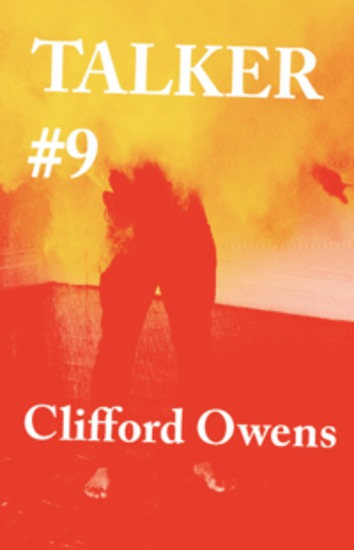
Talker #9: Clifford Owens - cover

Talker #9: Clifford Owens

Giles Bailey, Clifford Owens

Publisher: eeeeee.pub

  • 0
  • 0
  • 0

Summary

Talker is an interview zine about performance by Giles Bailey.Issue #9 is a conversation with Clifford Owens.He is based in Jersey City, New Jersey, and his work focuses on the body in relation to the power dynamics of race, masculinity, class and the fragility of social structures. It also closely examines the significance of photography in performance making and its histories.His project Anthology responds to the absence of a performance history that includes Black artists by soliciting and performing scores from Black artists working today. In Photographs with an Audience those attending the performance are invited to respond to prompts and questions by making a commitment to the moment and history by standing before the camera and having their picture taken.Giles Bailey is an artist based in London. He works with performance, using texts, video fragments and choreographies to explore how knowledge and meaning are generated through relationships with others. Since 2016 he has published Talker.Additional issues of Talker have featured Ian White, Kate Valk, Richard Maxwell, Sue Tompkins, Spalding Gray with Kathy Acker, Dora García, Jo Fong, Paul Maheke, Barby Asante, Gustav Metzger, Miranda July, and Agus Nur Amal PMTOH.
Available since: 06/30/2025.
Print length: 24 pages.

Other books that might interest you

  • Kofun Period - The Mysterious Tomb Builders and the Roots of Imperial Japan - cover

    Kofun Period - The Mysterious...

    Rolf Hedger

    • 0
    • 0
    • 0
    The Kofun Period, which lasted from approximately 250 to 600 AD, marks a significant era in early Japanese history. This period is named after the distinct burial mounds, or "kofun," that were constructed during this time. These mounds vary in size and shape but are most commonly recognized for their keyhole-like design. The Kofun Period is pivotal as it represents a time of political consolidation, the development of social structures, and the emergence of a powerful ruling elite that would lay the foundation for the imperial system in Japan. 
    The beginning of the Kofun Period is closely tied to the formation of more complex societies in the Japanese archipelago. By this time, a system of chiefdoms had developed, and the early Yamato state began to emerge as a dominant political force. The period sees the consolidation of power under a centralized leadership, which eventually paved the way for the establishment of the imperial family that still exists today. During the Kofun Period, society transitioned from small, localized groups to more organized and hierarchical structures, a shift that was reflected in the elaborate tombs built for the elites. 
    The most notable characteristic of the Kofun Period is the construction of large burial mounds for the ruling class. These tombs were not only elaborate final resting places for powerful individuals but also symbolized the political power and religious authority of the deceased. The kofun mounds varied in size, with some measuring several hundred meters in length. These tombs were often surrounded by moats and would contain a wealth of grave goods, such as weapons, jewelry, and pottery, which reflected both the material culture of the time and the importance of the individual being buried.
    Show book
  • How to Keep from Losing Your Mind - cover

    How to Keep from Losing Your Mind

    Deal W. Hudson

    • 0
    • 0
    • 0
    Liberal education is nothing other then the aquistion of a free mind. 
    Unfortunately, too many of us have a mind shackled by ideologies and moved by outside forces. We’re pulled and pushed by trends and the prevailing culture. Higher education has become ridiculously expensive and is producing graduates whose minds are anything but free, filled as they are with the prejudices of their teachers. 
    Only when we break these shackles and habitually exercise a free mind can we call ourselves liberally educated. 
    In How to Keep from Losing Your Mind, Deal Hudson will show you how to avoid the false open-mindedness and groupthink of the modern “-isms” promoted by the PC arbiters of our cultural milieu. Instead you’ll learn to: Form the habit of reconsideration, the key to a truly open mindEntertain doubts about your own immediate opinionsArgue coherently from first principles, instead of repeating ideological talking pointsRecognize prejudice and propagandaAvoid sloganeering and engage in real thought 
    This book will enable every person to rise above the shouting, the name-calling, and the brutal incivility of public discourse and rediscover the pleasure and benefit of contemplating the meaning and noble aims of human life.
    Show book
  • Art History Art of India - cover

    Art History Art of India

    Robert Weinstein

    • 0
    • 0
    • 0
    India, with its extensive and colourful history, has produced an artistic tradition in many forms. Architecture, painting, sculpture, calligraphy, mosaics, and artisan products all display the country's cultural, religious, and philosophical richness. From Hinduism, with its pantheon of imagery of gods, goddesses, animals, and many other figures, to Islam, with its astounding architecture and intricate calligraphy; the many facets of India have given rise to a fascinating and beautiful collection of artworks. Featuring incredible images and a text written by a renowned scholar on the subject, this work offers an in-depth look at the masterpieces of India, showcasing this fascinating country and her artists while covering a wide range of styles and techniques.
    Show book
  • Wei Shu and Wu - The Three Kingdoms Warlords Intrigue and the Fight for Supremacy - cover

    Wei Shu and Wu - The Three...

    Rolf Hedger

    • 0
    • 0
    • 0
    The fall of the Han Dynasty marked the end of one of China’s longest and most influential imperial reigns, setting the stage for the chaotic period of the Three Kingdoms. While the dynasty had enjoyed centuries of stability and prosperity, internal corruption, weak leadership, and external rebellions steadily eroded its power. By the late second century AD, the once-mighty Han court was little more than a battleground for rival factions, warlords, and opportunists seeking to seize control. 
    One of the first major signs of decline was the increasing corruption within the imperial court. Eunuchs, who had gained substantial influence over the young emperors, manipulated state affairs for personal gain. As these power struggles intensified, competent officials and generals were sidelined or purged, leaving the empire vulnerable to both internal unrest and external threats. The weakening of central authority allowed regional governors and warlords to act with growing independence, further fragmenting the empire. 
    Amidst this political turmoil, a major peasant uprising erupted in 184 AD—the Yellow Turban Rebellion. Led by Zhang Jue, a Taoist healer who promised salvation through divine intervention, the rebellion quickly spread across northern and central China, drawing hundreds of thousands of followers. Although the Han government eventually crushed the revolt, the effort severely drained the empire’s resources and exposed its inability to maintain control. The rebellion’s suppression also elevated the status of military commanders, many of whom would later become the powerful warlords who divided the empire.
    Show book
  • George Michael's Faith - cover

    George Michael's Faith

    Matthew Horton

    • 0
    • 0
    • 0
    On Saturday, June 28, 1986, George Michael picked up his tasseled leather jacket, walked out of London’s Wembley Stadium and cheerfully tore up five years of glittering pop history. He’d just disposed of Wham!, the band he’d formed with school friend Andrew Ridgeley when they were teenagers, and now, at 23, he knew he was all grown up. He just needed to convince everyone else. Faith is what happens when you’ve outstripped your dreams, your peers, your friends and your fans, and no one’s caught up yet. It’s about pouring all of that confusion, insecurity and sizzling ambition into music that comes out confused, insecure and ambitious – and then selling 25 million copies of it. George Michael was always preparing for this and, in the process, he set a template for all disaffected singers making that move. This book examines that model and the themes that went into Faith – from engaging in politics to crossing over to a Black audience and writing classic pop songs to endure – and speaks to the surviving key players to tell the story of how it was made.
    Show book
  • Shakespeare's Greatest Monologues - The Complete Collection - Over 40 Legendary Speeches - cover

    Shakespeare's Greatest...

    William Shakespeare

    • 0
    • 0
    • 0
    William Shakespeare, long hailed as the history's greatest dramatic writer, has been lauded for his mastery of poetic expression, his insight into the human condition and his deep exploration into the psyche and motivations of his characters. These skills are perhaps best exemplified in the monologues he gives his various protagonists, villains and bit players.   From King Henry V's inspiring speech to his soldiers on the field of Agincourt to the villainous Merchant of Venice Shylock defending his own cruelty, to the shepherdess Phebe from "As You Like It" grappling with her sudden attraction to a young courtier, to Nick Bottom from "A Midsummer Night's Dream," awaking from the strangest dream in history, Shakespeare's monologues are short distillations of his larger themes - love and loss, fairness and inequity, power and envy, lust and purity.   Fort Raphael Publishing is proud to present - in this complete volume - the best of Shakespeare's greatest monologues, each of which captures a shining, brilliant moment from his plays that gives us a deeper understanding of each character, whether flattering, damning or inspiring.   Enjoy this collection of monologues from the greatest theatrical writer in the English language - William Shakespeare - performed by some of the finest classical actors in the business.
    Show book