¡Acompáñanos a viajar por el mundo de los libros!
Añadir este libro a la estantería
Grey
Escribe un nuevo comentario Default profile 50px
Grey
Suscríbete para leer el libro completo o lee las primeras páginas gratis.
All characters reduced
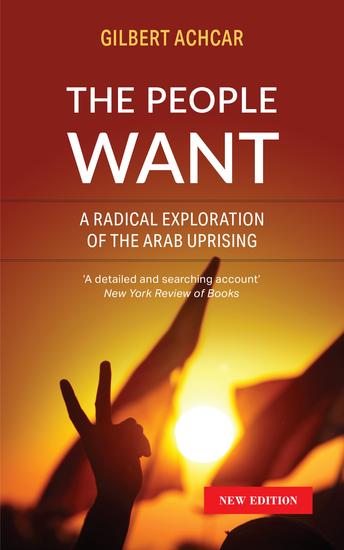
The People Want - A Radical Exploration of the Arab Uprising - cover

The People Want - A Radical Exploration of the Arab Uprising

Gilbert Achcar

Traductor G. M. Goshgarian

Editorial: Saqi Books

  • 0
  • 0
  • 0

Sinopsis

'The people want' - thus began the slogans chanted by millions of protesters in 2011 in what was dubbed the 'Arab Spring'. ?While the protests revealed a long-suppressed craving for democracy, they also laid bare a deep structural crisis. In this landmark work, Middle East analyst Gilbert Achcar examines the socio-economic roots and political dynamics of the regional upheaval. He assesses the peculiarities of the region's states and regimes, and sheds light on the movements that use Islam as a political banner. Achcar argues that the Arab Spring was but the beginning of a long-term revolutionary process - a perspective confirmed by a second wave of uprisings in 2019 - and outlines the requirements for a solution to the crisis. This new edition features a preface drawing a balance sheet of the upheaval's first decade.
Disponible desde: 31/03/2022.
Longitud de impresión: 416 páginas.


Otros libros que te pueden interesar

  • The American Operations in WW2: Rome-Arno - 22 January–9 September 1944 - cover

    The American Operations in WW2:...

    Clayton D. Laurie

    • 0
    • 0
    • 0
    World War II was the largest and most violent armed conflict in the history of mankind. Highly relevant today, World War II has much to teach us, not only about the profession of arms, but also about military preparedness, global strategy, and combined operations in the coalition war against fascism. This book follows military operations of the US Army in Italy from 22 January to 9 September 1944. 
    Rome was quiet on the morning of 4 June 1944. Propaganda leaflets dropped during the early morning hours by order of the commander of the Allied 15th Army Group, General Sir Harold R. L. G. Alexander, urged Romans "to stand shoulder-to-shoulder to protect the city from destruction and to defeat our common enemies." Even though the retreating Germans had declared Rome an open city, citizens were urged to do everything possible to protect public services, transportation facilities, and communications. "Citizens of Rome," the leaflets declared, "this is not the time for demonstrations. Obey these directions and go on with your regular work. Rome is yours! Your job is to save the city, ours is to destroy the enemy."
    Ver libro
  • On Class - cover

    On Class

    Deborah Dundas

    • 0
    • 0
    • 0
    Deborah Dundas is a journalist who grew up poor and almost didn’t make it to university. In On Class, she talks to writers, activists, those who work with the poor and those who are poor about what happens when we don’t talk about poverty or class—and what will happen when we do.
    		 
    Growing up poor, Deborah Dundas knew what it meant to want, to be hungry, and to long for social and economic dignity; she understood the crushing weight of having nothing much expected of you. But even after overcoming many of the usual barriers faced by lower- and working-class people, she still felt anxious about her place, and even in relatively safe spaces reluctant to broach the subject of class. While new social movements have generated open conversation about gender and racism, discussions of class rarely include the voices of those most deeply affected: the working class and poor. 
    On Class is an exploration of the ways in which we talk about class: of who tells the stories, and who doesn’t, which ones tend to be repeated most often, and why this has to change. It asks the question: What don’t we talk about when we don’t talk about class? And what might happen if, finally, we did?
    Ver libro
  • Fall of the Assyrian Empire The: The History and Legacy of Ancient Assyria’s Violent Destruction - cover

    Fall of the Assyrian Empire The:...

    Editors Charles River

    • 0
    • 0
    • 0
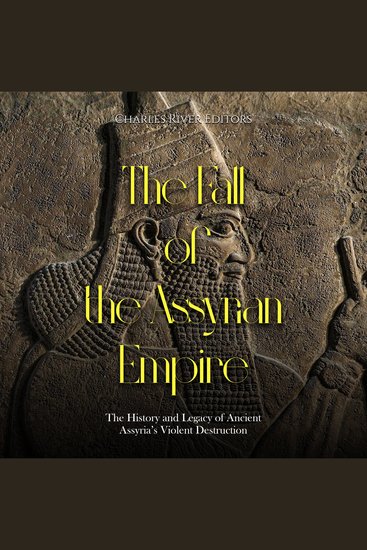
    When scholars study the history of the ancient Near East, several wars that had extremely brutal consequences (at least by modern standards) often stand out. Forced removal of entire populations, sieges that decimated entire cities, and wanton destruction of property were all tactics used by the various peoples of the ancient Near East against each other, but the Assyrians were the first people to make war a science. When the Assyrians are mentioned, images of war and brutality are among the first that come to mind, despite the fact that their culture prospered for nearly 2,000 years.  
    	Like a number of ancient individuals and empires in that region, the negative perception of ancient Assyrian culture was passed down through Biblical accounts, and regardless of the accuracy of the Bible’s depiction of certain events, the Assyrians clearly played the role of adversary for the Israelites. Indeed, Assyria (Biblical Shinar) and the Assyrian people played an important role in many books of the Old Testament and are first mentioned in the book of Genesis: “And the beginning of his kingdom was Babel and Erech, and Akkad, and Calneh, in the land of Shinar. Out of that land went forth Ashur and built Nineveh and the city Rehoboth and Kallah.” (Gen. 10:10-11). Although the Biblical accounts of the Assyrians are among the most interesting and are often corroborated with other historical sources, the Assyrians were much more than just the enemies of the Israelites and brutal thugs.
    Ver libro
  • National Ballot Measures 2024 - Living Democracy - cover

    National Ballot Measures 2024 -...

    Michael Mathiesen

    • 0
    • 0
    • 0
    National Ballot Measures 2024 - Living Democracy is my gift to the country that I love dearly and have always wanted to see it survive, thrive and improve. 
    Whenever I am forced to listen to a speech made by any of our Congressmen or women, I will often count the number of times they will refer to America as a 'Democracy'. They use that word an average of 15 to 20 times per speech. 
    They'll say things like - "Democracy is not pretty." Or they'll say, "Democracy is messy and people don't want to see how the sausage is made." Or they will say that people are trying to "end the 'American experiment in Democracy."  
    Or they'll quote one of the greatest of the founding fathers - Benjamin Franklin who was asked as the signers of of the Constitution were leaving: "Mr. Franklin, what kind of government have you given us?" 
    And Franklin replied: "A Republic, Madam, if you can keep it." 
    And so, we can take from this very portentous comment from Ben Franklin that the founding fathers were well aware that there would be forces someday who would try to take even this very modest amount of democracy - a Representative form of Democracy away from us.   
    It would take almost 250 years for this prediction to come true, but here we are under the threat of a dictatorship that could be forced upon us any minute will certainly spell the end of the American Experiment in Democracy, or it will cause a huge upheaval, perhaps even another Civil War, as many are predicting. 
    Not if we make a MAJOR IMPROVEMENT in our form of Government. . 
    Every election more than half of our registered voters sit it out and the reason is that every election we find ourselves voting for the same old same old. With the modern technology we have gained, there is no reason why we cannot vote on National Ballot Measures instead of two men in suits.
    Ver libro
  • Author at 8 - cover

    Author at 8

    Poorvi Gupta

    • 0
    • 0
    • 0
    Author at 8: Abhijita Gupta received Rs 3 lakh royalty after her latest book release
    Ver libro
  • The Enlightenment in America - Ideas and Revolution - cover

    The Enlightenment in America -...

    Nova Ashford

    • 0
    • 0
    • 0
    The Enlightenment, a period of intellectual and philosophical advancement in Europe during the 17th and 18th centuries, laid the groundwork for many of the principles that would shape modern democratic societies. Its influence reached far beyond Europe, significantly impacting the American colonies and their path to independence. Understanding the roots of Enlightenment thought requires exploring the major intellectual movements that preceded it, including the Renaissance, the Scientific Revolution, and the Reformation. 
    At the heart of the Enlightenment was a growing emphasis on reason, individualism, and skepticism toward traditional authority. The Renaissance, which spanned the 14th to the 17th centuries, marked a resurgence in classical learning and a renewed focus on humanism—the belief in the value and agency of human beings. Renaissance thinkers, such as Leonardo da Vinci and Michelangelo, laid the groundwork for later intellectual revolutions by advocating for a more secular view of the world, emphasizing human capability and creativity. This shift from a purely religious worldview to one that incorporated human reason would directly influence Enlightenment thinkers who challenged the authority of both the church and monarchy. 
    The Scientific Revolution, which began in the 16th century with figures like Copernicus, Galileo, and Newton, was a key precursor to Enlightenment thought. The scientific discoveries of this era demonstrated the power of reason and observation in understanding the natural world. These discoveries not only transformed scientific inquiry but also encouraged a new way of thinking about society and governance. The methods of empirical observation and logical reasoning that characterized the Scientific Revolution were adopted by Enlightenment philosophers, who sought to apply them to human behavior, politics, and ethics.
    Ver libro