Join us on a literary world trip!
Add this book to bookshelf
Grey
Write a new comment Default profile 50px
Grey
Subscribe to read the full book or read the first pages for free!
All characters reduced
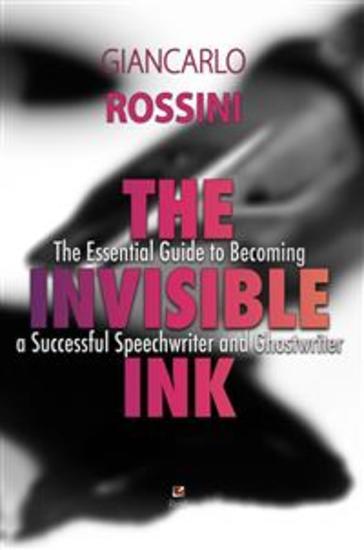
The Invisible Ink - The essential guide to becoming a successful Speechwriter and Ghostwriter - cover

The Invisible Ink - The essential guide to becoming a successful Speechwriter and Ghostwriter

Giancarlo Rossini

Publisher: Real

  • 0
  • 0
  • 0

Summary

The Invisible Ink: The Essential Guide to Becoming a Successful Speechwriter and Ghostwriter
The book, The Invisible Ink, by Giancarlo Rossini, is a valuable practical guide for anyone who wants to become a professional speechwriter or ghostwriter. The author, an expert in marketing and communication, shares his knowledge and techniques acquired over years of experience as a writing consultant for various public and private figures.
Through concrete examples and targeted advice, Rossini teaches how to write persuasive speeches, articles, books, and any other text on behalf of companies, politicians, and people in the entertainment industry. The book explains in detail how to become a successful ghostwriter, able to capture the style, tone, and voice of one's clients. The necessary skills and qualities for success in this field are illustrated, along with the best strategies for successfully approaching clients, whether they are public figures, companies, or private citizens.
The Invisible Ink examines all areas in which a speechwriter and ghostwriter can operate, from business to journalism, from politics to entertainment, and even personal writing. It is a comprehensive and essential manual for anyone who wants to become a professional writer, capable of producing persuasive texts on behalf of high-profile individuals.
With the techniques learned from this valuable guide, it is possible to build a successful career as a ghostwriter and speechwriter, putting one's persuasive writing skills at the service of those who wish to effectively communicate their ideas. This book is not only aimed at aspiring writing professionals but also managers, entrepreneurs, and public figures interested in improving their communication skills.
The book teaches the basics of persuasive writing, providing practical advice on how to capture the reader's attention, structure a text effectively, and reinforce the key message. 
The writing process for creating a speech, article, or book on behalf of a client is explained in detail. It starts with gathering information, defining objectives and style, and then writing, revising, and closing the project, with precise indications on timing and budget to propose.
Valuable advice is provided on how to identify ideal clients, professionally propose services, draft a contract, and manage relationships to establish long-term collaborations. Suggestions on networking, websites, social media, and other communication tools are included.
Direct testimonials and case studies from some of the most important speechwriters and ghostwriters are presented, offering insights into the profession, from challenges to secrets of success.
Also included is a chapter that describes how Artificial Intelligence can be used appropriately and non-invasively in speech writing and text processing.
Appendices include useful templates such as a standard collaboration proposal, a sample contract with essential clauses to include, and a questionnaire to gather information from clients. These practical resources make it easy to start one's own business.
The book is enriched with bibliographic and web references for further study of the topics covered. It is a complete guide to starting a career as a professional speechwriter and ghostwriter. The book is enriched with bibliographic and web references for further study of the topics covered. It is a complete guide to starting a career as a professional speechwriter and ghostwriter. This book is also available in Italian (THE INVISIBLE INK), Spanish (LA TINTA INVISIBLE) and Portuguese (A TINTA INVISÍVEL).
 
Available since: 05/03/2023.

Other books that might interest you

  • The Little Book of Stoic Wisdom - Learn the Art of Living Well with Classical Philosophy - cover

    The Little Book of Stoic Wisdom...

    Joseph Piercy

    • 0
    • 0
    • 0
    Learn how to thrive in the modern world by unlocking the ancient art of Stoicism. 


    The Little Book of Stoic Wisdom is a classical primer for anyone wanting to understand true Stoicism—and even though we're living in drastically different times than the ancients, many of the lessons of Seneca, Epictetus, and Marcus Aurelius still stand today. 


    The millennia-old mindset will show you how to learn the Stoic art of mindful acceptance, foster calmness, and reach your full potential. Featuring a breakdown of the central pillars of Stoic philosophy alongside practical everyday examples, this essential book will help you sharpen your focus, build your self-discipline, and banish negative thinking. 


    A Stoic life well-lived has been adopted by some of the most successful business leaders, from Steve Jobs to Bill Gates and Elon Musk, as well as high-performing athletes like Rory McIlroy, and historic figures such as George Washington, Theodore Roosevelt, and Thomas Jefferson, among others. The Little Book of Stoic Wisdom will show you what it truly means to live stoically and reach your goals.
    Show book
  • The Madness Of Reason Consciousness The Product Of Collective Unconsciousness - SUPERCOSCIENCE IS Unpredictable Capable of Subverting the Established Order The Greatest Nightmare - cover

    The Madness Of Reason...

    davide appi

    • 0
    • 0
    • 0
    CONSCIOUSNESS OR SUPERCONSCIOUSNESS THIS IS THE DILEMMA The present society continues to run like a mad elephant, toward global catastrophe. Why do we continue on this road that leads us to a dead end, with end view our own self-destruction? The answer to this question lies in human consciousness itself, the cause of every problem, while Superconsciousness is the solution to every difficulty. What is the difference between consciousness and Superconsciousness? Superconsciousness consciously connects us with everything that exists, and to understand it better we can make the analogy of a network: everything in existence is like a node that can have the illusion of being separate from the rest of the network. Most people are like that, they feel like a node separated from the rest, like a single individual separated from the rest of Humanity. This feeling of separation is the mode in which consciousness operates.
    Show book
  • The Rise of Fragmentation - A New Economic Security Era? - cover

    The Rise of Fragmentation - A...

    Alessandro Gili, Filippo Fasulo

    • 0
    • 0
    • 0
    Multiple crises have shaken the foundations of the global economy, and the resulting instability has yet to recover. Instead, it has led to increasing fragmentation along political and ideological lines. The current geoeconomic order is increasingly defined by the use of advanced trade defense and economic security tools, such as tariffs, trade barriers, sanctions, and export restrictions, which have become more sophisticated. Major economies are adapting to this new reality by shaping their own definitions of economic security, particularly to safeguard critical and high-tech sectors. The EU, the US, and China are each calibrating their economic security strategies, seeking a balance between openness and protection that maximizes their respective advantages. However, in this shifting international landscape, new actors are emerging with the potential to influence the global balance of power.
    What type of "new globalization" is emerging? Could economic security tools become the new normal in the global economy? What are the key economic security strategies adopted by the world's leading economies?
    Show book
  • The Iraq Wars - A Very Short Introduction - cover

    The Iraq Wars - A Very Short...

    Samuel Helfont

    • 0
    • 0
    • 0
    American wars in Iraq were a defining feature of global politics for almost thirty years. The Gulf War of 1991, the American invasion of Iraq in 2003, and the campaign against the Islamic State beginning in 2014 each had their own logic. Each occurrence was a distinct conflict; however they must not only be considered in isolation. The United States spent the 1990s trying but failing to implement the Gulf War's cease fire agreement. After the terrorist attacks of September 11, 2001, American leaders decided to settle the open-ended aftermath of the Gulf War by launching the Iraq War of 2003. The Iraq War unleashed resistance, civil war, insurgency and eventually the Islamic State in Iraq and Syria. Thus, following the Gulf War, each war was fought to finish the previous conflict. The Iraq Wars, therefore, are perhaps best understood as a chain of events.Academics, journalists, statesmen, and soldiers have produced many library shelves of books on the Iraq Wars. Yet, no short, easily digestible volume exists to synthesize this vast literature of both English and Arabic sources. The Iraq Wars: A Very Short Introduction covers this series of important conflicts as a whole, in a highly succinct and uniquely listenable way.
    Show book
  • History's Greatest Battles - From the Battle of Marathon to D-Day - cover

    History's Greatest Battles -...

    Nigel Cawthorne

    • 0
    • 0
    • 0
    Great battles mark history's turning points, occurring where cultures and ideologies clash. While some battles have been won by the superior force, others have been won by a sheer dogged refusal to surrender in the face of overwhelming odds. Superior weaponry has sometimes brought victory, as at Plassey, while the extraordinary generalship of a Napoleon, a Wellington, or a Marlborough has won the day on other occasions. 
     
    From the Battle of Marathon in 490 BC, when the vastly-outnumbered Athenian army turned back an invasion of the mighty Persian empire, up to the Vietnamese defeat of the French army at the battle of Dien Bien Phu, the battles in this book demonstrate that fate is not always on the side of the big battalions.
    Show book
  • Righteous Mind The: Book Summary & Analysis - cover

    Righteous Mind The: Book Summary...

    Briefly Summaries

    • 0
    • 0
    • 0
    This is a concise summary and analysis of The Righteous Mind, by Jonathan Haidt. It is not the original book and is not affiliated with or endorsed by Jonathan Haidt. Ideal for those seeking a quick and insightful overview.
     
    Why do people on different sides of the political spectrum see the world so differently? This insightful book explores the psychological foundations of morality, revealing how our values, intuitions, and group loyalties shape our political beliefs. Drawing from psychology, anthropology, and evolutionary biology, the book argues that moral reasoning is driven more by intuition than by logic, and it challenges readers to understand—and even empathize with—opposing viewpoints. A must-read for anyone seeking to bridge political and ideological divides.
    Show book