Join us on a literary world trip!
Add this book to bookshelf
Grey
Write a new comment Default profile 50px
Grey
Subscribe to read the full book or read the first pages for free!
All characters reduced
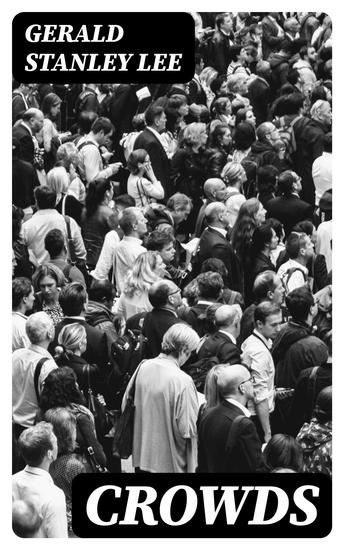
Crowds - A Moving-Picture of Democracy - cover

Crowds - A Moving-Picture of Democracy

Gerald Stanley Lee

Publisher: DigiCat

  • 0
  • 0
  • 0

Summary

In "Crowds," Gerald Stanley Lee delves into the complexities of human behavior and societal dynamics, exploring how large groups influence individual actions, emotions, and beliefs. Written in a reflective and analytical style characteristic of early 20th-century sociological thought, the book interweaves anecdotes, observations, and theoretical insights. Lee scrutinizes the psychological forces at play within collective gatherings, drawing upon his rich understanding of social psychology and the burgeoning field of crowd theory during his time. The text serves as both a chronicle of contemporary societal phenomena and a prescient exploration of the challenges posed by the massification of social behavior. Gerald Stanley Lee was an influential American writer, thinker, and social commentator whose interest in crowd psychology stemmed from the tumultuous events of his age, particularly the effects of World War I and the rise of mass movements. His academic background in literature and philosophy informed his distinctive perspective, enabling him to weave insightful observations about public sentiment and individual identity within the fabric of society. Lee's interdisciplinary approach makes "Crowds" a vital contribution to the fields of sociology and psychology alike. This thought-provoking book invites readers to reconsider the nature of collective existence, making it an essential read for those interested in psychology, sociology, and the human experience as a whole. Lee's keen insights are as relevant today as they were when first published, offering clarity into the complexities of contemporary social dynamics. It serves not only as a historical account but also as a guide for understanding current societal trends.
Available since: 09/16/2022.
Print length: 415 pages.
Other books that might interest you

  • The Hero and the Victim - Narratives of Criminality in Iraq War Fiction - cover

    The Hero and the Victim -...

    Gregory Brazeal

    • 0
    • 0
    • 0
    Two decades after the US invasion of Iraq in 2003, a canon of American literature about the war has begun to emerge. 
    The Hero and the Victim situates Iraq War fiction in war literature’s broader history. In contrast to the emphasis of most pre-modern war literature on the figure of the warrior-as-hero, and the growing modern emphasis on the figure of the soldier-as-victim, Iraq War fiction reflects the troubled emergence of a new narrative: the story of the ordinary soldier as a wrongdoer or even criminal. 
    To a greater extent than earlier literature about American wars, Iraq War fiction is haunted by depictions of moral injury and expressions of unresolved guilt. The emphasis on soldier criminality in Iraq War fiction can be partly explained by the rise of moral cosmopolitanism and its blurring of the traditional conceptual lines between war and crime. 
    The anti-war literature of the twentieth century often presented fallen soldiers on both sides equally as victims and viewed the distinction between heroes and villains as part of the illusion that battlefield experience strips away. 
    Written in the long shadow of Nuremberg, Iraq War fiction grapples with the possibility that the soldiers on one’s own side may not be the heroes in the story, or even the victims, but participants in a wrong, and perhaps even complicit in crimes. 
    The Hero and the Victim contributes to the ongoing, public reexamination of American traditions by confronting a topic that has, up to now, been largely untouched: the moral celebration of military service. 
    The Hero and the Victim explores the theme of soldier criminality through close readings of several works by American authors, including Kevin Powers’s The Yellow Birds, Phil Klay’s Redeployment, Helen Benedict’s Sand Queen, Chris Kyle’s American Sniper, and Roy Scranton’s War Porn.
    Show book
  • Stolen Family - Captive in Saudi Arabia - cover

    Stolen Family - Captive in Saudi...

    Johanne Durocher

    • 0
    • 0
    • 0
    Canadian Nathalie Morin's four children cannot leave Saudi Arabia without exit visas signed by Nathalie's abusive husband. Her mother chronicles her decades-long struggle to bring her daughter and four grandchildren home to safety in Montreal.
    Show book
  • Mr Vic’s X-Rated Television: “The Hot News Anchor!”!” - cover

    Mr Vic’s X-Rated Television:...

    VIC VITALE

    • 0
    • 0
    • 0
    "Porn For Katie! 
    "Have a seat!" I told the unsuspecting Katie Koric while I sat in front of the monitor showing a couple engaged in hot sex.   
    Having taken the bait, Katie quickly obliged by sitting down on the bed right next to where the computer was sitting on the desk.   
    Her eyes zoomed in on that picture, then the next, and the many, many that followed.  
     
    Show book
  • Calling My Deadname Home - Trans Bear Diaries - cover

    Calling My Deadname Home - Trans...

    Avi Ben Zeev

    • 0
    • 0
    • 0
    In this extraordinarily compelling trans memoir, Avi, a bearish trans man and Psychology Professor, navigates sex and dating in a phallic-centric universe of men who love men. But something is missing. To become the man he aspires to be, he needs to reconnect with Talia, his hyper-feminine straight female past, and invite her back in.  Growing up in a working-class right-wing Israeli family and barely finishing high school, he became involved in pro-Palestinian activism and escaped compulsory military service by faking madness. Despite poor schooling Avi went on to attain a PhD from Yale and change his life entirely. This memoir is the story of that journey and explores what it means to come home to oneself with brutal honesty, humour, and self-compassion.  Told in three episodes, early transition, later transition and Talia's story, this memoir tackles contemporary gender and social issues. At its heart is a universal theme: to become who we already are, we must integrate the past into the present
    Show book
  • Clara: From Victorian Governess to Lady of Pleasure - cover

    Clara: From Victorian Governess...

    Dorian Shellan

    • 0
    • 0
    • 0
    While working in the Chester household as a governess, the innocent Clara becomes sexually involved with Herbert Chester, her employer. Then, when the beautiful Catherine, Herbert's sister-in-law and secret lover, comes to stay at the house, Catherine introduces Clara into the pleasures of being with a woman.  On learning how the women are enjoying each other, Herbert encourages them into a threesome with him. This spurs jealousy in Catherine, however, and Clara is dismissed. 
    Now sexually awakened and excited by life in London, Clara has no desire to return to work as a governess and contemplates what form of employment best suits her ambitions. Her friend, Anna Quinlan, suggests the ideal solution. Anna is Madame Q and runs The Nunnery, an exclusive brothel catering only to the most select clientele. Tempted by a generous salary, room, board, freedom and independence, will Clara accept and become one of Madame Q's ladies of pleasure?
    Show book
  • Inner Revolution Poetry - From Māyāvada to Prabhupāda - cover

    Inner Revolution Poetry - From...

    Yashomatinandana Dasa

    • 0
    • 0
    • 0
    The beauty of poetry is also practical. It is said in the Vedic scripture that to be a poet is one of the divine qualities possessed by devotees of the Lord. Like an ornament it enhances the character of a person, if he is using this poetry not for own sense gratification, but for glorification of the Supreme Person. That is the only work of a poet, namely to glorify the all-attractive person, literally Kṛṣṇa. 
    Words that do not glorify the All-attractive Person, Kṛṣṇa, are considered by saintly persons to be like places of pilgrimage for crows. Swan-like devotees who are actually residents of the kingdom of God do not derive any pleasure there. Thus, I follow in the footsteps of my spiritual teachers who were all expert poets and writers. 
    2016, as a believer and traveler I came to win back faith. Finding shelter with the wisdom texts of the Vedas, a doorway to self-realisation was opened. Self-realisation is nothing cheap, but the sole purpose of human existence. This human form of life is essentially meant for inquiring about the Absolute Truth. 
    When this mystical door opened, I had insight into spiritual truth, substantial, enlightened and blissful. In a state of meditation this spiritual drop touched my heart and I tried to get hold of it. Expressing my experiences in words of poetry helped to channel these spiritual visions and insights. 
    Once I sat on the Pacific Ocean and meditated. A vast consciousness surrounded me and I felt as if I was one with that vast consciousness. Later, I came back to an individual consciousness. I would read about this oneness experience, warned that this is māyā, illusion. In retrospect, this path of illusion (Mayavada) was enlightened by the spiritual master (Prabhupāda) who felt compassion with this delusioned seeker.
    Show book