Join us on a literary world trip!
Add this book to bookshelf
Grey
Write a new comment Default profile 50px
Grey
Subscribe to read the full book or read the first pages for free!
All characters reduced
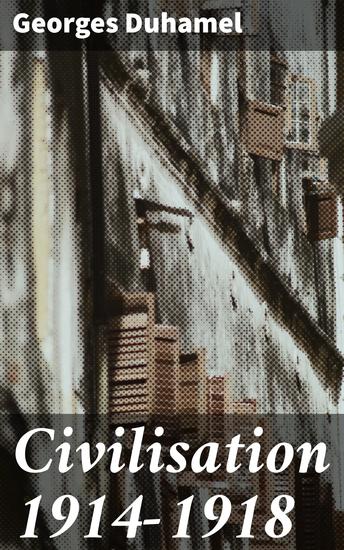
Civilisation 1914-1918 - Exploring the Psychological Impact of World War I on Society and Culture - cover

Civilisation 1914-1918 - Exploring the Psychological Impact of World War I on Society and Culture

Georges Duhamel

Translator Thomas P. Conwell-Evans

Publisher: Good Press

  • 0
  • 0
  • 0

Summary

In "Civilisation 1914-1918," Georges Duhamel delves into the profound transformations wrought by the Great War, exploring its impact on society, culture, and human psyche. Written in a reflective and poignant style, Duhamel's work is infused with an acute awareness of the disillusionment and social upheaval that characterized the early 20th century. The collection of essays underscores the stark contrast between the romanticized ideals of civilization and the brutal realities of war, situating the discourse within a broader literary context influenced by existentialism and modernist thought, which sought to grapple with the chaos of contemporary existence. Duhamel, a prominent figure of French literature as well as a physician, was deeply affected by the experiences of the war, both personally and professionally. His background informed his nuanced perspective on the intersection of human suffering and cultural evolution. Throughout his career, Duhamel advocated for a more empathetic understanding of the human condition, and this work crystallizes his philosophical reflections on what civilization truly means amid the madness of conflict. Readers seeking a profound examination of the intersection between war and society will find "Civilisation 1914-1918" an essential read. Duhamel's eloquent prose and thoughtful insights make this book a captivating exploration of the enduring scars left by war, encouraging readers to reflect critically on the nature of civilization and its vulnerabilities.
Available since: 07/09/2023.
Print length: 101 pages.
Other books that might interest you

  • Finding Genius: Homeschooling: Nurture Your Child's Hidden Genius - cover

    Finding Genius: Homeschooling:...

    Richard Jacobs

    • 0
    • 0
    • 0
    Homeschooling your children can be a compelling experience that will shape them in powerful and lasting ways. It’s a choice that allows you to create a learning environment where your children feel safe, respected, encouraged, and valued. It also allows them to explore their interests more deeply while enabling you to introduce them to subjects of your choosing and safeguard them from the biases of the public school system. 
    They will reliably receive the one-on-one attention they deserve, which means they’ll never feel left behind or too far ahead (and aimless or bored as a result).  
    With scheduling flexibility comes the freedom to take your kids on vacations where and when you want to, as well as ensure they get the quantity and quality of sleep essential to healthy development, energy levels, and overall well-being.  
    For these reasons (and even more not covered in this book), I can confidently say that homeschooling is a vastly superior option for most people.  
    If you’re undecided about the best decision for your family, know that you want to homeschool but are feeling intimidated, or want to learn more about the benefits of the homeschooling lifestyle, I wholeheartedly encourage you to keep learning and researching.  
    Remember that when it comes to homeschooling, what’s right for your family might not be for another… the lessons, topics, schedule, and style are yours to choose; they can be tailored to meet the needs, goals, and beliefs of your beautifully unique family.
    Show book
  • Hope Under Oppression - cover

    Hope Under Oppression

    Katie Stockdale

    • 0
    • 0
    • 0
    We have all been told, at one time or another, to "never give up hope." It's a common injunction to children, but as we grow older, sustaining hope becomes more challenging, particularly in a world we come to see as often frightening, dark, and unjust. But what is this thing "hope," and why is hope so valuable that we are so often urged to preserve and protect it? 


    This book explores the nature and essential role of hope in human life under conditions of oppression. Oppression is often a threat and damage to hope, yet many members of oppressed groups, including prominent activists pursuing a more just world, find hope valuable and even essential to their personal and political lives. Katie Stockdale offers a unique evaluative framework for hope that captures its intrinsic value, the rationality and morality of hope, and ultimately how we can hope well in the non-ideal world we share. She develops an account of the relationship between hope and anger about oppression and argues that when people are angry about oppression, they tend to also harbor hope for repair. 


    Ultimately, this work illustrates the crucial value of hope for both individuals and collectives in the pursuit of justice, and in an increasingly uncertain world.
    Show book
  • Stories from Kathasaritasagara series - 10 - From Various sources - cover

    Stories from Kathasaritasagara...

    Anusha HS

    • 0
    • 0
    • 0
    The book Kathasaritsagara has been created by Soma Deva. It consists of 21,500 shlokas. 
    This book Kathasaritsagara has been divided into 18 lambakaas, and those 18 lambakaas are still more divided into 125 Tharanga's. 
    Some lambakaas are very big, while some are very small. 
    If there are 115 Shlokas in the 11th Lambaka, there are around 4925 Shlokas in 12th Lambaka. 
    During ancient times from the mouth of Lord Shiva, this story got birth. Those who listen to this story will experience all sorts of worldly pleasures. They will be blessed by Lord Shiva and at last reach jnana Loka by the blessings of lord Shiva.
    Show book
  • Start of the Byzantine Empire The: The History of the Eastern Roman Empire’s Establishment as Rome Declined - cover

    Start of the Byzantine Empire...

    Editors Charles River

    • 0
    • 0
    • 0
    It would be hard if not outright impossible to overstate the impact Roman Emperor Constantine I had on the history of Christianity, ancient Rome, and Europe as a whole. Best known as Constantine the Great, the kind of moniker only earned by rulers who have distinguished themselves in battle and conquest, Constantine remains an influential and controversial figure to this day. He achieved enduring fame by being the first Roman emperor to personally convert to Christianity, and for his notorious Edict of Milan, the imperial decree which legalized the worship of Christ and promoted religious freedom throughout the Empire. More than 1500 years after Constantine’s death, Abdu'l-Bahá, the head of the Bahá'í Faith, wrote, “His blessed name shines out across the dawn of history like the morning star, and his rank and fame among the world's noblest and most highly civilized is still on the tongues of Christians of all denominations” 
    	However, it can be argued that despite his military successes – the most notable of which occurred fighting for supremacy against other Romans – Constantine may well have set the stage for the ultimate collapse of the Roman Empire as it had existed up until that point. It was Constantine who first decided that Rome, exposed and vulnerable near the gathering masses of barbarians moving into Germania and Gaul, was a strategically unsafe base for the Empire, and thus expanded the city of New Rome on the Dardanelles straits, creating what eventually became Constantinople. By moving the political, administrative and military capital of the Empire from Rome to the East, as well as the Imperial court with all its attendant followers, Constantine laid the groundwork for the eventual schism which saw the two parts of the Roman Empire become two entirely separate entities, go their own way, and eventually collapse piecemeal under repeated waves of invasion.
    Show book
  • Unspoken - The Silent Truth Behind My Lifelong Trauma as a Forced Adoptee (Stolen Lives) - cover

    Unspoken - The Silent Truth...

    Liz Harvie, Eve Hatton

    • 0
    • 0
    • 0
    “I was two when the woman I called Mummy told me, ‘You came out of another mummy’s tummy.’ I grew up thinking that my birth mother didn’t want me. I assumed there must’ve been something inherently wrong with me – why else would a mother give up her baby?” 
    In 1974, Liz Harvie – born Claire Elaine Watts – was given up for adoption by her birth mother Yvonne. Claire was just eight weeks old when her adoptive parents took her in – and renamed her Elizabeth. 
    Although brought up in a ‘perfect’ household, the emotional – and physical – trauma of being taken from her biological mother would never leave Liz. She constantly wondered: what does my real mum look like? Will she come back for me? Why did she abandon me? But whenever Liz voiced such questions, she invariably received the same response: “Your birth parents were not married. They couldn’t look after you.” 
    Years later, aged twenty-eight, Liz reconnected with her birth mother – and finally learned the shocking truth surrounding her adoption. Yvonne had not abandoned her daughter. A social worker had snatched her ten-day-old baby from her arms. “I didn’t even get a final cuddle. She just took her away from me,” says Yvonne. 
    Liz became one of 185,000 victims of forced adoption between 1949 and 1976 in England and Wales. As a young unmarried mum, Yvonne was deemed unfit as a parent by the government, churches, adoption agencies and her father – and made to give up her child against her will. 
    Although reunited, Liz and Yvonne are still struggling to cope with the agony resulting from their devastating separation. As Liz says, “We can’t just skip hand in hand into the sunset. The trauma of being a forced adoptee is lifelong.”
    Show book
  • Sparta - Fall of a Warrior Nation - cover

    Sparta - Fall of a Warrior Nation

    Philip Matyszak

    • 0
    • 0
    • 0
    This cultural history of Ancient Sparta chronicles the rise of its legendary military power and offers revealing insight into the people behind the myths. 


    The Spartans of ancient Greece are typically portrayed as macho heroes: noble, laconic, totally fearless. But life was not as simple as this image suggests. In truth, ancient Sparta was a city of contrasts. 


    We might admire their physical toughness, but Spartans also systematically abused their children. They gave rights to female citizens that were unmatched in Europe until the modern era, meanwhile subjecting their conquered subject peoples to a murderous reign of terror. Though idealized by the Athenian contemporaries of Socrates, Sparta was almost devoid of intellectual achievement. 


    In this revealing history of Spartan society, Philip Matyszak chronicles the rise of the city from a Peloponnesian village to the military superpower of Greece. Above all, Matyszak investigates the role of the Spartan hoplite, the archetypal Greek warrior who was feared throughout Greece in his own day and has since become a legend. The listener is shown the man behind the myth; who he was, who he thought he was, and the environment which produced him.
    Show book