Join us on a literary world trip!
Add this book to bookshelf
Grey
Write a new comment Default profile 50px
Grey
Subscribe to read the full book or read the first pages for free!
All characters reduced
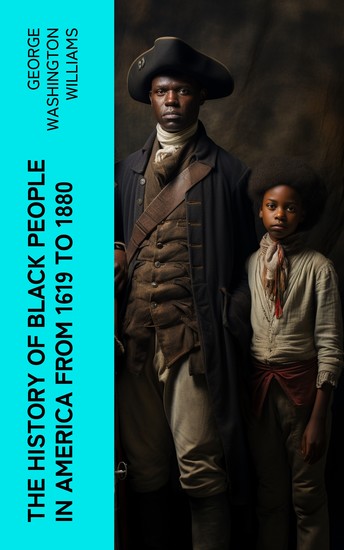
The History of Black People in America from 1619 to 1880 - Account of African Americans as Slaves as Soldiers and as Citizens - cover

The History of Black People in America from 1619 to 1880 - Account of African Americans as Slaves as Soldiers and as Citizens

George Washington Williams

Publisher: e-artnow

  • 0
  • 0
  • 0

Summary

The History of Black People in America from 1619 to 1880 is a two-volume work on African-American history, written by American Civil War soldier and historian George Washington Williams. It is considered to be the first overall history of African Americans, showing their participation and contributions from the earliest days of the colonies. The Work is divided in nine parts presenting African Americans as slaves, as soldiers and as citizens, together with preliminary considerations of the unity of the human family, an historical sketch of Africa, and an account of the negro governments of Sierra Leone and Liberia. Table of Contents: Part I. Preliminary Considerations Part II. Slavery in the Colonies Part III. The Negro During the Revolution Part IV. Conservative Era – Negroes in the Army and Navy Part V. Anti-Slavery Agitation Part VI. The Period of Preparation Part VII. The Negro in the War for the Union Part VIII. The First Decade of Freedom Part IX. The Decline of Negro Governments
Available since: 12/11/2023.
Print length: 1156 pages.
Other books that might interest you

  • Detroit in World War II - cover

    Detroit in World War II

    Gregory D. Sumner

    • 0
    • 0
    • 0
    When President Roosevelt called for the country to be the great "Arsenal of Democracy," Detroit helped turn the tide against fascism with its industrial might. Locals were committed to the cause, putting careers and personal ambitions on hold. Factories were retooled from the ground up. Industrialist Henry Ford, First Lady Eleanor Roosevelt, aviator Charles Lindbergh, legendary boxer Joe Louis, future baseball Hall of Famer Hank Greenberg and the real-life Rosie the Riveters all helped drive the city that was "forging thunderbolts" for the front lines. With a panoramic narrative, author Gregory D. Sumner chronicles the wartime sacrifices, contributions, and everyday life of the Motor City.
    Show book
  • Theodor Fontane: A short biography - 5 Minutes: Short on time – long on info! - cover

    Theodor Fontane: A short...

    5 Minutes, 5 Minute Biographies,...

    • 0
    • 0
    • 0
    Theodor Fontane, German poet and novelist: Life and work in a short biography! Everything you need to know, brief and concise. Infotainment, education and entertainment at its best!
    Show book
  • Plenty Good Room - Co-creating an Economy of Enough for All - cover

    Plenty Good Room - Co-creating...

    Andrew Wilkes

    • 0
    • 0
    • 0
    Plenty Good Room lays out in clear terms the hope of democratic socialism for a world ravaged by intensifying racial capitalism and social injustice. Unleash your ingenuity for systems that offer plenty good room—not for just a few but for all. 
     
    Economic inequality yawns as wide as ever. Capitalism is working as it was designed: replicating an uneven balance of power, constraining life chances, and limiting imaginations. Those of us concerned about injustice often confine ourselves to issue-by-issue activism. The end result? Owners, investors, and a politics of inequality win. 
     
    But what if there's another way to organize our common life—and what if it's as homegrown as sweet potato pie? What if we could become moral engineers who co-create the world we all deserve? 
     
    Plenty Good Room helps readers understand Black Christian socialism, a stream of the Black radical tradition, from the perspective of a Brooklyn pastor and political scientist's civic awakening. As the former director of the Drum Major Institute, founded by America's most famous democratic socialist, Dr. Martin Luther King Jr., Rev. Andrew Wilkes mounts a challenge to the endless greed, inequality, and profiteering of racial capitalism. 
     
    Tugging on the threads of history and scripture and pointing to the work of Black radicals like W. E. B. Du Bois, Rev. Addie Wyatt, and Fannie Lou Hamer, Wilkes weaves a narrative of "plenty good room moments": times in which communities and individuals had sufficient resources, human rights, and beauty. He invites us to join a movement that a day-laboring Christ initiated as he organized the dispossessed, the disinherited, and those pushed to the edges of society. Wilkes also introduces contemporary efforts pushing for reparations, community ownership, participatory democracy, and solidarity economies. These stories show us that we can create a world of care and reciprocity by envisioning an economy of enough for all—one rooted in justice, equity, and the God whose spirit falls on all flesh.
    Show book
  • The Hidden Wealth of Nations - The Scourge of Tax Havens - cover

    The Hidden Wealth of Nations -...

    Gabriel Zucman

    • 0
    • 0
    • 0
    A “masterful” work that quantifies the cost of tax havens and large-scale tax evasion to ordinary citizens, and explores solutions to the problem (American Prospect). One much-discussed solution to the rapidly growing problem of economic inequality is to significantly increase the rate at which we tax the wealthy. But with an enormous amount of the world’s wealth hidden in tax havens—in countries like Switzerland, Luxembourg, and the Cayman Islands—this wealth cannot be fully accounted for and taxed fairly. No one, from economists to bankers to politicians, has been able to quantify exactly how much of the world’s assets are currently hidden—until now. Gabriel Zucman is the first economist to offer reliable insight into the actual extent of the world’s money held in tax havens. And it’s staggering. Fighting the notion that any attempts to vanquish tax havens are futile since some countries will always offer more advantageous tax rates than others, as well the counter-argument that tax havens have disappeared since the 2007–2008 global financial crisis, Zucman shows how both sides are actually very wrong. In The Hidden Wealth of Nations he offers an ambitious agenda for reform, focused on ways in which countries can change the incentives of tax havens. Only by first understanding the enormity of the secret wealth can we begin to estimate the kind of actions that would force tax havens to give up their practices. Zucman’s work has quickly become the gold standard for quantifying the amount of the world’s assets held in havens. In this concise book, he lays out in approachable language how the international banking system works and the dangerous extent to which the large-scale evasion of taxes is undermining the global market as a whole. If we are to find a way to solve the problem of increasing inequality, The Hidden Wealth of Nations is essential reading. “Unusually lucid and elegant prose—particularly for an economist—complemented by an admirable grasp of history. His review of the ways that efforts to combat tax evasion have stalled for the past century makes the book a worthwhile read in and of itself. . . . Zucman is still at the beginning of what promises to be a brilliant career.” ―The Atlantic
    Show book
  • Genghis Khan - The Empire Conquests and Plunder of the Mongols - cover

    Genghis Khan - The Empire...

    Kelly Mass

    • 0
    • 0
    • 0
    Genghis Khan was the Mongol emperor who has expanded his region to the biggest empire on the face of the earth ever. His empire stretched from East Asia all the way to various European countries, the Middle East, and beyond. 
    What made Genghis Khan so successful? 
    Was he a brute, rapist, and pillaging dictator, or did he have a tolerant side as well? 
    How do the people in Mongolia see him, or the people in China? 
    All o these questions and more will be answered in this comprehensive overview of the history of Genghis Khan. You will learn more about his early life, his relationships, marriage, families and children, his attacks, his unification of the Mongolian Federations, his death, succession, and the continuing of the Mongolian Empire after his death.
    Show book
  • Believe - A Memoir in Stories - cover

    Believe - A Memoir in Stories

    Christina H Wilson

    • 0
    • 0
    • 0
    At 36 years old, Christina had it all...two young and healthy boys, an uber successful husband, and a big house in a gated-golf course community. She was young, rich, and on top of the world. On the morning of September 11, 2000, a devastating call would up-end everything and life as she knew it. While this cataclysmic event didn't mark the beginning of end of her life, it would be the test of her character, agency and faith. This book offers insight to a life journey that is extraordinary yet profoundly human. It's the chronical of an evolution from a frail child into a woman shaped by intense love, incredible upheavals, and ultimately, deep personal wisdom. Beginning with a childhood marked by illness and solitude, books and fairytales became Christina's refuge and compass. These influences weave throughout her life and the stories, not as naive fantasies, but as emotional frameworks that conflict with the sharp edges of her reality. Life takes a dramatic turn when at 25, Christina meets Jeffrey, a Wall Street Titan, whose fast-paced existence is worlds away from her quiet, reflective nature. The connection is immediate and all-consuming. Their life becomes exhilarating, fantastical, and materially abundant. The heart of this memoir is the defining moment when an unexpected phone call changes everything. This moment acts as a fault-line in Christina's life, splitting everything into a before and after. From this point on, the story becomes less about the external events and more about the quiet but radical life-changing shifts in Christina's understanding about self, love, loss, and destiny. At it's core, this story is about transformation that only comes when we are challenged and stripped of control and what we know. It's about learning to let life present itself with patience and understanding. This book is a tapestry of life-lesson stories woven together by themes of self-discovery, unconditional love, tragedy, spirituality, family, inner-strength, and grief.
    Show book