Join us on a literary world trip!
Add this book to bookshelf
Grey
Write a new comment Default profile 50px
Grey
Subscribe to read the full book or read the first pages for free!
All characters reduced
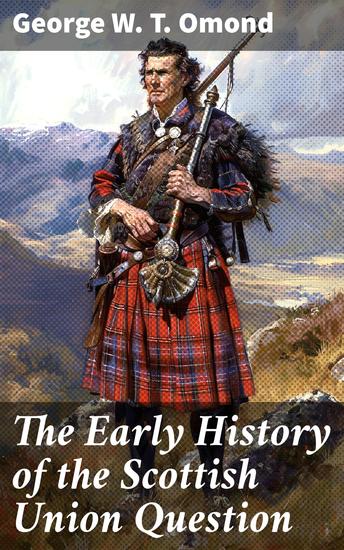
The Early History of the Scottish Union Question - Unraveling the Scottish Independence Debate - cover

The Early History of the Scottish Union Question - Unraveling the Scottish Independence Debate

George W. T. Omond

Publisher: Good Press

  • 0
  • 0
  • 0

Summary

In 'The Early History of the Scottish Union Question', George W. T. Omond delves into the intricate political, social, and cultural dynamics that paved the way for the historic Union of Scotland and England in 1707. Employing a rigorous analytical lens and an accessible narrative style, Omond engages with primary sources and contemporary accounts to chart the complexities of Scottish identity and governance during a transformative period. The book offers an in-depth exploration of early debates surrounding union, examining both the opposition and support within Scotland, thereby positioning the Union question within a broader European context of nationhood and state formation. George W. T. Omond was a distinguished Scottish historian and advocate, deeply invested in the historical narratives of Scotland. His keen interest in Scottish nationalism and unionism, coupled with extensive research into archival materials, provided him with a unique vantage point. Omond's scholarly pursuits not only illuminate the historical landscape but also reveal his personal motivations stemming from a fervent sense of Scottish identity and politics in his own time. For scholars, historians, and anyone intrigued by the evolution of Scottish political thought, Omond's work serves as an indispensable resource. His exhaustive examination of the early union debates acts as a poignant reminder of the layered and often contentious relationships that define national identities. This book is a vital addition for anyone seeking to comprehend the early underpinnings of modern Scotland.
Available since: 09/18/2023.
Print length: 103 pages.
Other books that might interest you

  • Internet Governance - Policies and Regulation - cover

    Internet Governance - Policies...

    Craig Dames

    • 0
    • 0
    • 0
    Internet governance refers to the development and application of rules, policies, and practices that shape the evolution and use of the internet. It involves multiple stakeholders, including governments, private sector entities, civil society organizations, and technical communities. As the internet has grown from an academic experiment to a global infrastructure, the need for effective governance has become increasingly crucial. The way the internet is managed impacts digital rights, economic development, and global security, making governance a central issue in today’s interconnected world. 
    The origins of internet governance can be traced back to the early days of the internet, when management was primarily handled by academic and research institutions. Over time, as commercial interests and governmental involvement increased, governance structures evolved to accommodate new challenges. Organizations like the Internet Corporation for Assigned Names and Numbers (ICANN) and the Internet Governance Forum (IGF) were established to facilitate discussions on technical coordination, policy-making, and regulation. The involvement of international bodies such as the United Nations further highlights the growing importance of internet governance in global affairs. 
    A fundamental aspect of internet governance is the balance between different stakeholder interests. Governments seek to regulate the internet to ensure national security, protect citizens' rights, and maintain economic stability. Meanwhile, private companies advocate for minimal regulation to encourage innovation and market growth. Civil society organizations focus on issues such as privacy, digital rights, and access to information. This multistakeholder model aims to create a collaborative and inclusive approach to governance, but it also presents challenges in reaching consensus on key issues.
    Show book
  • All In: How we build a country that works - cover

    All In: How we build a country...

    Lisa Nandy

    • 0
    • 0
    • 0
    ‘A persuasive manifesto for a better Britain.’ Observer Book of the Day 
    Britain needs a fresh start. This timely book by one of the stars of the new government shows how to achieve it. 
    In this brilliant and accessible intervention, Lisa Nandy reveals how Britain can leave behind the mess in which we find ourselves. All In charts a course towards a fairer, more equal, more prosperous country by drawing on the greatest asset we have – each other. 
    Rapid global changes, political division and economic crisis have left Britain reeling. For decades, large swathes of the country have been shut out, condemned to low productivity, underinvestment and managed decline, and stripped of their voice. With most major cities now beset with high housing costs, air pollution and congestion, even the ‘winners’ are losing. 
    All In shows how, by handing power and resources to people with a stake in the outcome, Britain can draw on the talent, assets and potential in every part of the country and start firing on all cylinders again. Finding strength rather than fear in our differences, it reimagines the relationship between people and government so that all of us can play our part in meeting the challenges of our age and rebuilding Britain the only way that works – together. 
    Lucid, clear-eyed and hopeful, this book sets out how we restore values, energy and direction to our politics and offers a glimpse of the alternative future that remains within our grasp. 
    Nandy's autobiography is a personal exploration of the process of political change, offering a best case scenario for a united, prosperous Britain. Drawing on history and economics, she presents a compelling vision for the 21st century. 
    For fans of Wes Streeting (One Boy, Two Bills and a Fry Up), Gordon Brown (My Life, Our Times), Jess Phillips (Truth to Power), Chris Bryant (Code of Conduct), and Sebastian Payne (Broken Heartlands). 
    HarperCollins 2022
    Show book
  • Wake Up America - Black Women on the Future of Democracy - cover

    Wake Up America - Black Women on...

    Keisha N. Blain

    • 0
    • 0
    • 0
    In 1968, civil rights activist Fannie Lou Hamer called for Americans to "wake up" if they wanted to "make democracy a reality." Today, as Black communities continue to face challenges built on centuries of discrimination, her plea is increasingly urgent. In this exhilarating anthology of original essays, Keisha N. Blain brings together the voices of major progressive Black women politicians, grassroots activists, and intellectuals to offer critical insights on how we can create a more equitable political future. 


    These women draw on their diverse experiences and expertise to speak to three core themes: claiming civil and human rights, building political and economic power, and combating all forms of hate. We hear from Black Lives Matter cofounder Alicia Garza, who argues that Black communities must organize to wield increased political power; EMILYs List president Laphonza Butler, who spells out ways to fight for women's reproductive rights; and Congresswoman Sheila Jackson Lee, who delineates practical, thorough steps toward tangible reparations. Additional incisive essays include those by former Ohio State Senator Nina Turner; prison abolitionist Mariame Kaba; disability rights activist Andraéa LaVant; Boston's first woman and first Black mayor, Kim Michelle Janey; and others at the forefront of the ongoing fight for social justice.
    Show book
  • Knights Templar The: An Enthralling History of the Rise and Fall of the Most Influential Catholic Military Order - cover

    Knights Templar The: An...

    Enthralling History

    • 0
    • 0
    • 0
    Did you know the Templar Order was so strict that its members could only have meat three times a week? 
    The Knights Templar has established itself as the most popular military organization of medieval times. Everyone has heard of the order, and everyone is familiar with the image of a medieval Crusader knight with a red cross on their white uniform. But who exactly were the Templars? What was their purpose? And are the rumors about their secretive nature true? 
    This audiobook will take a look at the two-hundred-year history of the Knights Templar. We will cover how the order was established and why it transformed from a Christian military organization into something much more. 
    In this audiobook, you will learn about the following:The events from the 11th to the early 14th centuries and how they shaped the orderDifferent actors, from kings to ordinary knights, who defined the Knights TemplarThe Templars’ involvement in the military endeavors of the known worldWhat caused the rise and downfall of the Order of the Knights TemplarThe truth behind Templar allegations and its secretive natureThe twisted Templar legacy and how it changed the way we viewed the world forever 
    Buckle up to find out more about one of the most influential organizations of its time. It is time to dive into the history of the infamous Knights Templar. 
    So scroll up and click the “add to cart” button to learn more about the Knights Templar!
    Show book
  • Both Not Half - 'Few people write about identity with such fluency and sincerity' SATHNAM SANGHERA - cover

    Both Not Half - 'Few people...

    Jassa Ahluwali

    • 0
    • 0
    • 0
    GOLD WINNER OF 'BEST NARRATOR' AT THE AUDIO PRODUCTION AWARDS. 'This guy has better Punjabi than both of us and he's only half Punjabi.' Only. Half. I stared at those words. The intent behind the comment was in no way malicious, but it hurt. I felt diminished. I felt like I was being robbed of something essential to me. And as I stared at my screen, realisation dawned. '#bothnothalf' I replied. For over twenty-five years, actor Jassa Ahluwalia described himself as 'half Indian, half English'. His fluent Punjabi always prompted bewilderment, medical staff questioned the legitimacy of his name, and the world of casting taught him he wasn't 'the right kind of mixed-race'. Feeling caught between two worlds, it wasn't long before Jassa embarked on a call to action: we need to change how we think and talk about mixed identity. By delving into the media we grew up consuming and the legacies of empire we have been taught, Ahluwalia asks: is there anything to be learnt from Rudyard Kipling? Why were movie stars urged to hide their mixed identities? To what extent did colonialism encourage or hinder mixed marriages? Is nationalism outdated? How can the politics of class and queer liberation inform our understanding of mixed identity? Both Not Half is a rallying cry for a new and inclusive future. It's a journey of self-discovery that unearths the historical roots of modern mixed identity as we know it, braving to deconstruct the binaries we have inherited and the narratives we passively accept. Part-memoir, part-manifesto: this is a campaign for belonging in a divided world.This immersive audiobook includes exclusive audio clips from Jassa 's Ted Talk, original audio from self-tapes, a bonus conversation with his sister Ramanique Ahluwalia, and much more.
    Show book
  • Medieval Conspiracy Theories: The History of the Most Popular Conspiracy Theories about the Middle Ages - cover

    Medieval Conspiracy Theories:...

    Editors Charles River

    • 0
    • 0
    • 0
    Few eras are easier to let the imagination run wild than the Middle Ages, which have often been coined the Dark Ages based on a perceived lack of progress and information.[1] Indeed, we can say that it is not completely unfounded because we know less about that historical period compared to those that come after it. In addition, it is a period marked by a great number of deaths caused by plague epidemics, crusades, and inquisitorial persecutions. Often, researchers are not even sure how and why certain events happened, and these mysteries still occupy the attention of historians. 
    	This era was very harsh, difficult, and often gloomy. In that greyness, burdened by various fears, people were looking for something that would light up their lives and bring them a feeling of beauty and joy. People experienced all things and events around them more intensely than people do today. They often exaggerated the events that happened, giving them a mystical and divine character. For this reason, medieval sources are taken with a grain of salt and are first carefully examined before believing.  
    	At the same time, some historical mysteries about the era may never be solved, if only because the relevant excavated material has been lost or the archaeological site has been destroyed. In other cases, it is because new evidence is unlikely to emerge, or the surviving evidence is too vague to lead to a consensus. Of course, the lack of answers only makes these enigmas more intriguing. 	For example, the topic of witchcraft in Europe, once considered marginal and even frivolous, has become the subject of international debate among historians since the early 1970s. However, only a few of the many studies have paid attention to the sabbath - the nocturnal gathering of witches and sorceresses - even though the sabbath is clearly of crucial importance in the history of witchcraft and witch-hunting.
    Show book