Join us on a literary world trip!
Add this book to bookshelf
Grey
Write a new comment Default profile 50px
Grey
Subscribe to read the full book or read the first pages for free!
All characters reduced
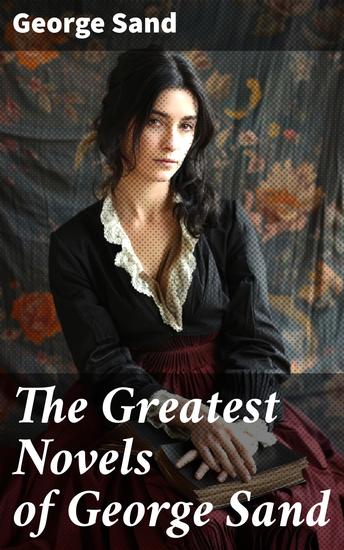
The Greatest Novels of George Sand - Indiana Mauprat The Countess of Rudolstadt Valentine Leone Leoni Antonia… - cover

The Greatest Novels of George Sand - Indiana Mauprat The Countess of Rudolstadt Valentine Leone Leoni Antonia…

George Sand

Translator Katharine Prescott Wormeley, Fayette Robinson, George Burnham Ives, Stanley Young, Ralph Keeler

Publisher: Good Press

  • 0
  • 0
  • 0

Summary

George Sand's "The Greatest Novels of George Sand" encapsulates the thematic richness and stylistic innovation that characterize her contributions to 19th-century literature. This collection delves deep into the intricacies of love, gender, and social structures, often set against the backdrop of rural France. Utilized through masterful narrative techniques, Sand's blending of realism and romanticism invites readers to explore the psychological and emotional landscapes of her characters, reflecting her own tumultuous life experiences. The collection resonates with the literary context of her time, challenging societal norms and advocating for women's rights, making her a pioneering figure in feminist literature. Born Amantine Lucile Aurore Dupin, George Sand was a revolutionary figure, both in her personal life and her literary endeavors. Her provocative lifestyle, including her romantic relationships and her outspoken views on the roles of women, provided fertile ground for her novels. Sand's commitment to social justice and her youthful encounters with political radicalism profoundly shaped her writing, allowing her to produce works that questioned the status quo and illuminated the human condition. Readers seeking a transformative literary experience will find in this collection a compelling exploration of enduring themes. Sand's ability to weave intricate plots with profound philosophical inquiries makes these novels not only a reflection of her time but also vital for contemporary discussions on gender and society. To immerse oneself in her work is to engage in a dialogue that transcends time, making this compilation an essential addition to any literary library.
Available since: 12/24/2023.
Print length: 2688 pages.
Other books that might interest you

  • Weird Tales: Best of the Early Years 1926-27 - Best of the Early Years 1926-27 - cover

    Weird Tales: Best of the Early...

    H.P. Lovecraft

    • 0
    • 0
    • 0
    This anthology from the acclaimed journal of fantasy, sci-fi, and horror fiction collects some of the most unforgettable stories from the early years. Founded in 1922, Weird Tales is an iconic literary publication and the forerunner to today’s pulp and speculative genres. Within these pages you’ll find some of the best of the classic stories originally published in Weird Tales during the years 1926 and 1927, now available in a single volume.  This Weird Tales anthology features spectral visions, world-conquering spiders, demonic paintings, and more, in stories by legendary authors such as Seabury Quinn, E. Hoffman Price, Greye La Spina, Edward Hamilton, Frank Belknap Long Jr., H. Warner Munn, August W. Derleth, A. Merritt, and H. P. Lovecraft.
    Show book
  • Love & Friendship - cover

    Love & Friendship

    Jane Austen

    • 0
    • 0
    • 0
    "Love and Friendship" is a novella by Jane Austen that explores the themes of love, friendship, and the societal expectations that govern relationships in the early 19th century. The narrative unfolds through the protagonist, Laura, who recounts her experiences and relationships in a series of letters. Austen's narrative is characterized by its wit and satire, as she keenly observes the manners and morals of the time. Through Laura's voice, the reader is taken on a journey that navigates the complexities of romantic entanglements and the consequences of societal pressures. 
     
    The novella delves into the consequences of impulsive decisions and the societal expectations placed on women to secure advantageous marriages. Austen uses humor and irony to expose the absurdities of the social norms and conventions that govern the characters' lives. As Laura navigates the challenges of love and friendship, Austen skillfully weaves a narrative that explores the tension between individual desires and societal expectations. The characters' flaws are exposed, highlighting the limitations placed on personal freedom in a society where social standing and financial considerations often take precedence over matters of the heart. 
     
    In "Love and Friendship," Austen's narrative mastery shines through as she crafts a tale that not only entertains but also offers a subtle commentary on the constraints of the society in which her characters live. The exploration of love and friendship serves as a lens through which Austen examines the intricacies of human relationships, making the novella a timeless and insightful exploration of the human condition.
    Show book
  • The Country of the Blind - And Other Stories - cover

    The Country of the Blind - And...

    H. G. Wells

    • 0
    • 1
    • 0
    Thirty-three science fiction and fantasy stories from the celebrated author of such classics as The War of the Worlds, The Times Machine, and The Invisible Man. Venture to strange worlds from the imagination of H. G. Wells with this collection of tales of science fiction and fantasy. Witness the darker side of humanity in “The Jilting of Jane” and “The Cone.” Learn what a man does when he faces fear itself in a haunted house in “The Red Room.” Travel to an Ecuadorian mountain community deprived of sight in “The Country of the Blind.” Find a curio inside an antique shop in London’s West End that allows you to see Mars in “The Crystal Egg.” Float down the Amazon on a Brazilian gunboat as a captain and his crew fight to save a village from terrifyingly evolved ants. These are just a few of the unusual journeys awaiting readers inside this compilation from one of the greatest science fiction writers in history.
    Show book
  • A Rich Woman - From their pens to your ears genius in every story - cover

    A Rich Woman - From their pens...

    Katharine Tynan

    • 0
    • 0
    • 0
    Katharine Tynan was born on 23rd January 1859 into a large family in Clondalkin, County Dublin. 
    The family business was cattle rearing and the farmhouse, set with the mountains for a backdrop, was a wonderful world for a young mind to learn and imagine. 
    She was educated at the convent school, St Catherine of Sienna, in Drogheda.  A stubborn streak inhibited her ability to learn as easily as the school wished. However she did learn on her own terms and soon began to take her ‘forbidden literature’, hidden in her clothing, to her loft in a stable hideaway.  
    Until she turned seventeen nothing appeared to point to a literary career.  But some verse printed in a Dublin newspaper changed everything. It led to a sonnet being printed in the Spectator.  Thereafter the Graphic published several others and even paid a half guinea for the privilege.   
    In 1884 Katharine dispatched herself to London and made an abiding friendship in Alice Meynell.  Alice was an established poet and helped, with her husband Wilfred, to publish many poets. The following year it was arranged for the publication of her first poetry volume, ‘Louise de la Vallière’.  
    She formed valuable friendships with the poets Gerard Manley Hopkins, William Butler Yeats and later Francis Ledwidge.  
    As she gathered friends and contacts into her life her literary output began to gather pace. Katharine had begun to write prose for the Speaker and for the Scots and National Observer.  
    In 1892 she married Henry Albert Hinkson, a fellow writer and a barrister.  They moved to England and had five children although two were to tragically die in infancy.   
    By now her output was prolific and ranged from poetry to novels to short stories.  It would later include a biography and further extend to editing and reviewing.   
    In 1912 the family returned to Claremorris, County Mayo, when her husband was appointed magistrate, a post he held until his early death in 1919.     
    Tynan is sometimes grouped amongst the War Poets of the First World War. Her experience was not direct but as a Mother with one son serving in France and another in Palestine, the emotions, fears and doubts are expressed in a beautiful and heart-felt way.  
    Involved in the Irish Literary Revival, Tynan expressed concern for feminist causes, the poor, and the effects of World War I in her work. She also meditated on her Catholic faith. 
    She is said to have written over 100 novels, 12 collections of short stories, plays and many volumes of enduring poetry as well as five volumes of autobiography. 
    Katharine Tynan Hinkson died at age 72 on 2nd April 1931 in London and is buried in Kensal Green Cemetery.
    Show book
  • The Railway Children - cover

    The Railway Children

    Edith Nesbit

    • 0
    • 0
    • 0
    After their father's sudden disappearance, siblings Roberta, Peter, and Phyllis relocate with their mother to a charming countryside cottage. Their adventurous spirits lead them to the nearby railway, where they forge friendships and unravel heart-stirring mysteries. Nesbit deftly weaves a story of hope and courage, capturing the magic of childhood against adversity.
    Show book
  • A Middle-Sized Artist - From their pens to your ears genius in every story - cover

    A Middle-Sized Artist - From...

    Charlotte Perkins Gilman

    • 0
    • 0
    • 0
    Charlotte Perkins Gilman was born on 3rd July 1860 in Hartford, Connecticut, to an unaffectionate mother and a father who abandoned her and her older brother to a life of poverty. 
    Inevitably her schooling was limited and by 15 she had attended seven different schools but received only four years education.  However Charlotte was resourceful and did spend time with her father’s aunts – the suffragist Isabella Beecher Hooker and the ‘Uncle Tom Cabin’s’ author, Harriet Beecher Stowe as well as many hours at the public library studying ancient civilisations. 
    In 1878, she enrolled in classes at the Rhode Island School of Design where she met Martha Luther and they developed a close relationship until Luther married in 1881. Charlotte was devastated and detested romance and love until she met and married the artist Charles Walter Stetson.  
    Their only child, Katharine Beecher Stetson, was born in 1885 but left Charlotte with post-natal depression, then often dismissed as a case of hysteria or nerves.  Unsuited to domestic life she ruptured her life and moved to California with Katherine.  She divorced in 1894 and then sent Katharine east to live with her father and his second wife confirming that his paternal rights be acknowledged and that Katherine establish a relationship with her father. 
    After her mother died in 1893, Charlotte moved back east and became involved with her first cousin, Wall Street attorney, Houghton Gilman who she married in 1900. After his death she moved back to California, where Katherine now lived.   
    Her most popular story is ‘The Yellow Wallpaper’ which touched on her own post-partum depression and underlined the need for women to be responsible for their mental and physical well-being, as the narrator is ordered by her husband/doctor to take compete rest in her room where she is isolated and becomes obsessed with the revolting yellow wallpaper.   
    She wrote other notable short stories the best of which we also include.   
    Charlotte lectured widely for social reform, wrote important non-fiction works that questioned our patriarchal system and left a legacy as a leading and positive spokesperson for feminism.  
    She was diagnosed with incurable breast cancer in 1932 and, as she wrote in her suicide note and autobiography, she ‘chose chloroform over cancer’    
    Charlotte Perkins Gilman took her own life on 17th August 1935, aged 75, in Pasadena, California.
    Show book