Join us on a literary world trip!
Add this book to bookshelf
Grey
Write a new comment Default profile 50px
Grey
Subscribe to read the full book or read the first pages for free!
All characters reduced
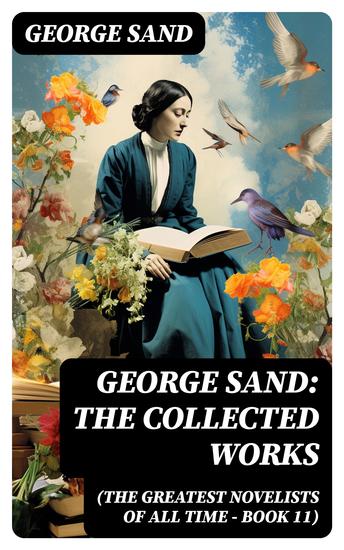
George Sand: The Collected Works (The Greatest Novelists of All Time – Book 11) - The Devil's Pool Indiana Mauprat The Countess of Rudolstadt Valentine Leone Leoni Antonia… - cover

George Sand: The Collected Works (The Greatest Novelists of All Time – Book 11) - The Devil's Pool Indiana Mauprat The Countess of Rudolstadt Valentine Leone Leoni Antonia…

George Sand

Publisher: DigiCat

  • 0
  • 0
  • 0

Summary

In "George Sand: The Collected Works (The Greatest Novelists of All Time – Book 11)," readers are presented with a rich tapestry of Sand's literary genius, showcasing her groundbreaking narratives and her penchant for exploring themes of love, gender, and identity. Through a unique amalgamation of realism and romanticism, the collection encapsulates the social complexities of 19th-century France, revealing the struggles and triumphs of her characters against a backdrop of societal norms. Sand's distinctive voice, characterized by emotional depth and intellectual rigor, invites readers to delve into her nuanced world, where personal experience intertwines with broader cultural landscapes. George Sand, born Amantine Lucile Aurore Dupin, remains a pivotal figure in literature, known for her bold defiance of gender conventions and passionate advocacy for social justice. Her upbringing, marked by a blend of aristocratic and peasant influences, significantly shaped her perspective on society and inspired her to write with both empathy and insight. Sand's relationships with various artists and thinkers of her time also informed her literary pursuits, fueling her desire to challenge the status quo and articulate the inner lives of women. This collection is essential for any literary enthusiast, as it not only highlights Sand's contributions to the literary canon but also invites readers to engage with the enduring themes that resonate today. It serves as a testament to her pioneering spirit and remains a vital exploration of the human condition, encouraging reflection on individual agency and societal constraints.
Available since: 11/24/2023.
Print length: 2688 pages.

Other books that might interest you

  • Political Ideals - cover

    Political Ideals

    Bertrand Russell

    • 0
    • 0
    • 0
    “Liberty demands self-government, but not the right to interfere with others.” 
     
    “The object of education ought not to be to make all men think alike, but to make each think in the way which is the fullest expression of his own.” 
     
    “You may kill an artist or a thinker, but you cannot acquire his art or his thought. You may put a man do death because he loves his fellow men, but you will not by so doing acquire the love which made his happiness.” 
     ― Bertrand Russell, Political Ideals 
     
    'Political Ideals' was written during the upheaval of World War One. It is, in many ways, a statement, of Russell's beliefs, a declaration of the ideas that influenced his thinking on the major events of the 20th century. In this sense, it is essential reading for every student of this great philosopher.
    Show book
  • John Davys Beresford - A Short Story Collection - A sadly neglected English author that captivated the audience of his time - cover

    John Davys Beresford - A Short...

    John Davys Beresford

    • 0
    • 0
    • 0
    John Davys Beresford was born on 17th March 1873.  His life was blighted by infantile paralysis which left him partially disabled. 
     
    After an education at Oundle school he trained to be an architect.  However, he quickly decided that his life was to be centred on a literary career.  His first offerings were in drama and as a journalist. 
     
    As well as being a book reviewer for the Manchester Guardian he contributed to New Statesman, The Spectator, Westminster Gazette, and the Theosophist magazine The Aryan Path.   
     
    His spiritual journey in early adulthood had claimed him as an agnostic, in defiance of his clergyman father.  This view he later abandoned in preference to describing himself as a Theosophist and a pacifist. 
     
    As well as many novels, many themed with spiritual and philosophical elements.  Beresford was also a gifted short story writer particularly across the science-fiction, horror and ghost genres. 
     
    All of these elements helped him to obtain a prominent place in Edwardian Literary London. 
     
    John Davys Beresford died on the 2nd February 1947. He was 73. 
     
    1 - John Davys Beresford - A Short Story Collection - An Introduction 
    2 - The Introvert by John Davys Beresford 
    3 - The Miracle by John Davys Beresford 
    4 - Enlargement by John Davys Beresford 
    5 - As the Crow Flies by John Davys Beresford 
    6 - The Barrage by John Davys Beresford 
    7 - Signs & Wonders by John Davys Beresford 
    8 - The Looking Glass by John Davys Beresford 
    9 - The Cage by John Davys Beresford
    Show book
  • Lying Awake (Unabridged) - cover

    Lying Awake (Unabridged)

    Charles Dickens

    • 0
    • 0
    • 0
    Lying Awake: The 'Gentleman Connected with the Press' are short stories by Charles Dickens. Charles John Huffam Dickens (7 February 1812 - 9 June 1870) was an English writer and social critic. He created some of the world's most memorable fictional characters and is generally regarded as the greatest novelist of the Victorian period. During his life, his works enjoyed unprecedented fame, and by the twentieth century his literary genius was broadly acknowledged by critics and scholars.
    Show book
  • Emerald City of Oz The [The Wizard of Oz series #6] - cover

    Emerald City of Oz The [The...

    L. Frank Baum

    • 0
    • 0
    • 0
    Uncle Henry can't pay the mortgage, so he, Aunt Em and Dorothy must leave their Kansas home. Where can they go? To the Land of Oz, of course! Dorothy and the Wizard take Em and Henry on a grand tour, discovering knowledge pills and living paper dolls, solving living puzzles, suffering abuse from living kitchen utensils and drooling over living baked goods - but will anyone in Oz be left living after the Nomes attack, allied with the highly disagreeable Growleywogs? And when General Guph persuades the most evil race alive - the shape-shift ing Phanfasms of Mt. Phantastico-to join the Nome Army, have the Nomes bitt en off more than they can chew?
    Show book
  • Ivanhoe - cover

    Ivanhoe

    Walter Scott

    • 0
    • 0
    • 0
    Ivanhoe, a trusted ally of Richard-the-Lionhearted, returns from the Crusades to reclaim the inheritance his father denied him. Ivanhoe defends Rebecca, a vibrant, beautiful Jewish woman, against a charge of witchcraft— but it is Lady Rowena who is Ivanhoe's true love. Richard's brother, the wicked Prince John, plots to usurp England's throne, but Richard and the well-loved famous outlaw, Robin Hood, team up to defeat the Normans and regain the castle. Blending historic reality, chivalric romance, and high adventure, Ivanhoe features action, high drama, adventure, and colorful characters.
    Show book
  • A Rich Woman - From their pens to your ears genius in every story - cover

    A Rich Woman - From their pens...

    Katharine Tynan

    • 0
    • 0
    • 0
    Katharine Tynan was born on 23rd January 1859 into a large family in Clondalkin, County Dublin. 
    The family business was cattle rearing and the farmhouse, set with the mountains for a backdrop, was a wonderful world for a young mind to learn and imagine. 
    She was educated at the convent school, St Catherine of Sienna, in Drogheda.  A stubborn streak inhibited her ability to learn as easily as the school wished. However she did learn on her own terms and soon began to take her ‘forbidden literature’, hidden in her clothing, to her loft in a stable hideaway.  
    Until she turned seventeen nothing appeared to point to a literary career.  But some verse printed in a Dublin newspaper changed everything. It led to a sonnet being printed in the Spectator.  Thereafter the Graphic published several others and even paid a half guinea for the privilege.   
    In 1884 Katharine dispatched herself to London and made an abiding friendship in Alice Meynell.  Alice was an established poet and helped, with her husband Wilfred, to publish many poets. The following year it was arranged for the publication of her first poetry volume, ‘Louise de la Vallière’.  
    She formed valuable friendships with the poets Gerard Manley Hopkins, William Butler Yeats and later Francis Ledwidge.  
    As she gathered friends and contacts into her life her literary output began to gather pace. Katharine had begun to write prose for the Speaker and for the Scots and National Observer.  
    In 1892 she married Henry Albert Hinkson, a fellow writer and a barrister.  They moved to England and had five children although two were to tragically die in infancy.   
    By now her output was prolific and ranged from poetry to novels to short stories.  It would later include a biography and further extend to editing and reviewing.   
    In 1912 the family returned to Claremorris, County Mayo, when her husband was appointed magistrate, a post he held until his early death in 1919.     
    Tynan is sometimes grouped amongst the War Poets of the First World War. Her experience was not direct but as a Mother with one son serving in France and another in Palestine, the emotions, fears and doubts are expressed in a beautiful and heart-felt way.  
    Involved in the Irish Literary Revival, Tynan expressed concern for feminist causes, the poor, and the effects of World War I in her work. She also meditated on her Catholic faith. 
    She is said to have written over 100 novels, 12 collections of short stories, plays and many volumes of enduring poetry as well as five volumes of autobiography. 
    Katharine Tynan Hinkson died at age 72 on 2nd April 1931 in London and is buried in Kensal Green Cemetery.
    Show book