Join us on a literary world trip!
Add this book to bookshelf
Grey
Write a new comment Default profile 50px
Grey
Subscribe to read the full book or read the first pages for free!
All characters reduced
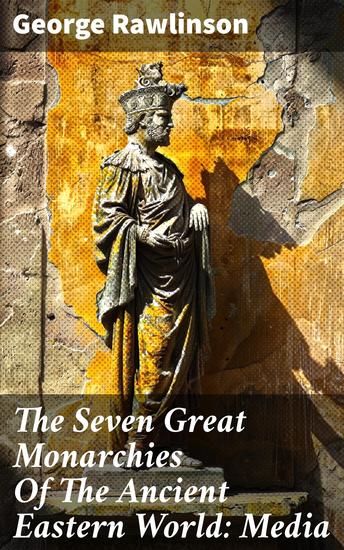
The Seven Great Monarchies Of The Ancient Eastern World: Media - Unveiling the Rise and Fall of a Forgotten Empire - cover

The Seven Great Monarchies Of The Ancient Eastern World: Media - Unveiling the Rise and Fall of a Forgotten Empire

George Rawlinson

Publisher: Good Press

  • 0
  • 0
  • 0

Summary

In 'The Seven Great Monarchies Of The Ancient Eastern World: Media,' George Rawlinson offers a meticulous exploration of the ancient kingdom of Media, one of the pivotal powers in the early history of the Eastern world. Through a blend of detailed historical accounts and engaging narrative, Rawlinson examines the political, cultural, and social dimensions of Media, contextualizing its significance within the broader tapestry of ancient empires. His scholarly approach, infused with rich descriptions and critical analyses, reflects the Victorian fascination with uncovering the vestiges of past civilizations while integrating classical sources with modern archaeological findings. George Rawlinson, a noted historian and Assyriologist, was deeply involved in the study of ancient civilizations, which profoundly influenced his writing. His academic background, including his work on cuneiform inscriptions and contributions to the deciphering of ancient texts, equipped him with the tools to delve into the complexities of the Medes and their interactions with neighboring empires. Rawlinson's scholarship not only aimed to illuminate the past but also to instill a sense of appreciation for the interconnectedness of ancient cultures. With its scholarly rigor and narrative depth, 'The Seven Great Monarchies' is an essential read for historians, students, and enthusiasts of ancient history. Rawlinson'Äôs incisive insights will not only provoke thought but also enrich one's understanding of the pivotal role Media played in shaping historical trajectories. This book is a must-have for anyone looking to grasp the intricacies of one of history'Äôs great monarchies.
Available since: 08/12/2023.
Print length: 133 pages.

Other books that might interest you

  • Green Renaissance - Unveiling the Historical Influence of Cannabis on Wellness Lifestyle and Culture Worldwide - cover

    Green Renaissance - Unveiling...

    JM Balbuena

    • 0
    • 0
    • 0
    Embark on an eye-opening journey into the multifaceted world of one of the most vilified plant in the history of humanity. From its pre-historical roots to its groundbreaking future, this book explores the complexities and possibilities of the cannabis plant. Ever wondered about the significance of terms like 'THC' or 'wake and bake' or the difference between decriminalization and legalization? 
    Discover the vital role of activists, communities, and politicians and how their actions shaped the industry's past and continue to pave its future. Get an inside look at cannabis culture, complete with an exploration into the historical influence of the plant in wellness, lifestyle and culture. Understand the nuanced of policies, connect the dots between major historical events, dive into the legal challenges and opportunities that canna-preneurs currently face, and weigh in on the possible pros and cons of federal legalization. 
    With a blend of cultural insight, policy discussion and a nod to the cannabis culture that continues to bring people together, this book serves as an essential guide for anyone interested in the world of cannabis—be it as a consumer, advocate, entrepreneur, or curious George. Let this book be your hindsight to a rich history full of lessons learned, and your foresight to what lies ahead: a future filled with promise and potential.
    Show book
  • W E B DuBois on Sociology and the Black Community - cover

    W E B DuBois on Sociology and...

    W. E. B. Du Bois

    • 0
    • 0
    • 0
    Historian, journalist, educator, and civil rights advocate W. E. B. Du Bois was perhaps most accomplished as a sociologist of race relations and of the black community in the United States. This volume collects his most important sociological writings from 1898 to 1910. The eighteen selections include five on Du Bois’s conception of sociology and sociological research, especially as a tool in the struggle for racial justice; excerpts from studies of black communities in the South and the North, including The Philadelphia Negro; writings on black culture and social life, with a selection from The Negro American Family; and later works on race relations in the United States and elsewhere after World War II. This section includes a powerful fiftieth-anniversary reassessment of his classic 1901 article in the Atlantic in which he predicted that “the problem of the twentieth century is the problem of the color line.“ 
     
    The editors provide an annotated bibliography, a lengthy overview of Du Bois’s life and work, and detailed introductions to the selections.
    Show book
  • Ottoman Empire The: An Enthralling Guide to One of the Mightiest and Longest-Lasting Dynasties in World History - cover

    Ottoman Empire The: An...

    Billy Wellman

    • 0
    • 0
    • 0
    From a small Turkish principality to a global superpower, the Ottoman Empire’s role in world history is certainly undeniable.  
    For over six centuries, the empire was arguably the world’s strongest Muslim empire, dominating its rivals in Europe and Asia for many years. 
    Spanning three continents and controlling lands in the Balkans, the Caucasus, Crimea, Anatolia, the Middle East, the Levant, Egypt, and North Africa, the Ottoman Empire was one of the most menacing powers at the height of its power in the 16th century. It was feared by other great empires of Europe. But how exactly did the Ottomans achieve this great power, and how did they lose it by the early 20th century? 
    This audiobook will cover these and other important topics from the history of the Ottoman Empire. 
    In this audiobook, you will discover the following:      The emergence of the Ottoman state under its first leader, Osman      The different sultans of the empire and their reigns      The fall of Constantinople and the Golden Age of the Ottoman Empire      Different wars and political processes that shaped the empire’s history      Factors responsible for the gradual Ottoman decline      The social, economic, and political policies of the empire throughout the ages      The dissolution of the empire in the 20th century      And much, much more! 
    Scroll up and click the “add to cart” button to learn about the Ottoman Empire!
    Show book
  • Phenomenology - The Study of Perception Experience and Consciousness - cover

    Phenomenology - The Study of...

    Mike Crawford

    • 0
    • 0
    • 0
    Phenomenology is a branch of philosophy that delves into the structures of experience and consciousness, aiming to understand how individuals perceive and interact with the world around them. At its core, phenomenology seeks to examine the nature of subjective experience and the ways in which our consciousness engages with phenomena, offering insights into the nature of reality from a first-person perspective. This philosophical approach was pioneered by Edmund Husserl in the early 20th century, and it has since evolved to influence numerous disciplines, from psychology to cognitive science and beyond. 
    The essence of phenomenology lies in its commitment to the lived experience. Unlike traditional philosophy, which often abstracts reality through logic and reason, phenomenology emphasizes the importance of understanding the world as it is experienced by individuals. This involves focusing on the way things appear to consciousness before any interpretation or theoretical assumptions are made. In this sense, phenomenology is concerned with describing and analyzing the direct, lived experience of human beings, often referred to as the “phenomenon” in phenomenological terms.
    Show book
  • Chief Energy Officer- the #newCEO - How High-Performing Leaders Manage People Pressure and Profit to Build Thriving Organizations - cover

    Chief Energy Officer- the...

    Suzy Siegle

    • 0
    • 0
    • 0
    What is leadership energy? How important is energy for leaders? 
    The role of the #newCEO is less about being an executive and more about being the organization's Chief Energy Officer. 
    This book explains why energy is the secret sauce for leaders, and how the right type of energy elevates culture, communication and organizational success. 
    And the best part? You don't have to be in the "C-Suite" to be your organization's Chief Energy Officer!
    Show book
  • Private Government - How Employers Rule Our Lives (and Why We Don't Talk about It) - cover

    Private Government - How...

    Elizabeth Anderson

    • 0
    • 0
    • 0
    Why our workplaces are authoritarian private governments—and why we can't see it 


    One in four American workers says their workplace is a "dictatorship." Yet that number almost certainly would be higher if we recognized employers for what they are—private governments with sweeping authoritarian power over our lives. Many employers minutely regulate workers' speech, clothing, and manners on the job, and employers often extend their authority to the off-duty lives of workers, who can be fired for their political speech, recreational activities, diet, and almost anything else employers care to govern. In this compelling book, Elizabeth Anderson examines why, despite all this, we continue to talk as if free markets make workers free, and she proposes a better way to think about the workplace, opening up space for discovering how workers can enjoy real freedom.
    Show book