Join us on a literary world trip!
Add this book to bookshelf
Grey
Write a new comment Default profile 50px
Grey
Subscribe to read the full book or read the first pages for free!
All characters reduced
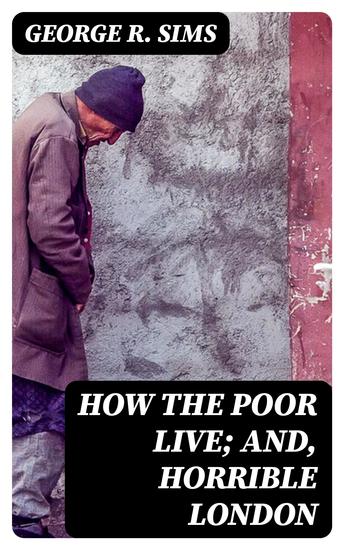
How the Poor Live; and Horrible London - Enriched edition 1889 - cover

How the Poor Live; and Horrible London - Enriched edition 1889

George R. Sims

Publisher: DigiCat

  • 0
  • 0
  • 0

Summary

In "How the Poor Live; and, Horrible London," George R. Sims adopts a journalistic approach, merging vivid narrative with social commentary to illustrate the dire conditions faced by the impoverished in Victorian London. This work serves as both a poignant exposé and a compelling call to action, detailing the squalor, despair, and resilience found within the city's underbelly. Sims' unflinching prose captures the stark realities of homelessness, unemployment, and the pervasive impact of systemic neglect, situating his observations within the broader socio-political context of 19th-century England—a time rife with industrial change yet marked by profound social disparity. George R. Sims, a playwright, poet, and journalist, was deeply influenced by the social reform movements of his time, which emphasized the urgent need for awareness and action regarding the plight of the urban poor. His works reflect not only his literary prowess but also his commitment to social justice, honed through his experiences in London's streets and his myriad interactions with its marginalized populations. Sims' ability to articulate the struggles of the working class stems from his own belief in literature as a vehicle for societal change and understanding. This book is indispensable for readers interested in social history, literature of the Victorian era, and the powerful intersection of art and advocacy. Sims' immersive narrative invites readers to contemplate the human experience behind the statistics, making it a vital read for anyone seeking to understand the complexities of urban life and the social conscience of literature.

In this enriched edition, we have carefully created added value for your reading experience:
- A comprehensive Introduction outlines these selected works' unifying features, themes, or stylistic evolutions.
- A Historical Context section situates the works in their broader era—social currents, cultural trends, and key events that underpin their creation.
- A concise Synopsis (Selection) offers an accessible overview of the included texts, helping readers navigate plotlines and main ideas without revealing critical twists.
- A unified Analysis examines recurring motifs and stylistic hallmarks across the collection, tying the stories together while spotlighting the different work's strengths.
- Reflection questions inspire deeper contemplation of the author's overarching message, inviting readers to draw connections among different texts and relate them to modern contexts.
- Lastly, our hand‐picked Memorable Quotes distill pivotal lines and turning points, serving as touchstones for the collection's central themes.
Available since: 05/28/2022.
Print length: 125 pages.

Other books that might interest you

  • The Tory’s Wife - A Woman and Her Family in Revolutionary America - cover

    The Tory’s Wife - A Woman and...

    Cynthia A. Kierner

    • 0
    • 0
    • 0
    The Spurgin family of North Carolina experienced the cataclysm of the American Revolution in the most dramatic ways—and from different sides. This engrossing book tells the story of Jane Welborn Spurgin, a patriot who welcomed General Nathanael Greene to her home and aided Continental forces while her loyalist husband was fighting for the king as an officer in the Tory militia. By focusing on the wife of a middling backcountry farmer, esteemed historian Cynthia Kierner shows how the Revolution not only toppled long-established political hierarchies but also strained family ties and drew women into the public sphere to claim both citizenship and rights—as Jane Spurgin did with a dramatic series of petitions to the North Carolina state legislature when she fought to reclaim her family's lost property after the war was over. 


    While providing listeners with stories of battles, horse-stealing, bigamy, and exile that bring the Revolutionary era vividly to life, this book also serves as an invaluable examination of the potentially transformative effects of war and revolution, both personally and politically.
    Show book
  • Fighting After the War: A History of the Most Famous American Battles that Took Place after the Wars Had Ended - cover

    Fighting After the War: A...

    Editors Charles River

    • 0
    • 0
    • 0
    There are countless examples of battles that take place in wars after a peace treaty is signed. The last battle of the Civil War was a skirmish in Texas that Confederate forces won, nearly a month after Lee’s surrender at Appomattox. As fate would have it, the last fighting of the Civil War took place two days after Confederate President Jefferson Davis had been captured in Georgia 
    It’s certainly rare for the most famous battle of a war to take place after the peace treaty is signed, but luckily for Andrew Jackson, the War of 1812 was that unique exception. Less than a year after his victory in the Battle of Horseshoe Creek, Jackson led his forces into a more important battle at the Battle of New Orleans. The British hoped to grab as much of the land on the western frontier as they could, especially New Orleans, which had a prominent position on the Mississippi River for trading. With more than 8,000 soldiers aboard a British fleet sailing in from Jamaica in early January 1815, the attack on New Orleans promised to be a significant one, while Jackson’s men defended New Orleans with about half that number. This went on despite the fact that the two sides had signed the Treaty of Ghent on Christmas Eve 1814, which was supposed to end the war.  
    Despite the fact the French & Indian War had recently concluded, Pontiac led the first major attack of Pontiac’s War in May 1763, when he and 300 of his men attacked Fort Detroit in what is now the city by the same name. Unfortunately for his cause, Pontiac failed to gauge just how strong the British presence there was, and his attack was quickly repelled. On the other hand, he was not a man who gave up easily, so instead of retreating, he and his warriors would lay siege to the British stronghold. In the days that followed, word spread of his efforts, and in short order nearly 1,000 men from various tribes in the area had joined him.
    Show book
  • Cold Peace - Avoiding the New Cold War - cover

    Cold Peace - Avoiding the New...

    Michael W. Doyle

    • 0
    • 0
    • 0
    An urgent examination of the world barreling toward a new Cold War. 


    With a historian's eye and a theorist's ingenuity, Michael Doyle, whose writings on liberal peace have revolutionized modern statesmanship, cogently assesses the tectonic shifts threatening a global order that has held for more than seventy years. As tensions among China, Russia, and the US escalate perilously toward a new Cold War, Doyle introduces a radical paradigm that will facilitate the international cooperation necessary to avert the global threats of our time. 


    Combining dramatic history with trenchant analysis and landmark theory, Doyle explores the impacts of cyberwarfare, foreign election meddling, and the unprecedented schism of modern politics on American foreign policy. He demonstrates that there can be no success in addressing climate change without China's cooperation, nor any hope of averting nuclear catastrophe without Russia's. 


    In the tradition of Gaddis's The Cold War and Clark's The Sleepwalkers, Cold Peace provides one of the most necessary analyses of global power in decades.
    Show book
  • Empathy Is Your Superpower - cover

    Empathy Is Your Superpower

    Prim Hartley

    • 0
    • 0
    • 0
    Empathy Is Your Superpower: A Guide on How to Use Empathy to Radically Enrich your Emotional Life and Build and Sustain Authentic, Meaningful, and Rewarding RelationshipsNot everyone thinks or feels alike. Every individual is unique. Fortunately, everyone can choose to look at the world through the special lens of empathy. Empathy gives us the power to think about, understand, and care about each other. It gives us the energy to go beyond self-interest and pursue authentic, meaningful, and mutually-satisfying relationships – and, in the process, enrich our emotional life.In this audiobook, you will learn how to  build and enhance your empathy. It will teach you sensible and time-tested tips you can use to rise above personal biases and become kinder, more forgiving, more accepting, and more loving toward other people. This audiobook will cover the following topics:- What is Empathy- Benefits of Empathy- Obstacles to Empathy and What to Do About Them- How to Develop and Nourish Empathy?- And many more!If you want to learn more on how to become a more empathetic person, download your copy of this audiobook today!
    Show book
  • Hamilcar and Hannibal: The History of the Carthaginian Generals Who Brought Rome to Its Knees - cover

    Hamilcar and Hannibal: The...

    Editors Charles River

    • 0
    • 0
    • 0
    One overlooked figure in the Punic Wars is Hamilcar Barca, who is now best remembered for being Hannibal’s father. However, before Hannibal marched out of Spain, it was Hamilcar who had positioned forces there, and he was already a significant historical figure in his own right. Indeed, had it not been for his death, his legacy likely would have been more important than that of his illustrious son, who is now remembered as one of history’s greatest generals.  
    	In the history of war, only a select few men always make the list of greatest generals. Napoleon. Caesar. Alexander. They are always joined by Hannibal, who has the distinction of being the only man who nearly brought Rome to its knees before its decline almost 700 years later. Rome never suffered a more horrifying defeat in its history than at Cannae, and indeed, Hannibal nearly rewrote the course of Western history during the Second Punic War. Even today there remains great debate on just how he accomplished his masterful invasion of Italy across the Alps. Since his army included war elephants, historians still argue over exactly where and how he crossed over 2,000 years after he managed that incredible feat.  
    	Although the Romans gained the upper hand in the wake of the First Punic War, Hannibal brought the Romans to their knees for over a decade during the Second Punic War. While military historians are still amazed that he was able to maintain his army in Italy near Rome for nearly 15 years, scholars are still puzzled over some of his decisions, including why he never attempted to march on Rome in the first place. Hannibal will always be listed among history’s greatest generals, and his military campaign in Italy during the Second Punic War will always be studied, but part of the aura and mystique surrounding the Carthaginian legend is that there is still a lot of mystery. 
    Show book
  • Conference Of The Birds - cover

    Conference Of The Birds

    Farid ud-Din Attar

    • 0
    • 0
    • 0
    The Conference of the Birds or Speech of the Birds is a Persian poem by Sufi poet Farid ud-Din Attar, commonly known as Attar of Nishapur. The title is taken directly from the Qur'an, 27:16, where Sulayman and Dāwūd are said to have been taught the language, or speech, of the birds. 
    In the poem, the birds of the world gather to decide who is to be their sovereign, as they have none. The hoopoe, the wisest of them all, suggests that they should find the legendary Simorgh. The hoopoe leads the birds, each of whom represents a human fault which prevents humankind from attaining enlightenment.
    Show book