¡Acompáñanos a viajar por el mundo de los libros!
Añadir este libro a la estantería
Grey
Escribe un nuevo comentario Default profile 50px
Grey
Suscríbete para leer el libro completo o lee las primeras páginas gratis.
All characters reduced
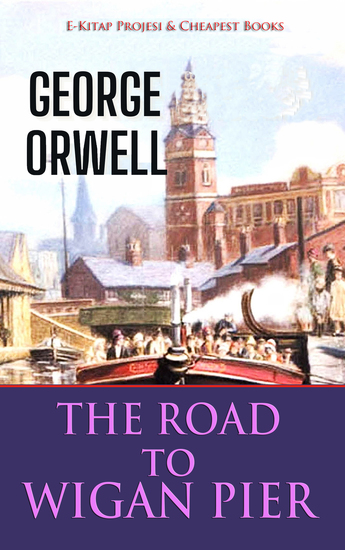
The Road to Wigan Pier - "Socialism and the English Genius" - cover

The Road to Wigan Pier - "Socialism and the English Genius"

George Orwell

Editorial: E-Kitap Projesi & Cheapest Books

  • 0
  • 0
  • 0

Sinopsis

The Road to Wigan Pier is a book by the English writer George Orwell, first published in 1937. The first half of this work documents his sociological investigations of the bleak living conditions among the working class in Lancashire and Yorkshire in the industrial north of England before World War II. The second half is a long essay on his middle-class upbringing, and the development of his political conscience, questioning British attitudes towards socialism. Orwell states plainly that he himself is in favour of socialism, but feels it necessary to point out reasons why many people who would benefit from socialism, and should logically support it, are in practice likely to be strong opponents. The book grapples "with the social and historical reality of Depression suffering in the north of England, - Orwell does not wish merely to enumerate evils and injustices, but to break through what he regards as middle-class oblivion, - Orwell's corrective to such falsity comes first by immersion of his own body - a supreme measure of truth for Orwell - directly into the experience of misery." Book Summary: Orwell submitted the typescript of Keep the Aspidistra Flying to Gollancz on 15 January 1936. At some point in the next few days Gollancz asked him to consider a new project - writing a book about unemployment and social conditions in economically depressed northern England. In the period from 31 January to 30 March 1936, Orwell lived in Wigan, Barnsley and Sheffield researching the book. Gollancz was not only a successful publisher but also a dedicated social reformer. "As a social reformer, a socialist, and an idealist, Gollancz had an unquestioning, perhaps overly optimistic, faith in education; if only people could be made to know the nature of poverty, he thought, they would want to eradicate it, remove from power the government that tolerated it, and transform the economic system that brought it into being." As a successful publisher however, he knew that to reach a large audience he needed something more than a collection of facts, statistics, graphs and dogmatic conclusions. The view that this was a specific commission with a £500 advance-two years' income for Orwell at the time-is based on a recollection by Geoffrey Gorer who was interviewed for Melvyn Bragg's TV programme Omnibus in 1970. He reported that Gollancz had offered Orwell £500 to underwrite the trip, and but for Gollancz's support Orwell would never have gone. Recent biographers, however, do not repeat this account.
Disponible desde: 30/11/2023.
Longitud de impresión: 300 páginas.

Otros libros que te pueden interesar

  • Persuasion - cover

    Persuasion

    Jane Austen

    • 0
    • 0
    • 0
    Delve into a story of love, regret, and second chances with Persuasion, Jane Austen’s poignant final novel. Anne Elliot, a thoughtful and kind-hearted woman, was once persuaded to break off her engagement to the man she deeply loved, Captain Frederick Wentworth, due to his lack of wealth and status. Now, eight years later, Anne remains unmarried and quietly endures life with her snobbish family. 
    When Captain Wentworth returns, wealthy and successful, their paths cross again. Amidst the intricate social dynamics of Regency England, Anne must navigate her lingering feelings for him while grappling with the pressures of family, society, and her own sense of self-worth. 
    Austen’s masterful exploration of resilience, maturity, and enduring love makes Persuasion a deeply moving and timeless classic. With its sharp social commentary and compelling characters, this novel is a treasure for lovers of romance, wit, and literary brilliance.
    Ver libro
  • The Adventure of the Noble Bachelor - cover

    The Adventure of the Noble Bachelor

    Arthur Conan Doyle

    • 0
    • 0
    • 0
    The Adventure of the Noble Bachelor, one of the 56 short Sherlock Holmes stories written by Sir Arthur Conan Doyle, is the tenth of the twelve stories collected in The Adventures of Sherlock Holmes. The story was first published in Strand Magazine in April 1892.The story entails the disappearance of Hatty, Lord St. Simon's bride on the day of their marriage. She participates in the wedding, but disappears from the reception.The events of the wedding day are most perplexing to Lord St. Simon as it seemed to him that his bride, Miss Hatty Doran of San Francisco, was full of enthusiasm about their impending marriage. St. Simon tells Holmes that he noticed a change in the young lady's mood just after the wedding ceremony. She was uncharacteristically sharp with him. The only thing out of the ordinary at the church where the wedding took place was Hatty's little accident: she dropped her wedding bouquet and a gentleman in the front pew picked it up and handed it back to her.Famous works of the author Arthur Conan Doyle's: "A Study in Scarlet", "Silver Blaze", "The Hound of the Baskervilles", "The Yellow Face", "A Scandal in Bohemia", "The Red-Headed League", A Case of Identity", "The Boscombe Valley Mystery", "The Five Orange Pips", "The Man with the Twisted Lip", "The Blue Carbuncle", "The Speckled Band", "The Engineer's Thumb", "The Noble Bachelor", "The Beryl Coronet", "The Copper Beeches" and many more.
    Ver libro
  • Hand and Heart - From their pens to your ears genius in every story - cover

    Hand and Heart - From their pens...

    Elizabeth Gaskell

    • 0
    • 0
    • 0
    Elizabeth Stevenson was born in Chelsea in London on 29th September 1810.  
    Both parents embedded their strong Unitarian beliefs into Elizabeth who rebelliously was often reluctant to display these religious convictions.  
    The early death of Elizabeth’s mother saw her sent away to be brought up by her maternal aunt in Knutsford, Cheshire.  
    Her father now remarried but Elizabeth spent most of her childhood in Cheshire away from her father and his new family but was supportive towards her half-siblings.  
    Elizabeth’s aunt encouraged her education and particularly to read and express herself through writing.   
    In 1828, her brother John, who worked in the merchant navy, disappeared on a journey to India. This disastrous loss depressed her father, and she went to his household to nurse him for the next year before he died.  
    In 1832, she fell in love with William Gaskell, a Unitarian minister like her father, and married him.  They settled in Manchester. This booming industrial city had a great impact on Elizabeth who felt the need to speak up for poor workers and their exploitation by large industrial companies. A collection of poems and short stories, ‘Sketches among the Poor’ appeared in 1837, co-authored by her husband.  Her first major work, under a pseudonym, was ‘Mary Barton: A Tale of Manchester Life’ published in 1848. 
    During her career she worked continually with Charles Dickens and published much in his various magazines. With him she published ‘Lizzie Leigh’ in 1850 which dealt with the taboo subject of prostitution.  She was an excellent writer and impressed her many Victorian literary peers. Much of her writing reflects her work as a social critic highlighting the exploitation of the working class and the situation of women in society.  
    On 12th November 1865, Elizabeth Gaskell died in Holybourne, Hampshire, after suffering from a heart attack a month earlier.
    Ver libro
  • The Ghost in the Cupboard Room - From their pens to your ears genius in every story - cover

    The Ghost in the Cupboard Room -...

    Wilkie Collins

    • 0
    • 0
    • 0
    Wilkie Collins was born on 8th January 1824 in Marylebone, London.  
    The family moved several times in his early years before, at 12, they travelled to France and Italy for 2 years where the sights and atmosphere made a deep and lasting impression on him. 
    He resumed his education at Mr Cole’s private boarding school in Highbury, Islington.  Here, he began his literary career under unusual circumstances: the school bully would give him no peace until he had been told a bedtime story.  This ‘little brute’ helped create one of England’s greatest writers.  
    On leaving school, in 1841, he became a clerk at a tea merchant before, 2 years later, publishing his first short story.  However, his first novel was rejected and remained so during his lifetime.  
    A brief stint at Lincoln’s Inn to please his father and to acquire a steady income was halted by his father’s death.  Collins then wrote and published his fathers’ memoirs.  He then completed his legal education though he would never practice.  
    In March 1851, he was introduced to Charles Dickens and there now started a period of sustained literary output and a remarkable lifelong friendship.  His stories were published in Dicken’s magazines, and he toured with Dicken’s theatrical before the two of them travelled to the Continent. 
    By the early 1860’s worrying signs of ill-health appeared with rheumatic gout.  As it worsened, he sought respite and cures in German spa towns and gave up writing to help his recuperation. 
    His personal life had become very complicated.  He was living with the widowed Caroline Graves and conducting an affair with a much younger Martha Rudd.  With the serialised release of ‘The Moonstone’ and vicious attacks of gout Caroline left him and married another.  Collins was now prescribed opium and was soon its lifelong dependent.  Martha bore him two children and with the return of a now divorced Caroline Graves he now divided his time between the two women. 
    In 1874 he set aside writing to tour North America on a reading tour. 
    Throughout his later years he continued to write and publish.  In all 30 novels, 14 plays, 60 short stories and over a 100 non-fiction essays as well as many more collaborations with Dickens. 
    In 1884 the Society of Authors elected him as it’s Vice-President. 
    Wilkie Collins died from a paralytic stroke on September 23rd, 1889, in London. He was 65.
    Ver libro
  • Tarzan and the Golden Lion - cover

    Tarzan and the Golden Lion

    Edgar Rice Burroughs

    • 0
    • 0
    • 0
    The iconic jungle hero faces a new threat when the mysterious and powerful Golden Lion begins to prey on the people of the African jungle. Tarzan, along with his loyal friends and allies, including the brave warrior, Hei, and the intelligent ape, Opi, must uncover the truth behind the Golden Lion's reign of terror. As they delve deeper into the dangerous jungle, they discover a hidden civilization and an ancient prophecy that foretells the rise of the Golden Lion. With the fate of the jungle hanging in the balance, Tarzan and his allies must race against time to fulfill the prophecy and put an end to the Golden Lion's reign of terror. This thrilling adventure showcases Tarzan's unmatched courage and his unwavering dedication to protecting the people and creatures of the African jungle.
    Ver libro
  • Christmas Eve at a Cornish Manor House - From their pens to your ears genius in every story - cover

    Christmas Eve at a Cornish Manor...

    Clara Venn

    • 0
    • 0
    • 0
    The bookshelves of British literature are incredible collections that have gathered together centuries of very talented authors.  From these Isles their fame spread and whilst among their number many are now forgotten or neglected their talents endure.  Among them is Clara Venn.
    Ver libro