Join us on a literary world trip!
Add this book to bookshelf
Grey
Write a new comment Default profile 50px
Grey
Subscribe to read the full book or read the first pages for free!
All characters reduced
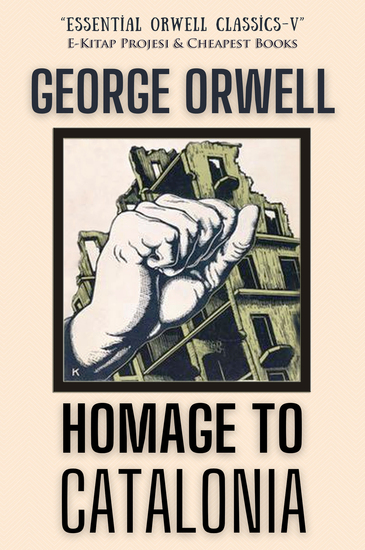
Homage to Catalonia - cover

Homage to Catalonia

George Orwell

Publisher: E-Kitap Projesi & Cheapest Books

  • 0
  • 0
  • 0

Summary

Homage to Catalonia is George Orwell's personal account of his experiences and observations fighting for the POUM militia of the Republican army during the Spanish Civil War. The war was one of the defining events of his political outlook and a significant part of what led him to write in 1946, "Every line of serious work that I have written since 1936 has been written, directly or indirectly, against totalitarianism and for Democratic Socialism, as I understand it."

The first edition was published in the United Kingdom in 1938. The book was not published in the United States until February 1952, when it appeared with an influential preface by Lionel Trilling. The only translation published in Orwell's lifetime was into Italian, in December 1948. A French translation by Yvonne Davet-with whom Orwell corresponded, commenting on her translation and providing explanatory notes-in 1938-39, was not published until five years after Orwell's death.

Book Summary:

Orwell served as a private, a corporal (cabo) and-when the informal command structure of the militia gave way to a conventional hierarchy in May 1937-as a lieutenant, on a provisional basis, in Catalonia and Aragon from December 1936 until June 1937. In June 1937, the leftist political party with whose militia he served (the POUM, the Workers' Party of Marxist Unification, an anti-Stalinist communist party) was declared an illegal organisation, and Orwell was consequently forced to flee.

Having arrived in Barcelona on 26 December 1936, Orwell told John McNair, the Independent Labour Party's (ILP) representative there, that he had "come to Spain to join the militia to fight against Fascism." He also told McNair that "he would like to write about the situation and endeavour to stir working class opinion in Britain and France." McNair took him to the POUM barracks, where Orwell immediately enlisted. "Orwell did not know that two months before he arrived in Spain, the [Soviet law enforcement agency] NKVD's resident in Spain, Aleksandr Orlov, had assured NKVD Headquarters, 'the Trotskyist organisation POUM can easily be liquidated'-by those, the Communists, whom Orwell took to be allies in the fight against Franco."
Available since: 11/27/2023.
Print length: 300 pages.

Other books that might interest you

  • Dream of the Red Chamber - A Tale Of Betrayal - cover

    Dream of the Red Chamber - A...

    Cao Xueqin

    • 0
    • 0
    • 0
    The Dream of the Red Chamber (also known as The Story of the Stone) is one of the Four Great Classical Novels of China, and considered the greatest of them all. Almost 40 main characters and some 500 minor characters tell the fortunes of the Chia family; the book details mainly the life of Chia Pao-yü, the heir apparent, who is described as very intelligent, but also as carefree and self-indulging. The already wealthy Chia family rises to new heights when Pao-yü's elder sister becomes an imperial consort. On her first visit home, a lush garden is built, where much of the rest of the story takes place. The intrigues surrounding Pao-yü and his cousins, especially Lin Tai-yü who he loves, and Hsüeh Pao-ch'ai who he is finally tricked into marrying, make up a large part of the story. The decline of the Chia family begins with the death of the imperial consort, and when they fall into disfavour with the emperor, their mansions and the garden are eventually destroyed. 
     
    The whole book has 120 chapters, only 80 of which were written by Cao Xueqin before his death in 1764. Cheng Weiyuan and Gao E claimed to have access to Cao's papers, and published what is now known as the Cheng-Gao version in 1791. Henry Bencraft Joly translated only part of the book written by Cao. Book I contains the first 24 chapters, Book II ends abruptly with chapter 56; a Book III was never published.
    Show book
  • Christmas On Ganymede - cover

    Christmas On Ganymede

    Isaac Asimov

    • 0
    • 0
    • 0
    "Christmas on Ganymede" is a science fiction short story by American writer Isaac Asimov. It was written in December 1940, first published in the January 1942 issue of Startling Stories, and reprinted in the 1972 collection The Early Asimov and the anthology Christmas on Ganymede and Other Stories, edited by Martin H. Greenberg. It was the twenty-sixth story written by Asimov, and the nineteenth to be published."The writings of Isaac Asimov do not always display his quirky sense of humor. This story, however, which first appeared in a 1942 edition of Startling Stories, certainly does.The tale takes place on one of Jupiter's moons, Ganymede, where a home sick Olaf Johnson shares the legend of Santa Claus with the ""Ossies"" (local inhabitants) who are employed by the same company he works for. The Ossies' embrace the story whole-heartedly and declare a shut-down in production unless ""Sante"" pays them a visit. Will Olaf be able to re-create this Earth legend in outer space? Will Olaf keep his job after Commander Pelham (his boss) learns what he has done? Listen and find out!
    Show book
  • Great Tasmania's Cargo The (Unabridged) - cover

    Great Tasmania's Cargo The...

    Charles Dickens

    • 0
    • 0
    • 0
    Charles Dickens was a writer and social critic who created some of the world's best-known fictional characters and is regarded as the greatest novelist of the Victorian era. His works enjoyed unprecedented popularity during his lifetime, and by the twentieth century critics and scholars had recognised him as a literary genius. His novels and short stories enjoy lasting popularity.
    THE GREAT TASMANIA'S CARGO: It is in the nature of things that such an institution as our English army should have many bad and troublesome characters in it. But, this is a reason for, and not against, its being made as acceptable as possible to well-disposed men of decent behaviour.
    Show book
  • The Europeans - cover

    The Europeans

    Henry James

    • 0
    • 0
    • 0
    "The Europeans" by Henry James is an enchanting novel that revolves around the arrival of two European siblings, Eugenia and Felix, to their American relatives' home. The cultured and mysterious newcomers create a stir among their pragmatic and reserved American kin. As the two worlds collide, romantic entanglements, cultural clashes, and social complexities unfold. Eugenia, a charming baroness, captivates the locals, including the earnest and polite Robert Acton, who falls for her continental allure. Meanwhile, Felix, a talented artist, courts the free-spirited Gertrude Wentworth, creating tension within the family.
    Show book
  • Emma - Volume Two - cover

    Emma - Volume Two

    Jane Austen

    • 0
    • 0
    • 0
    The second volume of this classic novel by Jane Austen wonderfully narrated by Penny Wyatt-Gold. Penny has the perfect voice to bring all the author's characters to life in a way that will enthrall and entertain.
    Show book
  • Anna Karenina (Part 1) - cover

    Anna Karenina (Part 1)

    Leo Tolstoy

    • 0
    • 0
    • 0
    Part 1: Prince Stepan Arkadyevich Oblonsky ("Stiva"), a Moscow aristocrat and civil servant, has been unfaithful to his wife, Princess Darya Alexandrovna ("Dolly"). Dolly has discovered his affair with the family's governess, and the household and family are in turmoil. Stiva informs the household that his married sister, Anna Arkadyevna Karenina, is coming to visit from Saint Petersburg in a bid to calm the situation.
    Anna Karenina is a novel by the Russian author Leo Tolstoy, first published in book form in 1878. Many writers consider Anna Karenina the greatest work of literature ever, and Tolstoy himself called it his first true novel. It was initially released in serial installments from 1873 to 1877 in the periodical The Russian Messenger.
    Show book