Join us on a literary world trip!
Add this book to bookshelf
Grey
Write a new comment Default profile 50px
Grey
Subscribe to read the full book or read the first pages for free!
All characters reduced
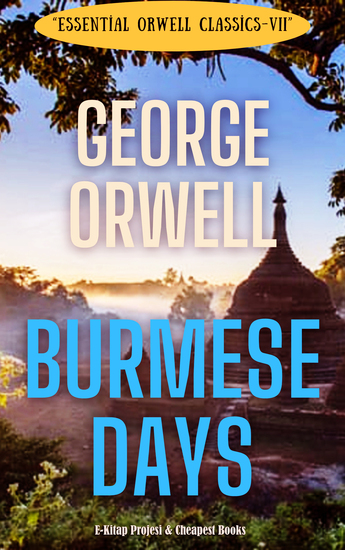
Burmese Days - cover

Burmese Days

George Orwell

Publisher: E-Kitap Projesi & Cheapest Books

  • 0
  • 0
  • 0

Summary

Burmese Days is the first novel by English writer George Orwell, published in 1934. Set in British Burma during the waning days of Empire, when Burma was ruled from Delhi as part of British India, it is "a portrait of the dark side of the British Raj." At the centre of the novel is John Flory, "the lone and lacking individual trapped within a bigger system that is undermining the better side of human nature." The novel describes "both indigenous corruption and imperial bigotry" in a society where, "after all, natives were natives-interesting, no doubt, but finally...an inferior people".

Burmese Days was first published "further afield," in the United States, because of concerns that it might be potentially libelous; that the real provincial town of Katha had been described too realistically; and that some of its fictional characters were based too closely on identifiable people. A British edition, with altered names, appeared a year later. Nonetheless, Orwell's harsh portrayal of colonial society was felt by "some old Burma hands" to have "rather let the side down". In a letter from 1946, Orwell wrote, "I dare say it's unfair in some ways and inaccurate in some details, but much of it is simply reporting what I have seen".

Book Summary:

Burmese Days is set in 1920s imperial Burma, in the fictional district of Kyauktada, based on Kathar (formerly spelled Katha), a town where Orwell served. Like the fictional town, it is the head of a branch railway line above Mandalay on the Ayeyarwady (Irrawaddy) River. As the story opens, U Po Kyin, a corrupt Burmese magistrate, is planning to destroy the reputation of the Indian, Dr Veraswami. The doctor hopes for help from his friend John Flory who, as a pukka sahib (European white man), has higher prestige. Dr Veraswami also desires election to the town's European Club, of which Flory is a member, expecting that good standing among the Europeans will protect him from U Po Kyin's intrigues. U Po Kyin begins a campaign to persuade the Europeans that the doctor holds anti-British opinions in the belief that anonymous letters with false stories about the doctor "will work wonders". He even sends a threatening letter to Flory.

John Flory, a jaded 35-year-old teak merchant with a birthmark on his face in the shape of a ragged crescent, spends three weeks of every month acquiring jungle timber. Friendless among his fellow Europeans and unmarried, but with a Burmese mistress, he has become disillusioned with life in an expatriate community centred round the local European Club in a remote provincial town. At the same time, he has become so embedded in Burma that it is impossible for him to leave and return to England. Flory has one good friend, the Indian, Dr Veraswami, whom he often visits for what the Doctor delightedly calls "cultured conversation". But when Flory dismisses the British as mere moneymakers, living a lie, "the lie that we're here to uplift our poor black brothers instead of to rob them," he provokes consternation in the doctor, who defends the British as the efficient administrators of an unrivalled empire. Toward his mistress, Flory is emotionally ambivalent: "On the one hand, Flory loves Burma and craves a partner who will share his passion, which the other local Europeans find incomprehensible; on the other hand, for essentially racist reasons, Flory feels that only a European woman is acceptable as a partner".
Available since: 11/26/2023.
Print length: 400 pages.
Other books that might interest you

  • 3 Stories About Bad Weather - A trio of classic tales perfect for a commute walk or quiet night in - cover

    3 Stories About Bad Weather - A...

    Alexander Puskin, Kate Chopin,...

    • 0
    • 0
    • 0
    There is something about the number 3.    
    The Ancient Greeks believed 3 was the perfect number, and in China 3 has always been a lucky number, and they know a thing or two.   
    Most religions also have 3 this and 3 that and, of course, in these more modern times, three’s a crowd may be too many, except when it’s a ménage à trois.  It seems good things usually come in threes. 
    Whatever history and culture says WE think 3, a hat-trick of stories, is a great number to explore themes and literary avenues that classic authors were so adept at creating. 
     
     
    01 - 3 Stories About Bad Weather 
    02 - The Blizzard by Alexander Pushkin 
    03 - The Lightning Rod Man by Herman Melville 
    04 - The Storm by Kate Chopin
    Show book
  • The Forgotten Secret - cover

    The Forgotten Secret

    Kathleen McGurl

    • 0
    • 0
    • 0
    Can she unlock the mysteries of the past? 
    A country at war 
    It’s the summer of 1919 and Ellen O’Brien has her whole life ahead of her. Young, in love and leaving home for her first job, the future seems full of shining possibility. But war is brewing and before long, Ellen and everyone around her are swept up by it. As Ireland is torn apart by the turmoil, Ellen finds herself facing the ultimate test of love and loyalty. 
      
    A long-buried secret 
    A hundred years later and Clare Farrell has inherited a dilapidated old farmhouse in County Meath. Seizing the chance to escape her unhappy marriage she strikes out on her own for the first time, hoping the old building might also provide clues to her family’s shadowy history. As she sets out to put the place – and herself – back to rights, she stumbles across a long-forgotten hiding place, with a clue to a secret that has lain buried for decades. 
      
    For fans of Kate Morton and Gill Paul comes an unforgettable novel about two women fighting for independence.Readers LOVE The Forgotten Secret! 
    ‘WOW! I can’t begin to find the right words to describe just how much I adored this… Had me hooked from the first few pages… Unputdownable.’ Goodreads reviewer, 5 stars 
    ‘A story you really live, wonderfully told… Absolutely compelling.’ Goodreads reviewer, 5 stars 
    ‘A compelling and gripping story that will hook you from the very first page… I highly recommend it.’ Goodreads reviewer, 5 stars 
    ‘I cannot say how much I loved this book! It was wonderful… I couldn’t turn the pages fast enough.’ Goodreads reviewer, 5 stars 
    ‘Just so delightful… Such a wonderful book and easily the best book I’ve read so far this year.’ Goodreads reviewer, 5 stars 
    ‘I am totally lost for words… I can’t praise this book enough and will be telling family and friends to read this ROLLER COASTER EXTRAVAGANZA OF A BOOK.’ Goodreads reviewer, 5 stars 
    Kathleen McGurl's The Forgotten Secret is a top-tier fiction novel that beautifully captures the essence of romance in a rural town. The small town sagas and holiday traditions that are woven into the narrative make the story even more engaging. 
    For fans of Daisy O'Shea (The Irish Child), Kate Morton (The Forgotten Garden), Ellen Marie Wiseman (The Lost Girls of Willowbrook), Barbara Davis (The Wishing Tide), and Kristin Hannah (The Nightingale).
    Show book
  • Forgotten Authors The - Men - Volume 3 - Théophile Gautier to Mór Jókai - cover

    Forgotten Authors The - Men -...

    Théophile Gauthier, Perceval...

    • 0
    • 0
    • 0
    Throughout the long centuries of human history is the want, and the need, to share information, to exchange ideas and for that knowledge and experience, for curiosity and learning, to be the basis of a civil society. 
    In literature the ambition is much narrower.  In order to be known, to be popular, you had to be published.  And for that people had to know you existed and your ideas worth reading.  Obviously for most of humanity’s time people couldn’t read and texts couldn’t be published in any great number. 
    In the 15th Century Gutenberg’s printing press began the revolution to address the second and by the 19th century had gathered pace with startling speed and mass distribution.  Education for the many was brought in to help people understand more of their world and, with new skills, how to have a better place within it.  Now, if the powers that owned the presses and means of distribution agreed an audience would now be able to avail themselves of your ideas, your printed words.  
    Sadly, in the thirst for the new, the recent and the past fell from sight, relegated to dark corners and dusty shelves.   
    But the printed word is rarely without someone, somewhere busying themselves through piles of papers and books rediscovering what a good story is, whatever its age. 
    In this volume we offer up a small selection of those talents whose time has now come again.
    Show book
  • The Archer's Tale - cover

    The Archer's Tale

    Bernard Cornwell

    • 0
    • 0
    • 0
    From New York Times bestselling author Bernard Cornwell, the first book in the Grail Series—the spellbinding tale of a young man, a fearless archer, who sets out wanting to avenge his family's honor and winds up on a quest for the Holy Grail. 
     
    A brutal raid on the quiet coastal English village of Hookton in 1342 leaves but one survivor: a young archer named Thomas. On this terrible dawn, his purpose becomes clear—to recover a stolen sacred relic and pursue to the ends of the earth the murderous black-clad knight bearing a blue-and-yellow standard, a journey that leads him to the courageous rescue of a beautiful French woman, and sets him on his ultimate quest: the search for the Holy Grail.
    Show book
  • Wind Knows My Name The: Book summary & analysis - cover

    Wind Knows My Name The: Book...

    Margot Langley

    • 0
    • 0
    • 0
    This content is an independent and unofficial summary created for informational and educational purposes only. It is not affiliated with, authorized, approved, licensed, or endorsed by the original author or publisher. All rights to the original work belong to its respective copyright holders. This summary is not intended to substitute the original book, but to offer a concise overview and interpretation of its main ideas.
    Show book
  • Isabela's Way - a novel - cover

    Isabela's Way - a novel

    Barbara Stark-Nemon

    • 0
    • 0
    • 0
    Isabela’s Way is a coming of age tale, set during a dangerous time in early 17th century Portugal, Spain, France and Germany. 14-year-old Isabela, an obedient Catholic girl with a talent for needle work, believes she has nothing to fear from the Inquisition. But when a mysterious woman arrives with a message from Isabela’s traveling father, the girl must leave her home and embroider her way along a clandestine network of sanctuaries created to conduct Conversos, or secret Jews, to safety.  
    A host of supporters, as well as one special young man, assist Isabela as she eludes the Inquisitors and makes her way across countries and cultures. She learns of the danger and importance of her secret work, with its coded symbols, and is shocked to discover her family’s true origins. Isabela’s Way explores the magic of a young adult overcoming peril and challenge, as one hidden circumstance after another is revealed.   
    Barbara Stark-Nemon weaves a beautiful tapestry of stories, as elegantly embroidered as the linens that Isabela weaves. Reminiscent of Rachel Kadish's The Weight of Ink, Isabela's Way is a meticulously researched and elegantly written novel of secret histories, fierce determination and ultimately love. – Mary Morris, author of Gateway to the Moon 
    Isabela's Way powerfully evokes the era of the Inquisition in Portugal and the courage of the conversos who lived between faiths as they risked their lives to make their way to freedom. Both informative and deeply moving, this is a book that makes a lasting contribution to Sephardic literature. 
    --Ruth Behar, author of Across So Many Seas
    Show book