Junte-se a nós em uma viagem ao mundo dos livros!
Adicionar este livro à prateleira
Grey
Deixe um novo comentário Default profile 50px
Grey
Assine para ler o livro completo ou leia as primeiras páginas de graça!
All characters reduced
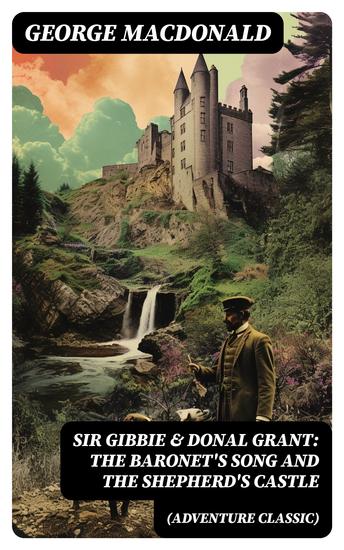
SIR GIBBIE & DONAL GRANT: The Baronet's Song and The Shepherd's Castle (Adventure Classic) - cover
LER

SIR GIBBIE & DONAL GRANT: The Baronet's Song and The Shepherd's Castle (Adventure Classic)

George MacDonald

Editora: DigiCat

  • 0
  • 0
  • 0

Sinopse

In "Sir Gibbie & Donal Grant: The Baronet's Song and The Shepherd's Castle," George MacDonald artfully intertwines adventure, morality, and spirituality into a rich narrative that reflects the Victorian fascination with individual character and social responsibility. The dual tales feature the resolute yet innocent Gibbie, whose unwavering kindness and profound loyalty challenge societal norms, alongside Donal, a character deeply rooted in themes of redemption and personal growth. MacDonald's lyrical prose, interspersed with Scots dialect, enriches the storytelling, providing an immersive experience that captivates the reader while prompting reflections on faith and the human condition. George MacDonald, a pioneer of modern fantasy literature and a significant influence on authors such as C.S. Lewis and J.R.R. Tolkien, drew upon his own experiences as a minister and his appreciation for nature and folk wisdom in crafting this work. His exploration of complex theological themes and ethical dilemmas parallels his own struggles with faith and societal expectations, offering readers insight into his moral philosophy and rich imagination. MacDonald's penchant for blending the fantastical with the real manifests in these tales, inviting readers to engage both with the text and their own lives. Highly recommended for enthusiasts of adventure literature and those searching for deeper truths, this collection offers more than just thrilling escapades; it challenges readers to reconsider the meaning of bravery, loyalty, and love. MacDonald's engaging narratives resonate with both youth and adult audiences, providing timeless lessons in integrity and compassion that transcend generations.
Disponível desde: 06/12/2023.
Comprimento de impressão: 590 páginas.

Outros livros que poderiam interessá-lo

  • Thing in the Moonlight The (Unabridged) - cover

    Thing in the Moonlight The...

    H. P. Lovecraft

    • 0
    • 0
    • 0
    "The Thing in the Moonlight" is a short story by J. Chapman Miske. The story is based on a letter dated November 24, 1927 from H. P. Lovecraft to Donald Wandrei describing one of Lovecraft's dreams. The story was prepared for publication by Miske, who filled in the story surrounding the description of the dream. In places, the letter and published story are identical to Lovecraft's style. It was first published in Bizarre magazine on January 1941.
    Ver livro
  • A Slav Soul - From their pens to your ears genius in every story - cover

    A Slav Soul - From their pens to...

    Alexander Kuprin

    • 0
    • 0
    • 0
    Alexander Kuprin was born in Narovchat, Penza in Russia on 7th September 1870. 
    At 3 his Father died and he and mother moved to Moscow. By 10 he was enrolled at the Second Moscow Military High School and there his interest in literature began. The Alexander Military Academy followed and two years later he was a sub-lieutenant and posted to an Infantry Regiment for a further four years. 
    Despite his duties he was a now a keen writer and published his first short story at this time. His military duties also garnered him experiences for his breakthrough work ‘The Duel’.  Leaving the military he left for Kiev to work for local newspapers.  He continued to publish both stories and novels and by 1901 he was in St Petersburg becoming part of a group that included Chekhov, Ivan Bunin, Maxim Gorky and Leonid Andreyev.  
    In the years that followed further controversial works and acclaim followed.  His comments on the regime meant he was also put under secret police surveillance.   
    As World War I erupted, Kuprin opened a military hospital but was then given command of an infantry company in Finland. He was soon discharged on grounds of ill health.  
    The October Revolution saw him praise Lenin, but he warned that the Bolsheviks threatened Russian culture and might cause further widespread suffering to the peasants.  As Civil War raged he took his family to Helsinki and then on to Paris. 
    Exile saw his talents decline further and his succumbing to alcoholism. He became lonely and withdrawn. The family's poverty increased his malaise.   
    In May 1937, the Kuprin’s returned to Moscow.  He now saw his work published but wrote almost nothing new.  In 1938 his health rapidly deteriorated.  Already suffering from a kidney problems and sclerosis, he had now developed cancer of the oesophagus.  
    Alexander Kuprin died on 25th August 1938.
    Ver livro
  • The Complete Works of James Allen - cover

    The Complete Works of James Allen

    James Allen

    • 0
    • 0
    • 0
    What if changing your thoughts could change your life?
    
    The Complete Works of James Allen brings together the full writings of one of the most influential voices in personal development and spiritual philosophy. Best known for As a Man Thinketh, James Allen taught that thought shapes character, character shapes destiny, and inner discipline leads to lasting success.
    
    This comprehensive collection includes Allen's books, essays, and reflections on self-mastery, purpose, calmness, integrity, and spiritual growth. Written in clear, timeless language, his work offers practical wisdom for building inner strength, moral clarity, and a peaceful mind.
    
    Allen's philosophy bridges self-help and spirituality, emphasizing responsibility, self-control, and the power of positive, purposeful thinking.
    
    Inside this eBook, you'll explore:
    
    All major works by James Allen in one collection
    
    Foundational teachings on mindset and self-discipline
    
    Practical guidance for character building and inner peace
    
    A cornerstone collection of early self-help philosophy
    
    Read and quoted worldwide for over a century, James Allen's writings remain as relevant today as when they were first published.
    
    Master your thoughts. Shape your life. Buy now and experience the complete works of James Allen.
    Ver livro
  • Music of Erich Zann The (Unabridged) - cover

    Music of Erich Zann The...

    H. P. Lovecraft

    • 0
    • 0
    • 0
    Due to lack of funds, a student studying metaphysics abroad is forced to take up lodging in a cheap apartment building on a street named the "Rue d'Auseil". The street is not far from his university and is bordered by a river, dark warehouses and a large wall, giving the street an appearance of being on a cliff. The student cannot see what lies on the other side of the wall, as only a single window on the top floor of his building looks over it. Along with the building's disabled landlord, Blandot, one of the few other tenants is an old German man named Erich Zann. The old man is mute and plays the viol[a] with a local theater orchestra. He lives alone on the top floor and at night he plays strange melodies the student has never heard before. Despite Zann's reclusiveness, Blandot reveals his identity to the student, who approaches him in the hallway one evening and asks if he can listen to Zann's music. Zann relents and allows the student to enter his room. He plays for the student some of his unique melodies but not the same as the student had previously heard. The student asks him if he could play his music from the previous nights, awkwardly humming and whistling the notes he remembered. Zann is taken aback by the request and nervously glances at the window in his room, covered by curtains. The student recognizes the window as the only one that can oversee the wall at the end of the mysterious street. He approaches it to look outside but Zann angrily pulls him back. The student is fed up with Zann's eccentricities but Zann explains through writing that he is simply a lonely old man, and suffers from numerous phobias and nervous disorders. He is pleased that the student likes his music, but refuses to play the particular tunes that the student asked for. He persuades the student to move to a lower floor in the apartment as he would prefer the student not listen to them. The student sympathizes with Zann and agrees to move. Zann promises that he will invite the student to his room to hear his other music. After the student moves, however, Zann returns to his antisocial behavior and his health deteriorates, eventually not letting the student listen at all. The student's curiosity to hear the secret music and look out the window grows, and he begins eavesdropping on Zann while he plays at night. His melodies have an unearthly sound, and the student praises Zann as a musical genius. One night while secretly listening outside Zann's room, the student hears a commotion and the old man scream inside. When the student bangs at the door, Zann lets him in and asks him to wait while he writes, promising to explain everything. More than an hour into writing, Zann is startled by a distant sound in the form of a low note, interrupts his writing and starts furiously playing his viol with a crescent terror. The music is horrific and the student surmises that Zann is playing wildly to drown out or keep something out of the room. Zann seemingly enters a stupor, doing nothing but playing his music. Another sound from outside the room, which the student perceives to be mocking them, is heard and a gust shatters the window. The unnatural wind sweeps through the room, blowing Zann's unread papers out the window, despite the student's attempts at catching them. The student remembers his curiosity and finally looks out the window. Instead of seeing the city lights, he only sees a terrible black void, an infinite abyss of chaos. The howling winds and cacophony of elements snuff out the candles in the room, leaving the student and Zann in complete darkness. He blindly moves through the dark with desperation, beginning to feel "chilling things" brush up against him. Determined to save Zann, the student reaches the musician and screams at him to run, but Zann only continues to play his music. Upon attempting to physically carry him to safety, he discovers Zann is dead, although his body is still playing. With this re
    Ver livro
  • The Horror That Lurks Beneath - Nine Tales of the Underground - cover

    The Horror That Lurks Beneath -...

    H.P. Lovecraft

    • 0
    • 0
    • 0
    What was the ultimate fate of Harley Warren? 
    What inspired the vile paintings of Richard Upton Pickman? 
    Why was the abandoned house on Benefit Street left to rot? 
    Though Lovecraft was chiefly known for his Cthulhu Mythos stories, he penned many other tales that explore equally terrifying concepts, many involving strange, subterranean spaces, peopled by ghastly and otherworldly beings. 
    Nine of these tales of the underground are collected here, in THE HORROR THAT LURKS BENEATH. 
    The collection includes two dramatic readings: PICKMAN'S MODEL and DAGON.
    Ver livro
  • A Book of Ghosts: 1 - cover

    A Book of Ghosts: 1

    D. H. Lawrence, Edith Nesbit,...

    • 0
    • 0
    • 0
    "The Dead Do Not Sleep Soundly in the West Country."
    
    Sabine Baring-Gould was one of the most versatile minds of the 19th century, but it was in the realm of the supernatural that his imagination truly flickered with a dark, cold light. A Book of Ghosts is a cornerstone of Victorian weird fiction, moving away from simple "jump scares" to explore the lingering, uncomfortable presence of those who refuse to leave this world behind.
    
    The Master of the Folkloric Fright: Baring-Gould's ghosts are not mere optical illusions; they are manifestations of history, guilt, and the rugged landscape itself. Drawing on his deep knowledge of English folklore and antiquarian history, he crafts stories where the supernatural feels as tangible as the ancient stone walls and foggy marshes of Devon and Cornwall. His work excels at the "slow burn" of dread—where a simple domestic object or a misunderstood local legend becomes the herald of something truly unsettling.
    
    A contemporary of M.R. James and Bram Stoker, Baring-Gould offers a more grounded, yet equally terrifying, vision of the afterlife. This volume is an essential cornerstone for any library of classic ghost stories, Victorian Gothic, and supernatural fiction.
    
    Step into the shadows of the past. Buy "A Book of Ghosts" today and discover why some doors are better left locked.
    Ver livro