Join us on a literary world trip!
Add this book to bookshelf
Grey
Write a new comment Default profile 50px
Grey
Subscribe to read the full book or read the first pages for free!
All characters reduced
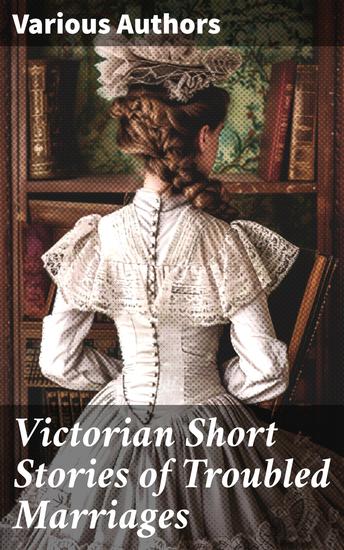
Victorian Short Stories of Troubled Marriages - Exploring Troubled Marriages in Victorian England - cover

Victorian Short Stories of Troubled Marriages - Exploring Troubled Marriages in Victorian England

George Gissing, Rudyard Kipling, Arthur Conan Doyle, Arthur Morrison, Ella D'Arcy

Publisher: Good Press

  • 0
  • 0
  • 0

Summary

Exploring the complexities of nuptial discord, *Victorian Short Stories of Troubled Marriages* dives into the nuanced emotional and societal landscapes of late 19th-century matrimony. Featuring an assemblage of short stories from prominent voices of the Victorian era, this anthology illuminates the struggles and unforeseen transformations within marital relationships. Readers will discover an array of literary styles, from Arthur Conan Doyle's incisive narrative to Rudyard Kipling's vivid prose, all of which capture the period's intricate patina of appearances, expectations, and hidden personal truths. The anthology showcases the diverse backgrounds and literary prowess of its contributors, whose works are emblematic of the broader Victorian literary and cultural landscape. The collection's authors, including the narrative prowess of Ella D'Arcy and the socially reflective storytelling of George Gissing, engage with prevailing themes that shaped the era, such as social class dynamics, gender roles, and the evolution of domestic life. Through these narratives, the collection not only reflects historical norms but also challenges them, inviting readers to reconsider the implications of each story'Äôs revelations in the context of the broader themes of Victorian social and literary movements. A uniquely enriching foray into the matrimonial mores of the Victorian age, this anthology offers readers a compelling blend of perceptive narrations and poignant reflections. The anthology's rich tapestry of voices presents a captivating dialogue that spans across diverse perspectives, inviting both seasoned scholars and curious readers to traverse the intricate inner worlds of its characters. By engaging with this collection, readers take part in an enlightening journey through the traditions, tensions, and transformations that continue to resonate within the framework of personal relationships today.
Available since: 08/19/2023.
Print length: 60 pages.

Other books that might interest you

  • The Horse-Stealers - cover

    The Horse-Stealers

    Anton Chekhov

    • 0
    • 0
    • 0
    The Horse-Stealers - a story by Anton Pavlovich Chekhov. Written in 1890, first published in the magazine "New Time" No. 5061, April 1, 1890, signed Anton Chekhov.
    Show book
  • Stories To Make You Cry - Sometimes you need a good cry - cover

    Stories To Make You Cry -...

    Anton Chekhov, Stephen Crane,...

    • 0
    • 0
    • 0
    When we read or listen, words can have a transforming effect.  Our mood can alter in the space of a few sentences from joy to sadness.  And not just our mood.  These words can affect us physically, they can engage our emotions and even in their sadness bring a lump to our throat and tears to our eyes.  Sometimes the relief can be palpable. 
     
    Our authors, from Anton Chekhov, Stephen Crane, Willa Cather, Katherine Mansfield and a wealth of others are well aware of what their talents will evoke.   Genius has many names.   
     
    1 - Short Stories To Make You Cry  - An Introduction 
    2 - Vanka by Anton Chekhov 
    3 - A Dark Brown Dog by Stephen Crane 
    4 - Suicides by Guy de Maupassant 
    5 - The Life of Ma Parker by Katherine Mansfield 
    6 - The District Doctor by Ivan Turgenev 
    7 - Paul's Case by Willa Cather 
    8 - Hands by Sherwood Anderson 
    9 - Silence by Leonid Andreyev 
    10 - The Stones of the Village by Alice Dunbar Nelson 
    11 - Hide And Seek or Pliatki by Fyodor Sologub
    Show book
  • Ozma of Oz [The Wizard of Oz series #3] - cover

    Ozma of Oz [The Wizard of Oz...

    L. Frank Baum

    • 0
    • 0
    • 0
    Dorothy Gale is transported during a storm to the land of Ev, where she and a talking chicken must save the royal family from the malicious Nome King and somehow get Dorothy back to Kansas.
    Show book
  • Persuasion - cover

    Persuasion

    Jane Austen

    • 0
    • 0
    • 0
    The novel revolves around the life of Anne Elliot, a young woman who had rejected the proposal of her true love, Captain Frederick Wentworth, on the advice of her family and friends, who considered him beneath her in social status and fortune. Years later, Anne finds herself unmarried and regretful of her decision to refuse Wentworth's proposal. He, on the other hand, has become a successful naval captain and has acquired wealth and social status. When they meet again, Anne finds that her feelings for Wentworth have not diminished, but he appears to be indifferent towards her. Read in English, unabridged.
    Show book
  • All's Well That Ends Well - cover

    All's Well That Ends Well

    William Shakespeare

    • 0
    • 0
    • 0
    All's Well That Ends Well is a play by William Shakespeare.    Helena, the low-born ward of a Spanish countess, is in love with the countess' son Bertram, who is indifferent to her. Bertram goes to Paris to replace his late father as attendant to the ailing King of France. Helena, the daughter of a recently deceased doctor, follows Bertram, ostensibly to offer the King her services as a healer. The King is sceptical, and she guarantees the cure with her life: if he dies, she will be put to death, but if he lives, she may choose a husband from the court. The King is cured and Helena chooses Bertram, who rejects her, owing to her poverty and low status.     The King forces him to marry her, but after the ceremony Bertram immediately goes to war in Italy without so much as a goodbye kiss. He says that he will only marry her after she has borne his child and wears his family ring. In Italy, Bertram is a successful warrior and also a successful seducer of local virgins. Helena follows him to Italy, befriends Diana, a virgin with whom Bertram is infatuated, and they arrange for Helena to take Diana's place in bed. Diana obtains Bertram's ring in exchange for one of Helena's. In this way Helena, without Bertram's knowledge, consummates their marriage and wears his ring. Helena returns to the Spanish countess, who is horrified at what her son has done, and claims Helena as her child in Bertram's place. Helena fakes her death, and Bertram, thinking he is free of her, comes home.
    Show book
  • Frankenstein - cover

    Frankenstein

    Mary Shelley

    • 0
    • 0
    • 0
    A POWERFUL FULL-CAST DRAMATIC MARATHON “Beware; for I am fearless, and therefore powerful.” Mary Shelley was an English novelist who wrote the Gothic novel Frankenstein; or, The Modern Prometheus in 1818, which is considered an early example of science fiction. She also edited and promoted the works of her husband, the Romantic poet, and philosopher Percy Bysshe Shelley. Her father was the political philosopher William Godwin and her mother the philosopher and feminist activist Mary Wollstonecraft.Shelley's mother died less than a month after giving birth to her. She was raised by her father, who provided her with a rich if informal education, encouraging her to adhere to his own anarchist political theories. When she was four, her father married a neighbor, Mary Jane Clairmont, with whom Shelley came to have a troubled relationship.In 1814, Shelley began a romance with one of her father's political followers, Percy Bysshe Shelley, who was already married. Together with her stepsister, Claire Clairmont, she and Percy left for France and traveled through Europe. Upon their return to England, Shelley was pregnant with Percy's child. Over the next two years, she and Percy faced ostracism, constant debt, and the death of their prematurely born daughter. They married in late 1816, after the suicide of Percy Shelley's first wife, Harriet.In 1816, the couple and her stepsister famously spent a summer with Lord Byron and John William Polidori near Geneva, Switzerland, where Shelley conceived the idea for her novel Frankenstein. The Shelleys left Britain in 1818 for Italy, where their second and third children died before Shelley gave birth to her last and only surviving child, Percy Florence Shelley.
    Show book