Join us on a literary world trip!
Add this book to bookshelf
Grey
Write a new comment Default profile 50px
Grey
Subscribe to read the full book or read the first pages for free!
All characters reduced
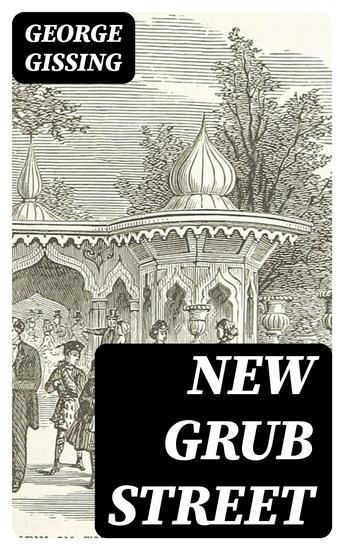
New Grub Street - cover

New Grub Street

George Gissing

Publisher: DigiCat

  • 0
  • 0
  • 0

Summary

In "New Grub Street," George Gissing intricately weaves a narrative that captures the tumultuous world of late Victorian literature, examining the struggles and moral quandaries faced by writers in a rapidly changing society. Through the lives of characters such as Edwin Reardon and Jasper Milvain, Gissing critiques the commodification of art, exploring themes of commercialism, artistic integrity, and the tension between creativity and financial survival. Stylistically, the novel melds naturalism with poignant character studies, emphasizing psychological depth and social commentary reflective of Gissing's own milieu, steeped in the realities of literary life in London. George Gissing, a figure often overshadowed in the annals of English literature, drew upon his own experiences in the literary trenches to inform this work. Born into a lower-middle-class family, Gissing struggled with poverty and the harsh realities of the publishing world during his early career. His intimate knowledge of both personal aspirations as a writer and the critical reception of contemporaries infused "New Grub Street" with authenticity, serving as both a critique of and a mirror to the struggles inherent to authorship. This novel is highly recommended for those interested in the interplay between art and commerce, as well as readers seeking an insightful exploration of the psychological and societal factors shaping literary ambition. Gissing's mastery of character and astute observations make "New Grub Street" an essential read, unearthing the sacrifices writers make in their quest for recognition.
Available since: 10/11/2022.
Print length: 469 pages.
Other books that might interest you

  • Ruth - cover

    Ruth

    Elizabeth Gaskell

    • 0
    • 0
    • 0
    Ruth is a heartwarming biblical story about loyalty, love, and redemption. Ruth, a Moabite widow, remains devoted to her mother-in-law, Naomi, and accompanies her back to Bethlehem. Despite facing hardships and discrimination, Ruth's kindness and perseverance lead to her marriage to Boaz, a wealthy landowner. Their union results in the birth of Obed, who becomes the grandfather of King David. The book celebrates the power of love, the importance of family, and the idea that even in the face of adversity, hope and happiness can prevail.
    Show book
  • Sailors' Yarns (Unabridged) - cover

    Sailors' Yarns (Unabridged)

    Pierre Loti

    • 0
    • 0
    • 0
    Pierre Loti born to a Protestant family, Loti's education began in his birthplace, Rochefort, Charente-Maritime. At age 17 he entered the naval school in Brest and studied at Le Borda. He gradually rose in his profession, attaining the rank of captain in 1906. In January 1910 he went on the reserve list. He was in the habit of claiming that he never read books, saying to the Académie française on the day of his introduction (7 April 1892), "Loti ne sait pas lire" ("Loti doesn't know how to read"), but testimony from friends proves otherwise, as does his library, much of which is preserved in his house in Rochefort. In 1876 fellow naval officers persuaded him to turn into a novel passages in his diary dealing with some curious experiences in Istanbul. The result was the anonymously published Aziyadé (1879), part romance, part autobiography, like the work of his admirer, Marcel Proust, after him.
    SAILORS' YARNS: Within the tropics, on a wondrous evening when the Southern trades were blowing with their balmiest softness, the corporeal portion of his being tired with a healthy muscular fatigue, gently lulled by the slumberous rhythmic motion of the ship.
    Show book
  • The Fall of the House of Usher and Other Classic Tales of Horror - cover

    The Fall of the House of Usher...

    Edgar Allan Poe

    • 0
    • 0
    • 0
    Edgar Allen Poe is regarded as one of the greatest American writers and a pioneer of the horror genre, and this collection brings together some of his most celebrated tales. Themes of guilt, fear and revenge abound as the master of gothic horror transports readers to mysterious worlds, carries them on dangerous sea voyages, and investigates gruesome murders. Exploring the hidden depths of the human mind, these are tales full of thrills and intrigue. 
     
    Includes: 
    • The Fall of the House of Usher 
    • The Tell-Tale Heart 
    • The Black Cat 
    • The Cask of Amontillado 
    • The Masque of the Red Death 
    • The Pit and the Pendulum
    Show book
  • The Time Machine The Lost Manuscript - Stories For Everyone - cover

    The Time Machine The Lost...

    H.G. Wells

    • 0
    • 0
    • 0
    Herbert George Wells was an English writer. Prolific in many genres, he wrote dozens of novels, short stories, and works of social commentary, history, satire, biography, and autobiography. His work also included two books on recreational war games. Wells is now best remembered for his science fiction novels and is often called the "father of science fiction", along with Jules Verne. 
     
    During his own lifetime, however, he was most prominent as a forward-looking, even prophetic social critic who devoted his literary talents to the development of a progressive vision on a global scale. A futurist, he wrote a number of utopian works and foresaw the advent of aircraft, tanks, space travel, nuclear weapons, satellite television, and something resembling the World Wide Web. His science fiction imagined time travel, alien invasion, invisibility, and biological engineering.  
     
    Wells's earliest specialized training was in biology, and his thinking on ethical matters took place in a specifically and fundamentally Darwinian context. He was also an outspoken Socialist from a young age, often (but not always, as at the beginning of the First World War) sympathizing with pacifist views. His later works became increasingly political and didactic, and he wrote little science fiction, while he sometimes indicated on official documents that his profession was that of a journalist. Novels such as Kipps and The History of Mr. Polly, which describe lower-middle-class life, led to the suggestion that he was a worthy successor to Charles Dickens, but Wells described a range of social strata and even attempted a diagnosis of English society as a whole.
    Show book
  • Of the New Reign (Unabridged) - cover

    Of the New Reign (Unabridged)

    H. G. Wells

    • 0
    • 0
    • 0
    Herbert George Wells (21 September 1866 - 13 August 1946) was an English writer. Prolific in many genres, he wrote dozens of novels, short stories, and works of social commentary, history, satire, biography and autobiography. His work also included two books on recreational war games. Wells is now best remembered for his science fiction novels and is often called the "father of science fiction", along with Jules Verne and the publisher Hugo Gernsback.
    OF THE NEW REIGN: The bunting and the crimson vanish from the streets. Already the vast army of improvised carpenters that the Coronation has created set themselves to the work of demolition, and soon every road that converges upon Central London will be choked again with great loads of timber-but this time going outward-as our capital emerges from this unprecedented inundation of loyalty. The most elaborately conceived, the most stately of all recorded British Coronations is past.
    Show book
  • Top 10 Short Stories The - The Russian 19th - The top ten Short Stories of the 19th Century written by Russian authors - cover

    Top 10 Short Stories The - The...

    Alexander Pushkin, Nikolai...

    • 0
    • 0
    • 0
    Short stories have always been a sort of instant access into an author’s brain, their soul and heart.  A few pages can lift our lives into locations, people and experiences with a sweep of landscape, narration, feelings and emotions that is difficult to achieve elsewhere. 
     
    In this series we try to offer up tried and trusted ‘Top Tens’ across many different themes and authors. But any anthology will immediately throw up the questions – Why that story? Why that author?  
     
    The theme itself will form the boundaries for our stories which range from well-known classics, newly told, to stories that modern times have overlooked but perfectly exemplify the theme.  Throughout the volume our authors whether of instant recognition or new to you are all leviathans of literature. 
     
    Some you may disagree with but they will get you thinking; about our choices and about those you would have made.  If this volume takes you on a path to discover more of these miniature masterpieces then we have all gained something. 
     
    In the vast Empire of the Russians literature was a way to exchange ideas, values and cultures.  Yet each author, each story, each character is an individual example of a journey that, story by story, has transformed the glimmering arc of its literature.   
     
    1 - The Top 10 - The 19th Century - The Russians - An Introduction 
    2 - How Much Land Does A Man Need by Leo Tolstoy 
    3 - The Cloak by Nikolai Gogol also known as 'The Overcoat' 
    4 - The Crocodile. An Extraordinary Incident - Part 1 by Fyodor Dostoevsky 
    5 - The Crocodile. An Extraordinary Incident - Part 2 by Fyodor Dostoevsky 
    6 - Twenty-Six Men and a Girl by Maxim Gorky 
    7 - The Bet by Anton Chekhov 
    8 - The District Doctor by Ivan Turgenev 
    9 - The Shot by Alexander Pushkin 
    10 - Hide And Seek or Pliatki by Fyodor Sologub 
    11 - Taman by Mikhail Yurievich Lermontov 
    12 - The Signal by Vsevolod Garshin
    Show book