Unisciti a noi in un viaggio nel mondo dei libri!
Aggiungi questo libro allo scaffale
Grey
Scrivi un nuovo commento Default profile 50px
Grey
Iscriviti per leggere l'intero libro o leggi le prime pagine gratuitamente!
All characters reduced
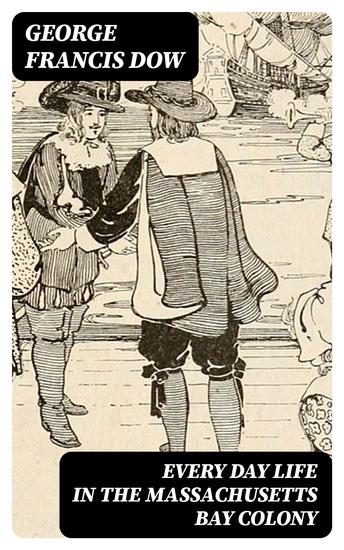
Every Day Life in the Massachusetts Bay Colony - cover

Every Day Life in the Massachusetts Bay Colony

George Francis Dow

Casa editrice: DigiCat

  • 0
  • 0
  • 0

Sinossi

In "Every Day Life in the Massachusetts Bay Colony," George Francis Dow offers an incisive exploration of the daily experiences of the settlers in one of America's earliest and most significant colonies. Through meticulous research and vivid descriptive prose, Dow creates a rich tapestry of the social, economic, and cultural practices that shaped the lives of the Puritan inhabitants. The book is structured thematically, providing readers with insights into domestic life, religious practices, and community engagements, all framed within the early 17th-century context. Dow's literary style is both engaging and scholarly, making extensive use of primary sources that illuminate the nuances of colonial life often overlooked by contemporary historians. George Francis Dow was a dedicated historian and an avid collector of historical artifacts, specializing in New England's colonial period. His intense interest in the details of daily living and cultural heritage likely stemmed from his commitment to preserving history, as evidenced by his previous works. Dow's attention to the socio-political environment of the Massachusetts Bay Colony reveals his understanding of how that historical backdrop influenced the settlers' choices and interactions. This book is essential for anyone interested in early American history, offering a comprehensive overview that transcends mere dates and events to reveal the heart of a community. It serves as an invaluable resource for historians, educators, and general readers alike, inviting them to step into the shoes of the colonists and experience their lives firsthand.
Disponibile da: 13/11/2022.
Lunghezza di stampa: 262 pagine.

Altri libri che potrebbero interessarti

  • Battle of the Boyne The: The History of the Battle that Ended James II’s Attempt to Reclaim the Throne of England - cover

    Battle of the Boyne The: The...

    Editors Charles River

    • 0
    • 0
    • 0
    The striking saga of the Glorious Revolution is one that continues to fascinate historians around the world today. Some chroniclers have referred to these events as the “Bloodless Revolution,” but other historians say otherwise. The ruthless game of politics that William of Orange and England’s King James II played may have been somewhat bloodless in comparison to history's greatest rebellions, but the rebels, soldiers, and other pawns who lost their lives along the way must not be forgotten. The revolution would also pave the path for a series of bloody wars between England and Scotland, the result of which has left quite a legacy of its own.  
    Furthermore, it’s important to remember that James did try to return to England, and there would be two more years of war before James II gave up the quest to regain the throne. On July 1, 1690, the famous Battle of the Boyne was fought near the town of Drogheda, about five miles west of Baltray. The combatants were the supporters of King James II and King William III, both claiming to be the lawful sovereigns of England, Scotland, and Ireland. The conflict was part of a broader struggle for the destiny of the British Isles, and though it was not the decisive battle of the war, it is the most famous, the commemoration of which still fans tensions between Protestants and Catholics in Northern Ireland and the Republic of Ireland. In its aftermath, James II would again leave the British Isles, this time for good. 
    Mostra libro
  • Guerrilla Marketing for Writers - 100 No-Cost Low-Cost Weapons for Selling Your Work - cover

    Guerrilla Marketing for Writers...

    Jay Conrad Levinson, Rick...

    • 0
    • 0
    • 0
    Because the battle begins before a book even hits the shelves, an author needs every weapon to get ahead of the competition. Guerrilla Marketing for Writers is packed with proven insights and advice, it details 100 “Classified secrets” that will help authors sell their work before and after it’s published. This life range of weapons-practical low-cost and no-cost marketing techniques-will help authors design a powerful strategy for strengthening their proposals, promoting their books, and maximizing their sales.
    Mostra libro
  • Emotional Intelligence: Book summary & analysis - cover

    Emotional Intelligence: Book...

    Briefly Summaries

    • 0
    • 0
    • 0
    This is a concise summary and analysis of Emotional Intelligence, by Daniel Goleman. It is not the original book and is not affiliated with or endorsed by Daniel Goleman. Ideal for those seeking a quick and insightful overview.
     
    In "Emotional Intelligence," the author explores the critical role emotional intelligence plays in our lives, often overshadowing technical abilities and IQ. Through compelling anecdotes and scientific research, the book illustrates how EI can affect relationships, career success, and overall well-being.
    Mostra libro
  • Liberty and Crisis: The History of the American Revolution during 1776 - cover

    Liberty and Crisis: The History...

    Editors Charles River

    • 0
    • 0
    • 0
    Although the Declaration of Independence is now considered one of the most important political documents in history, the men that drafted it did not initially favor such a move at the start of the American Revolution. Despite its assumption of governing duties, the Second Continental Congress never intended, at least initially, to become the governing body of a new nation. Instead, it merely hoped to transform the relationship between Britain and her colonies to allow for greater self-government on their side of the Atlantic. Separation between the two was rarely favored, and this initial sentiment coalesced into the Olive Branch Petition, which sought a reasonable motion of reconciliation between George III and the colonies. It was drafted by one of Virginia’s delegates, Thomas Jefferson.  
    	By April of 1776, talk had heated up concerning independence, and a consensus was quickly growing in Congress. However, one problem was in the way: did the Congress have the authority to declare independence for its 13 member colonies? The process was riddled with confusion across the colonies. independence. And of course, simply declaring independence did not mean the British were going to grant it, and during that time, things were looking quite dire for the cause. After the siege of Boston forced the British to evacuate that city in March 1776, Continental Army commander George Washington suspected that the British would move by sea to New York City, the next logical target in an attempt to end a colonial insurrection. He thus rushed his army south to defend the city. 
    In the summer of 1776, the British conducted the largest amphibious expedition in North America’s history at the time, landing over 20,000 troops on Long Island. They easily captured Staten Island, which Washington was incapable of defending without a proper navy. Washington’s army attempted to fight, but Washington was badly outmaneuvered, and his army was nearly cut off from escape. 
    Mostra libro
  • A Rare Recording of Poet Robert Frost Reading "The Gift Outright" at President Kennedy's Inauguration - cover

    A Rare Recording of Poet Robert...

    Robert Frost

    • 0
    • 0
    • 0
    In 1961, poet Robert Frost was invited to read at the inauguration of President John F. Kennedy. It would be the first by a poet for an inaugural ceremony. President-elect Kennedy asked Frost to recite the poem "The Gift Outright" unless the poet planned to write a poem especially for the occasion. Frost did, in fact, write a new poem for the day entitled "Dedication." However, when the time came to read, the wind and sun's glare made this impossible, though Frost made a valiant attempt. Instead, he reverted to "The Gift Outright," which he read by heart: 
     
    "The land was ours before we were the land’s. She was our land more than a hundred years, Before we were her people. She was ours In Massachusetts, in Virginia, But we were England’s, still colonials, Possessing what we still were unpossessed by, Possessed by what we now no more possessed. Something we were withholding made us weak, Until we found out that it was ourselves, We were withholding from our land of living, And forthwith found salvation in surrender. Such as we were we gave ourselves outright, (The deed of gift was many deeds of war), To the land vaguely realizing westward, But still unstoried, artless, unenhanced, Such as she was, such as she will become."
    Mostra libro
  • The Great Miscalculation - The Race to Save New York City's Citicorp Tower - cover

    The Great Miscalculation - The...

    Michael M. Greenburg

    • 0
    • 0
    • 0
    The Citicorp Center, a fifty-nine-story skyscraper built in 1977, immediately became one of the most recognizable features on the New York City skyline with its distinctive inclined roof and oddly placed support columns. Designed by one of the top structural engineers in the field, William LeMessurier, the tower would become the crown jewel of his professional career; In essence, he created a skyscraper on stilts. The building was a modern marvel—until it was revealed that it had a one in sixteen chance of collapse. 


    The Great Miscalculation tells the riveting story of LeMessurier's discovery of a fatal flaw in his building's design and his decision to blow the whistle on himself, putting his reputation on the line in a race to save this iconic skyscraper. With hurricane season rapidly approaching, the structural design flaws of the Citicorp Tower posed a menacing danger. Meanwhile, the economic hardships and political turmoil of 1970s New York only compounded the obstacles to a massively expensive, never-before-seen structural redesign in the heart of downtown Manhattan. 


    A fascinating piece of overlooked New York City history, The Great Miscalculation tells the gripping narrative of a catastrophe averted in the nick of time.
    Mostra libro