Join us on a literary world trip!
Add this book to bookshelf
Grey
Write a new comment Default profile 50px
Grey
Subscribe to read the full book or read the first pages for free!
All characters reduced
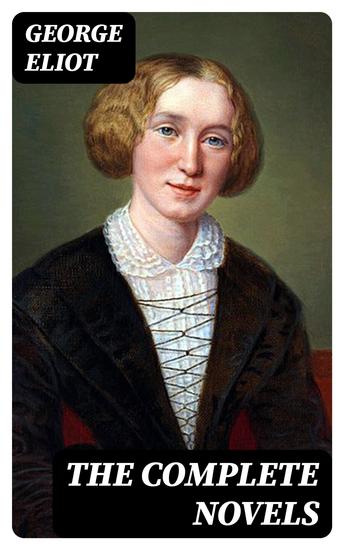
The Complete Novels - cover

The Complete Novels

George Eliot

Publisher: DigiCat

  • 0
  • 0
  • 0

Summary

George Eliot's 'The Complete Novels' represents a comprehensive collection of her esteemed works that deftly explore themes of morality, society, and the complexities of human relationships. Eliot's literary style, characterized by its psychological depth and narrative richness, reflects the Victorian era's dynamism and philosophical inquiries. Each novel is imbued with social critique and profound character development, utilizing a realistic portrayal of life that challenges societal norms and expectations. The collection showcases her ability to weave intricate plots that reveal the inner workings of her characters' minds, illuminating their motivations and struggles in a rapidly changing world. Eliot, born Mary Ann Evans, was a pioneering figure in literature, renowned not only for her writing but also for her intellect and progressive views on gender and society. Her experiences as a woman in a male-dominated literary landscape greatly influenced her works, as she often grappled with the limitations imposed on women of her time. Her keen insight into human nature and societal complexities is a hallmark of her writings, making her a central figure in the development of the modern novel. Readers are invited to immerse themselves in 'The Complete Novels,' a remarkable anthology that offers a rich tapestry of human emotion and societal commentary. This collection not only showcases Eliot's literary genius but also serves as an essential exploration of the human condition, making it a vital addition to any literary collection.
Available since: 10/11/2022.
Print length: 4729 pages.

Other books that might interest you

  • The Affair At Coulter's Creek - From their pens to your ears genius in every story - cover

    The Affair At Coulter's Creek -...

    Ambrose Bierce

    • 0
    • 0
    • 0
    Ambrose Gwinnett Bierce was born on 24th June 1842 at Horse Cave Creek in Meigs County, Ohio. His parents were poor but they introduced him to literature at an early age, instilling in him a deep appreciation of books, the written word and the elegance of language.  
    Growing up in Koscuisko County, Indiana poverty and religion were defining features of his childhood, and he would later describe his parents as “unwashed savages” and fanatically religious, showing him little affection but always quick to punish. He came to resent religion, and his introduction to literature appears to be their only positive effect. 
    At age 15 Bierce left home to become a printer’s devil, mixing ink and fetching type at The Northern Indian, a small Ohio paper. Falsely accused of theft he returned to his farm and spent time sending out work in the hopes of being published. 
    His Uncle Lucius advised he be sent to the Kentucky Military Institute. A year later he was commissioned as an Officer.  As the Civil War started Bierce enlisted in the 9th Indiana Infantry Regiment.  
    In April 1862 Bierce fought at the Battle of Shiloh, an experience which, though terrifying, became the source of several short stories. Two years later he sustained a serious head wound and was off duty for several months. He was discharged in early 1865.  
    A later expedition to inspect military outposts across the Great Plains took him all the way to San Francisco. He remained there to become involved with publishing and editing and to marry, Mary Ellen on Christmas Day 1871.  They had a child, Day, the following year.  
    In 1872 the family moved to England for 3 years where he wrote for Fun magazine. His son, Leigh, was born, and first book, ‘The Fiend’s Delight’, was published.  
    They returned to San Francisco and to work for a number of papers where he gained admiration for his crime reporting. In 1887 he began a column at the William Randolph Hearst’s San Francisco Examiner.  
    Bierce’s marriage fell apart when he discovered compromising letters to his wife from a secret admirer. The following year, 1889 his son Day committed suicide, depressed by romantic rejection. 
    In 1891 Bierce wrote and published the collection of 26 short stories which included ‘An Occurrence at Owl Creek Bridge’.  Success and further works including poetry followed.  
    Bierce with Hearst’s resources helped uncover a financial plot by a railroad to turn 130 million dollars of loans into a handout. Confronted by the railroad and asked to name his price Bierce answered “my price is $130 million dollars. If, when you are ready to pay, I happen to be out of town, you may hand it over to my friend, the Treasurer of the United States”.  
    He now began his first foray as a fabulist, publishing ‘Fantastic Fables’ in 1899.  But tragedy again struck two years later when his second son Leigh died of pneumonia relating to his alcoholism.  
    He continued to write short stories and poetry and also published ‘The Devil’s Dictionary’.  
    At the age of 71, in 1913 Bierce departed from Washington, D.C., for a tour of the battlefields where he had fought during the civil war. At the city of Chihuahua he wrote his last known communication, a letter to a friend. It’s closing words were “as to me, I leave here tomorrow for an unknown destination,” Ambrose Bierce then vanished without trace.
    Show book
  • The Magic Shop - cover

    The Magic Shop

    H. G. Wells

    • 0
    • 0
    • 0
    Out for a walk in London one day, Gip and his father happen upon a magic shop. At Gip's urging, the two go in — and things grow more and more curious by the minute. Counters, store fixtures, and mirrors seem to move around the room, and the shopkeeper is most mysterious of all. Gip is thrilled by all he sees, and his father is at first amused, but when things become stranger and sinister father is no longer sure where reality ends and illusion begins.
    Show book
  • War and Peace - Book 11: 1812 (Unabridged) - cover

    War and Peace - Book 11: 1812...

    Leo Tolstoy

    • 0
    • 0
    • 0
    War and Peace is a literary work mixed with chapters on history and philosophy by the Russian author Leo Tolstoy. It was first published serially, then published in its entirety in 1869. It is regarded as one of Tolstoy's finest literary achievements and remains an internationally praised classic of world literature.
    Book 11: 1812: Absolute continuity of motion is not comprehensible to the human mind. Laws of motion of any kind become comprehensible to man only when he examines arbitrarily selected elements of that motion; but at the same time, a large proportion of human error comes from the arbitrary division of continuous motion into discontinuous elements.
    Show book
  • The Prince And The Pauper - cover

    The Prince And The Pauper

    Mark Twain

    • 0
    • 0
    • 0
    "The Prince and The Pauper" is a historical fiction novel penned by the celebrated American author, Mark Twain. Set in 16th-century Tudor England, the story revolves around two young boys who are identical in appearance: Tom Canty, a pauper living in the slums of London, and Prince Edward, the heir to the throne. Through a twist of fate, the two boys swap places, leading to a series of misadventures as they experience each other's lives. Through this engaging tale, Twain offers a biting commentary on social inequality, human nature, and the arbitrary nature of birthright, all wrapped up in a captivating adventure.
    Show book
  • Kipps - cover

    Kipps

    H. G. Wells

    • 0
    • 0
    • 0
    First published in 1905 Kipps soon became H.G Wells’ most popular novel. It is a rags to riches story of a “simple soul” Arthur Kipps, a naïve young man who finds himself suddenly struggling to keep afloat in the deep waters of unlooked for wealth. He reaches out to those he considers his betters to anchor himself in this new world, so far removed from his relatively humble life of apprentice to a Draper. 
      
    Young Kipps is quick to abandon his first love Ann for the allure of Helen Walsingham, whom he feels is more the match for the inevitable rise in his status which must surely follow his new found wealth. 
      
    Wells lets the obviously humorous side of the situation naturally unfold, whilst subtly framing Kipps’ rise and fall in the context of the hypocrisies and futilities of Edwardian English society. 
    Narrated by Simon Hester. With original music.
    Show book
  • History of the Philippines A (Unabridged) - cover

    History of the Philippines A...

    David P. Barrows

    • 0
    • 0
    • 0
    A History of the Philippines is a short, dense and temporally expansive book. It starts with the Evolution of the Land 100 million years ago. The writing is predominantly dry, dispassionate and academic. It's full of details, and often presumes an existing familiarity with Philippine history and culture, introducing terms with no definition provided.
    Show book