Join us on a literary world trip!
Add this book to bookshelf
Grey
Write a new comment Default profile 50px
Grey
Subscribe to read the full book or read the first pages for free!
All characters reduced
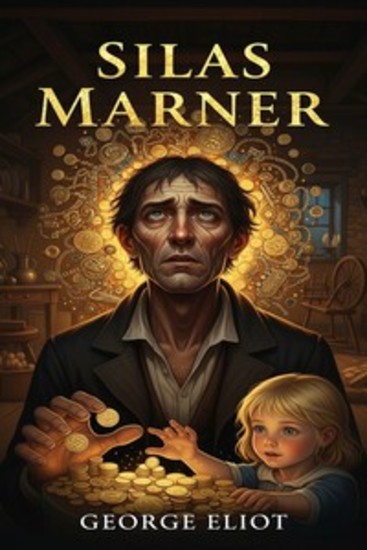
Silas Marner - cover

Silas Marner

George Eliot

Publisher: Bu Classics Books

  • 0
  • 0
  • 0

Summary

A solitary weaver, embittered by betrayal and obsessed with his hoard of gold, finds his life transformed by the arrival of an orphaned child. This heartwarming fable explores the healing power of human connection, contrasting the sterility of wealth with the richness of love and community.
Available since: 03/05/2026.
Print length: 284 pages.
Other books that might interest you

  • The Westminster Alice - cover

    The Westminster Alice

    Saki Saki

    • 0
    • 0
    • 0
    The Westminster Alice is a collection of humorous vignettes by Saki, first published in the Westminster Gazette in 1902, which form a political pastiche of the Alice books by Lewis Carroll, featuring an unforgettable cast of notable politicians of the day, and brought to life with illustrations by F. Carruthers Gould – 'with apologies to Sir John Tenniel' for their striking likeness to the original Alice illustrations.
    Desperately trying to navigate her way through the world of Ineptitudes, Knights, Queens and Mad Hatters, Alice delivers a stinging satire of Westminster politics – which, imbued with Saki's charm and delicate wit, and set in a world evocative of Carroll's timeless Wonderland, is as charming today as when it was written, and belongs on every Alice fan's bookshelf.
    Show book
  • The Seed of McCoy - cover

    The Seed of McCoy

    Jack London

    • 0
    • 0
    • 0
    “The Seed of McCoy” written by Jack London: The Pyrenees, her iron sides pressed low in the water by her cargo of wheat, rolled sluggishly, and made it easy for the man who was climbing aboard from out a tiny outrigger canoe. As his eyes came level with the rail, so that he could see inboard, it seemed to him that he saw a dim, almost indiscernible haze. It was more like an illusion, like a blurring film that had spread abruptly over his eyes. He felt an inclination to brush it away, and the same instant he thought that he was growing old and that it was time to send to San Francisco for a pair of spectacles.
    Show book
  • To Build A Fire - cover

    To Build A Fire

    Jack London

    • 0
    • 0
    • 0
    To Build A Fire is the best known of all London's stories. It tells the story of a new arrival to the Klondike who stubbornly ignores warnings about the folly of traveling alone. He falls through the ice into a creek in seventy-below weather, and his survival depends on being able to build a fire and dry his clothes, which he is unable to do. The famous version of this story was published in 1908.
    Show book
  • A Cullenden of Virginia - From their pens to your ears genius in every story - cover

    A Cullenden of Virginia - From...

    Thomas Wolf

    • 0
    • 0
    • 0
    Thomas Clayton Wolfe was born at the family home, 92 Woodfin Street, in Asheville, North Carolina on October 3rd, 1900.  
    Aged 15, Wolfe began his studies at the University of North Carolina at Chapel Hill (UNC) where he enrolled in a playwriting course. Wolfe graduated in 1920 and enrolled at the Graduate School for Arts and Sciences at Harvard. Here he studied playwriting under the tutelage of George Pierce Baker. In 1922 he received his master's degree from Harvard.  
    Wolfe now began the transition from studying to commercial playwright. He went to New York in November, 1923 trying to sell his plays to Broadway.  The Theatre Guild came close to producing Welcome to Our City but in the end declined.  Wolfe now believed his style of writing was more suited to fiction.  Grasping the opportunity this afforded him he sailed to England in October 1924 to write and from there on to France, Italy and Switzerland. 
    In 1926 Wolfe began writing a novel, O Lost. This would eventually become Look Homeward, Angel. It was based on his years in Asheville. The original manuscript of O Lost was over 1100 pages. Maxwell Perkins, one of the great book editors of the age, worked at his publishers, Scribner’s and he began to focus the book, cutting and re-shaping it to center it on the character of Eugene.   
    The novel was published in 1929. It was a success.   
    Wolfe now committed the next 4 years to writing a multi-volume epic entitled The October Fair.  At Scribner’s Perkins once more decided to edit it down to a single volume; Of Time and the River.  It was even more successful than his first. It was hailed as the literary event of 1935 and cemented his reputation as one of America’s foremost novelists.  
    In 1938, after submitting his new opus, which ran to an incredible one million words, to his new editor, Edward Aswell, Wolfe left to tour the West, a part of the country he had never before visited. Whilst travelling Wolfe became ill with pneumonia and spent three weeks in a Seattle hospital. Complications arose. The prognosis was serious.  He was diagnosed with miliary tuberculosis of the brain. 
    On September 6th, he was sent to Baltimore's Johns Hopkins Hospital for treatment. The ensuing operation revealed that the disease had overrun the entire right side of his brain.  
    Thomas Clayton Wolfe never regained consciousness and died shortly before his 38th birthday on September 15th, 1938.
    Show book
  • A Story Without An End - cover

    A Story Without An End

    Anton Chekhov

    • 0
    • 0
    • 0
    Soon after two o'clock one night, long ago, the cook, pale and agitated, rushed unexpectedly into my study and informed me that Madame Mimotih, the old woman who owned the house next door, was sitting in her kitchen."She begs you to go in to her, sir…" said the cook, panting. "Something bad has happened about her lodger… He has shot himself or hanged himself…""What can I do?" said I. "Let her go for the doctor or for the police!"
    "How is she to look for a doctor! She can hardly breathe, and she has huddled under the stove, she is so frightened… You had better go round, sir."
    I put on my coat and hat and went to Madame Mimotih's house. The gate towards which I directed my steps was open. After pausing beside it, uncertain what to do, I went into the yard without feeling for the porter's bell. In the dark and dilapidated porch the door was not locked. I opened it and walked into the entry. Here there was not a glimmer of light, it was pitch dark, and, moreover, there was a marked smell of incense. Groping my way out of the entry I knocked my elbow against something made of iron, and in the darkness stumbled against a board of some sort which almost fell to the floor. At last the door covered with torn baize was found, and I went into a little hall...
    Show book
  • The Encantadas - cover

    The Encantadas

    Herman Melville

    • 0
    • 0
    • 0
    "The Encantadas, or Enchanted Isles" is a novella by American author Herman Melville. First published in Putnam's Magazine in 1854, it consists of ten philosophical "Sketches" on the Encantadas, or Galápagos Islands. It was collected in The Piazza Tales in 1856. The Encantadas was a success with the critics, and contained some of Melville's "most memorable prose".
    An anonymous narrator unites the ten disparate "Sketches", each of which begin with a few lines of poetry, mostly taken from Edmund Spenser's The Faerie Queene. All of the stories are replete with symbolism reinforcing the cruelty of life on the Encantadas. "Sketch First" is a description of the islands; though they are the Enchanted Isles they are depicted as desolate and hellish. "Sketch Second" is a meditation on the narrator's encounter with ancient Galápagos tortoises, while "Sketch Third" concerns the narrator's trip up the enormous tower called the Rock Rodondo. "Sketch Fourth" details the narrator's musings from atop the tower, and his recollection of the islands' accidental discovery by Juan Fernández. "Sketch Fifth" describes the USS Essex' encounter with a phantom British ship near the area during the War of 1812.
    Show book