Join us on a literary world trip!
Add this book to bookshelf
Grey
Write a new comment Default profile 50px
Grey
Subscribe to read the full book or read the first pages for free!
All characters reduced
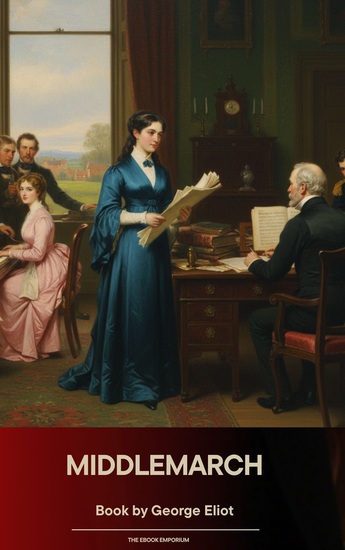
Middlemarch - cover

Middlemarch

George Eliot

Publisher: The Ebook Emporium

  • 0
  • 0
  • 0

Summary

"The growing good of the world is partly dependent on unhistoric acts."

Set in a fictional Midlands town during the social upheaval of the 1832 Reform Act, Middlemarch is a sprawling, deeply moving tapestry of human life. It follows the parallel lives of Dorothea Brooke, an idealistic woman seeking a "grand life" of purpose, and Tertius Lydgate, a brilliant young doctor determined to revolutionize medicine. Both find their lofty ambitions shackled by the realities of unhappy marriages and the suffocating weight of social gossip. George Eliot's "Study of Provincial Life" is a brilliant exploration of how our smallest choices and hidden sacrifices shape the world around us.

The Masterpiece of Realism: Eliot doesn't rely on melodrama or easy villains. Instead, she offers an unprecedented level of psychological depth, showing how even "mediocre" people struggle with their consciences. Through characters like the dry scholar Edward Casaubon and the charismatic but troubled Will Ladislaw, she examines the gap between our private dreams and our public failures.

A Mirror of History: While deeply personal, the novel is also a brilliant historical document. It captures a moment of massive transition—the arrival of the railroads, the rise of modern science, and the birth of political reform. Eliot argues that history isn't just made by "Great Men," but by the "hidden lives" of ordinary people striving to be better.

Discover the novel that Virginia Woolf called "one of the few English novels written for grown-up people." Purchase "Middlemarch" today.
Available since: 01/07/2026.
Print length: 696 pages.
Other books that might interest you

  • Around The World In Eighty Days - cover

    Around The World In Eighty Days

    Jules Verne

    • 0
    • 0
    • 0
    "Around the World in Eighty Days" is an adventure novel by French author Jules Verne, published in 1873. The story follows Phileas Fogg, an English gentleman, who accepts a wager that he can travel around the world in just 80 days. Accompanied by his loyal valet Passepartout, Fogg sets off on a journey that takes him through various countries and involves numerous adventures and challenges. The book is a celebration of the technological innovations of the time and explores themes like cultural diversity, friendship, and the human spirit.
    Show book
  • Fox and the Cat The - Story Time Episode 31 (Unabridged) - cover

    Fox and the Cat The - Story Time...

    Brothers Grimm

    • 0
    • 0
    • 0
    The German tale of four brothers who set out to learn their crafts in the big wide world. When they return home as skilled men; a thief, an astronomer, a hunter, and a tailor their skills are challenged by their father - 'I should like to try what each of you can do in this way.
    Show book
  • The Tale of the Flopsy Bunnies - cover

    The Tale of the Flopsy Bunnies

    Beatrix Potter

    • 0
    • 0
    • 0
    The Tale of the Flopsy Bunnies is written by the popular children's author Beatrix Potter This is a wonderful bedtime story. The flopsy bunnies fall asleep in Mr. McGregors garden. He puts them in a sack and wants to take them home. But their father and Thomasina Tittlemouse rescue them. The moral of the story is: listen to your parents. Recommended for age 3+.
    Show book
  • The Black Cat - cover

    The Black Cat

    Sampi Books, Edgar Allan Poe

    • 0
    • 0
    • 0
    Edgar Allan Poe's "The Black Cat" is a short story that explores themes of guilt and perversity. The narrator, haunted by cruelty to his black cat and acts of domestic violence, is consumed by paranoia and madness. His attempt to conceal a crime leads to his own disgrace.
    Show book
  • Beowulf - cover

    Beowulf

    Unknown Unknown

    • 0
    • 0
    • 0
    Beowulf is an Old English epic poem in the tradition of Germanic heroic legend consisting of 3,182 alliterative lines. It is one of the most important and most often translated works of Old English literature. The date of composition is a matter of contention among scholars; the only certain dating is for the manuscript, which was produced between 975 and 1025. Scholars call the anonymous author the "Beowulf poet". The story is set in pagan Scandinavia in the 6th century. Beowulf, a hero of the Geats, comes to the aid of Hrothgar, the king of the Danes, whose mead hall in Heorot has been under attack by the monster Grendel. After Beowulf slays him, Grendel's mother attacks the hall and is then defeated. Victorious, Beowulf goes home to Geatland and becomes king of the Geats. Fifty years later, Beowulf defeats a dragon but is mortally wounded in the battle. After his death, his attendants cremate his body and erect a tower on a headland in his memory. Scholars have debated whether Beowulf was transmitted orally, affecting its interpretation: if it was composed early, in pagan times, then the paganism is central and the Christian elements were added later, whereas if it was composed later, in writing, by a Christian. Beowulf is written mostly in the West Saxon dialect of Old English, but many other dialectal forms are present, suggesting that the poem may have had a long and complex transmission throughout the dialect areas of England.No definite sources or analogs of the poem can be proven, but many suggestions have been made, including the Icelandic Grettis saga, the Norse story of Hrolf Kraki and his bear-shapeshifting servant Bodvar Bjarki, the international folktale the Bear's Son Tale, and the Irish folktale of the Hand and the Child. Persistent attempts have been made to link Beowulf to tales from Homer's Odyssey or Virgil's Aeneid. More definite are Biblical parallels, with clear allusions to the books of Genesis, Exodus, and Daniel.
    Show book
  • The Crown Derby Plate - cover

    The Crown Derby Plate

    Marjorie Bowen

    • 0
    • 0
    • 0
    Written in 1933, this classic ghost story features Bowen's typically superb descriptions of desolation and decay.
    Show book