Join us on a literary world trip!
Add this book to bookshelf
Grey
Write a new comment Default profile 50px
Grey
Subscribe to read the full book or read the first pages for free!
All characters reduced
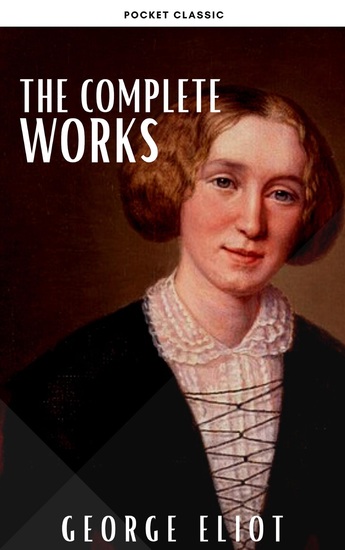
George Eliot : The Complete Works - cover

George Eliot : The Complete Works

George Eliot, Pocket Classic

Publisher: Pocket Classic

  • 0
  • 0
  • 0

Summary

This ebook comprises the complete writings of English writer George Eliot.

The collection is sorted chronologically by book (or magazine) publication. There are the usual inline tables of contents and links after each text/chapter to get back to the respective tables. The dates of first publication are noted whenever available.


Contents:

Scenes of Clerical Life. (1858): The Sad Fortunes of the Rev. Amos Barton, Mr. Gilfil's Love Story, Janet's Repentance.

Adam Bede. (1859)

The Lifted Veil. (1859)

The Mill on the Floss. (1860)

Silas Marner, the Weaver of Raveloe. (1861)

Romola. (1863)

Brother Jacob. (1864)

Felix Holt, the Radical. (1866)

The Spanish Gypsy. (1868)

Middlemarch. (1871/72)

The Legend of Jubal, and Other Poems. (1874): The Legend of Jubal, Agatha, Armgart, How Lisa Loved the King, A Minor Prophet, Brother and Sister, Stradivarius, A College Breakfast-Party, Two Lovers, Self and Life, "Sweet Endings Come and Go, Love," The Death of Moses, Arion, "O May I Join the Choir Invisible."

Daniel Deronda. (1876)

Impressions of Theophrastus Such. (1879)

The Essays: From the Note-Book of an Eccentric, How to Avoid Disappointment, The Wisdom of the Child, A Little Fable with a Great Moral, Hints on Snubbing, Carlyle's Life of Sterling, Margaret Fuller, Woman in France: Madame de Sablé, Three Months in Weimar, Evangelical Teaching: Dr. Cumming, German Wit: Henry Heine, The Natural History of German Life, Silly Novels by Lady Novelists, George Forster, Worldliness and Other-Worldliness: The Poet Young, The Influence of Rationalism, The Grammar of Ornament, Address to Working Men, by Felix Holt, Leaves from a Note-Book.

Miscellaneous Poems: On Being Called a Saint, Farewell, Sonnet, Question and Answer, "'Mid my Gold-Brown Curls," "'Mid the Rich Store," "As Tu Va la Lune se Lever," In A London Drawing Room, Arms! To Arms!, Ex Oriente Lux, In the South, Will Ladislaw's Song, Erinna, I Grant you Ample Leave, Mordecai's Hebrew Verses, Count that Day Lost.
Available since: 06/13/2022.
Print length: 5409 pages.


Other books that might interest you

  • The Kingdom of Brunel - cover

    The Kingdom of Brunel

    Phil G

    • 0
    • 0
    • 0
    He would become one of the leading figures of this new technological age, helping to bring the world out of the darkness of the previous centuries, and into a new era of progress. 
     
    He was a visionary – an engineer and inventor of unparalleled ingenuity and ambition. With his railway projects he would conquer rivers, mountains, and vast stretches of land. His oceanic projects would produce the largest and most powerful ships the world had ever seen – helping thousands of people to bridge the continents and bringing mankind closer than ever before. His architectural projects would serve as testament to the ingenuity of mankind and would stamp his legacy upon the landscape. But his legacy endures in more than his constructions and inventions – his genius would come to inspire whole generations of new engineers, architects, and scientists – his legacy lives on all around us. 
     
    So, join us now, as we trace his story from its very beginnings – join us on an exploration of the life and times of Isambard Kingdom Brunel.
    Show book
  • The Mythology of the Aborigines - Dreamtime Stories from Australia - cover

    The Mythology of the Aborigines...

    Odessa Nightshade

    • 0
    • 0
    • 0
    Aboriginal mythology is one of the oldest and most enduring oral traditions in the world, deeply intertwined with the identity, spirituality, and way of life of Indigenous Australians. At the heart of this mythology is the concept of **Dreamtime**, the sacred era in which the land, people, and laws of existence were formed. Unlike Western myths, which often separate the past from the present, Dreamtime stories are timeless—continuing to shape and guide Aboriginal communities today.  
      
    One of the most profound aspects of Aboriginal mythology is its role in explaining the creation of the natural world. The Dreaming tells of powerful ancestral beings who shaped the land, created rivers and mountains, and gave life to animals and people. These stories are not just myths but sacred truths, passed down through generations as a way of preserving knowledge, laws, and cultural values. The **Rainbow Serpent**, for example, is a common figure in many Aboriginal cultures, often depicted as a creator spirit responsible for forming the land and waterways. Other tales speak of celestial beings, tricksters, and wise elders who teach important lessons about survival, respect, and harmony with nature.  
      
    Oral tradition is central to Aboriginal culture, ensuring that these sacred stories remain alive. Unlike written texts, Dreamtime stories are preserved through song, dance, rock art, and storytelling, allowing each generation to contribute to and maintain their significance. The stories are more than entertainment; they serve as maps for navigating the landscape, moral guides for behavior, and spiritual connections to the ancestors. They also emphasize a deep respect for the land, as many stories explain the sacred nature of particular sites, reinforcing the importance of environmental stewardship. 
    Show book
  • Artists Siblings Visionaries - The lives and loves of Gwen and Augustus John - cover

    Artists Siblings Visionaries -...

    Judith Mackrell

    • 0
    • 0
    • 0
    'Outstanding' - The Guardian 'Judith Mackrell has done an incredible job in bringing to life the stories of these two great artists' - Anthony D’Offay'This is a must read . . . a deeply moving account of a family bursting with talent' - Anne SebbaIn Artists, Siblings, Visionaries, acclaimed biographer Judith Mackrell turns her attention to British brother and sister artists Gwen and Augustus John.In many ways they were polar opposites. Augustus was the larger of the two; vivid, volatile and promiscuous, he was a hero among romantics and bohemians, celebrated as one of the great British talents of his generation.As a woman, Gwen's place in the art world was much smaller, and her private way of working and reserved nature meant it was only long after her death that her tremendous gifts were fully acknowledged. But her temperament was as turbulent as her brother's. She formed passionate attachments to men and woman, including a long affair with the sculptor Rodin.And there were other ways in which the two Johns were remarkably alike, as Mackrell vividly reveals. The result is a powerful portrait of two prodigiously talented artists and visionaries, whose experiments with form and colour created some of the most memorable work of the early twentieth century.
    Show book
  • The Boys in Chicago Heights - The Forgotten Crew of the Chicago Outfit - cover

    The Boys in Chicago Heights -...

    Matthew J. Luzi

    • 0
    • 0
    • 0
    Chicago Heights was long the seat of one of the major street crews of the Chicago Outfit, but its importance has often been overlooked and misunderstood. 


    The crew's origins predate Prohibition, when Chicago Heights was a developing manufacturing center with a large Italian immigrant population. Its earliest bosses struggled for control until a violent gang war left the crew solidified under the auspices of Al Capone. For the remainder of the twentieth century, the boys from Chicago Heights generated large streams of revenue for the Outfit through its vast gambling enterprises, union infiltration and stolen auto rackets. For the first time, the history of the Chicago Heights street crew is traced from its inception through its last known boss.
    Show book
  • On the Razor's Edge - The Story of The Art of Shaving - cover

    On the Razor's Edge - The Story...

    Eric Malka

    • 0
    • 0
    • 0
    Eric Malka, founder of The Art of Shaving, set out on his entrepreneurial journey at the age of seventeen as an undocumented immigrant with $100 to his name. In On the Razor’s Edge, Malka details his rags-to-riches story while sharing the many business and life lessons he acquired along the way. As an investor and advisor, he shares insights that are designed to empower tomorrow’s entrepreneurs and increase their odds of success.
    Show book
  • Eye for Genius An: James Brand Pinker and Henry James - cover

    Eye for Genius An: James Brand...

    Kerry Sutherland

    • 0
    • 0
    • 0
    A middle aged author declining in popularity. An up and coming literary agent with an eye for genius. A partnership that would forge a prodigious legacy in American literature.  
    Henry James was a middle-aged author who had established himself on a transatlantic scale when he employed James Brand Pinker as his literary agent in 1898. The changing preferences of a growing audience of readers along with James’s self-defeating practice of shifting from publisher to publisher, rather than adhering to the trade courtesy of remaining loyal to one house, were making the author’s efforts to keep his work in print increasingly difficult; bringing Pinker, who managed the literary business of over 100 authors including Stephen Crane, H.G. Wells, Joseph Conrad, and Jack London, into the picture made it possible for James to maintain a presence before the reading public to an extent that would have been impossible without the agent’s assistance. 
    Pinker’s involvement was vital to the continuance of James’s career, as his later works and the New York Edition proved difficult material to place. The agent’s role as the mediator of conflict between the commercial writer and literary artist, positions that James had difficulty reconciling, had considerable influence on the shape of James’s later career and thus the way in which the author is remembered; James’s legacy is therefore clearly tied to Pinker’s efforts. 
    Using correspondence between Pinker, James, and the primary publishers of James’s material from 1898 until Pinker’s death in 1922, along with secondary works addressing the agent’s endeavors during this period, this volume demonstrates the link between Pinker’s work and James’s continued presence in print, both during the author’s lifetime and after his death.
    Show book