Join us on a literary world trip!
Add this book to bookshelf
Grey
Write a new comment Default profile 50px
Grey
Subscribe to read the full book or read the first pages for free!
All characters reduced
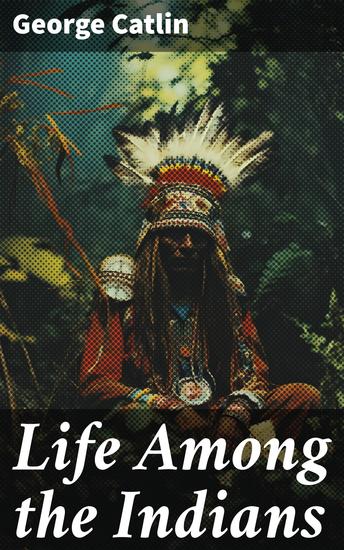
Life Among the Indians - Illustrated Edition - Indians of North and South America: Everyday Life & Customes of Indian Tribes Indian Art & Architecture Warfare Medicine and Religion - cover

Life Among the Indians - Illustrated Edition - Indians of North and South America: Everyday Life & Customes of Indian Tribes Indian Art & Architecture Warfare Medicine and Religion

George Catlin

Publisher: Good Press

  • 0
  • 0
  • 0

Summary

In "Life Among the Indians," George Catlin presents an evocative and meticulous account of his experiences with Native American tribes during the 1830s. His narrative, rich in descriptive imagery and observational detail, blends travelogue and anthropological study, reflecting a Romantic era's fascination with the 'noble savage.' Catlin's prose is complemented by his stunning illustrations, which provide a visual documentation of indigenous cultures, rituals, and landscapes, offering readers a captivating glimpse into a world on the brink of transformation due to westward expansion and encroaching civilization. George Catlin was not only an artist but also an early ethnographer who felt a profound sense of responsibility to document the lives and customs of Native Americans as he perceived them. His travels across the American frontier and interactions with various tribes fueled his desire to preserve their culture in the face of inevitable change. This passion led him to advocate for the establishment of a national Indian museum, highlighting his commitment to preserving the legacy of Native American tribes through both art and writing. Catlin's "Life Among the Indians" is essential reading for those interested in American history, indigenous cultures, or the evolving narrative of the American frontier. Its vivid illustrations and heartfelt prose invite readers to engage with the complexity of Native American life while reflecting on the impact of colonization, making it a significant contribution to both literary and historical discourse.
Available since: 11/17/2023.
Print length: 215 pages.

Other books that might interest you

  • Philosophy Pussycats & Porn - cover

    Philosophy Pussycats & Porn

    Stoya

    • 0
    • 0
    • 0
    Philosophy, Pussycats, & Porn is a series of essays, blog posts, and stories surveying more than a decade of poignant journalistic accounts from internationally recognized writer, actor, and pornographer Stoya. 
    Stoya provides crucial examinations of systemic biases toward sex workers and how sexuality is reflected in society. She often points her journalistic lens inward, providing us with personal, illustriously detailed stories of her life, her collaborators, and ow she has built a flourishing media haven in the face of a culture that is still learning how to handle public discourses on sex work.
    Show book
  • Shame and Attachment Loss - The Practical Work of Reparative Therapy - cover

    Shame and Attachment Loss - The...

    Joseph Nicolosi

    • 0
    • 0
    • 0
    Bringing together a Judeo-Christian anthropology with biological and psychodynamic theories of human development and sexuality, psychologist Joseph Nicolosi details the therapeutic techniques of reparative therapy he has developed over the past decades. 
    Written in three parts, the book first describes the nature of the psychodynamics of same-sex attraction as understood in the reparative therapy approach. The second part describes the various phases of treatment. The final part deals with walking clients through the process of grieving and the healing of their wounding. 
    Endorsed by numerous notable leaders in psychotherapy, Nicolosi offers practical guidance for counselors and therapists who want to offer reparative therapy to those seeking change. 
    Revised edition with new chapter on EMDR.
    Show book
  • Freemasonic Symbolism - cover

    Freemasonic Symbolism

    Manly Palmer Hall

    • 0
    • 0
    • 0
    According to Freemasonic symbolism, Enoch, fearing that all knowledge of the sacred Mysteries would be lost at the time of the Deluge, erected the two columns mentioned in the quotation. Upon the metal column in appropriate allegorical symbols he engraved the secret reaching and upon the marble column placed an inscription stating that a short distance away a priceless treasure would be discovered in a subterranean vault. After having thus faithfully completed his labors, Enoch was translated from the brow Of Mount Moriah. In time the location of the secret vaults was lost, but after the lapse of ages there came another builder--an initiate after the order of Enoch--and he, while laying the foundations for another temple to the Great Architect of the Universe, discovered the long-lost vaults and the secrets contained within.
    Show book
  • The Cultural Revolution - China's Radical Change - cover

    The Cultural Revolution -...

    Nova Ashford

    • 0
    • 0
    • 0
    The Cultural Revolution, which took place in China from 1966 to 1976, was one of the most tumultuous and transformative periods in the country’s history. Initiated by Mao Zedong, the founding father of the People’s Republic of China, the movement sought to preserve Chinese communism by removing capitalist, traditional, and cultural elements from Chinese society. At its core, the Cultural Revolution aimed to enforce Maoist ideology, reaffirm his leadership, and transform the cultural, social, and political fabric of China. It was a radical attempt to reshape Chinese society by addressing perceived corruption and ideological impurity within the Communist Party and broader society. 
    Mao’s motivations for launching the Cultural Revolution were multifaceted. After the failure of the Great Leap Forward (1958-1962), which had resulted in widespread famine and economic chaos, Mao’s position within the Communist Party had been weakened. The Cultural Revolution provided Mao with an opportunity to reassert his control over the party and eliminate rivals, many of whom were seen as too moderate or resistant to his vision of a truly communist society. It also reflected Mao’s concern that China was veering away from the revolutionary ideals that had initially driven the Communist Party. 
    The movement was largely propelled by the Red Guards, a youth-based movement that encouraged the younger generation to challenge authority and remove perceived counter-revolutionary influences. Under the banner of Maoism, the Red Guards sought to destroy the "Four Olds"—old customs, old culture, old habits, and old ideas. This led to widespread destruction of cultural heritage, including temples, books, and artworks. Intellectuals, teachers, and perceived enemies of the revolution were subjected to violent persecution, public humiliation, and forced labor, with many being sent to the countryside for "re-education."
    Show book
  • Summary: The Life-Changing Magic of Tidying Up – The Japanese Art of Decluttering and Organizing by Marie Kondo - cover

    Summary: The Life-Changing Magic...

    ExecutiveGrowth Summaries

    • 0
    • 0
    • 0
    The Life-Changing Magic of Tidying Up became a #1 New York Times bestseller for simple reasons… 
    (Notice: This is a SUMMARY of Marie Kondo’s bestseller, The Life-Changing Magic of Tidying Up: The Japanese Art of Decluttering and Organizing) 
    Marie Kondo’s unique approach to tidying changes lives. Both her book, The Life-changing Magic of Tidying, and her Netflix series have caught the attention – and application – of millions. And those millions sing her praises. 
    How has this petite Japanese woman persuaded so many people to joyfully and eagerly do what parents have been begging their children to do for ages? Why are people posting pictures on Instagram and Facebook of neatly folded shirts and shorts, lined up in drawers like soldiers, awaiting the opportunity to be put to use by their owner? Is there any way that you, too, could implement her system in your own home and life? 
    Millions of people have learned from the woman The London Times calls “Japan’s preeminent guru of tidiness, a warrior princess in the war on clutter.” You’ll learn why you can’t seem to stay organized no matter what you’ve tried, in which order to tidy your items, and how to tidy them well (including the KonMari folding technique). You’ll come to understand how and why tidying up can revolutionize your entire life and build the ability to discern what brings you joy. 
    If you truly resonate with Marie Kondo’s concepts we implore you to buy her full audiobook once you’re done! 
    DISCLAIMER: Testimonies show that our professional summaries introduce more readers to the full book who otherwise would have been overwhelmed by the initial commitment. Readers can use this summary as an introduction or a companion to the original, NOT AS A SUBSTITUTE.
    Show book
  • Mapping The End of History with Terence McKenna - cover

    Mapping The End of History with...

    Terence McKenna

    • 0
    • 0
    • 0
    Terrance McKenna's captivating lecture, he delves into his theory of the universe as an engine geared towards generating and preserving novelty, with an escalation in novelty corresponding to an increase in complexity. Drawing from the Chinese divination text, the I-Ching, which he views as a tool rather than the focal point, McKenna elaborates on the concept of the time wave. Time, he proposes, manifests as a colossal wave, gathering density and intensity until its culmination, fueled by novelty in various forms such as information, incidents, and events. 
     
    Throughout history, this wave of novelty has propelled progress and evolution, with each novelty birthing further innovations in a fractal-like manner. McKenna observes an exponential acceleration in novelty in recent times, with the pace of change surpassing anything witnessed in previous eras. The rapid advancements in technology and discovery over the past century exemplify this phenomenon, leaving humanity pondering the trajectory of the future. 
     
    McKenna's thought-provoking ideas challenge conventional notions of time and evolution, prompting speculation on the ultimate culmination of the time wave's journey. Regardless of one's agreement or disagreement with his theories, McKenna's discourse captivates with its depth, originality, and provocative insights into the nature of existence and progress.
    Show book