Join us on a literary world trip!
Add this book to bookshelf
Grey
Write a new comment Default profile 50px
Grey
Subscribe to read the full book or read the first pages for free!
All characters reduced
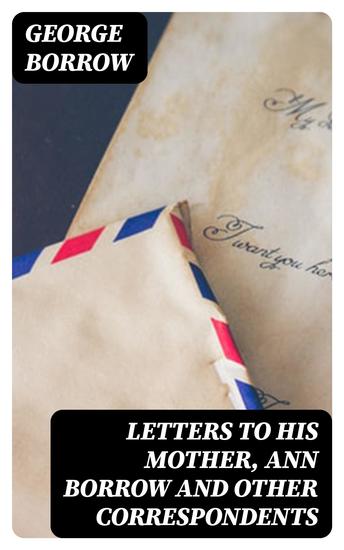
Letters to his mother Ann Borrow and Other Correspondents - cover

Letters to his mother Ann Borrow and Other Correspondents

George Borrow

Publisher: DigiCat

  • 0
  • 0
  • 0

Summary

In "Letters to his Mother, Ann Borrow and Other Correspondents," George Borrow offers an intimate glimpse into his life through a collection of heartfelt correspondences. Written in a style that is both candid and reflective, these letters traverse the landscape of 19th-century England, revealing Borrow's profound connections with family and friends. The text is imbued with personal anecdotes, literary insights, and a rich cultural commentary that highlights Borrow's experiences as an author, traveler, and translator. This compilation not only showcases Borrow's eloquence but also serves as a testament to the epistolary tradition while providing a contextual understanding of his literary milieu. George Borrow was a pioneering figure in English literature known for his passion for language and his exploration of diverse cultures. His travels across Spain and Portugal significantly influenced his renowned works, including "Lavengro" and "The Bible in Spain." The letters compiled in this volume offer insight into Borrow's motivations, fears, and joys, reflecting the complex emotional landscape of a man deeply affected by the world around him and his literary pursuits. This collection is highly recommended for readers seeking to understand the personal dimensions of Borrow's life and work. It is a vital resource for scholars of 19th-century literature and anyone intrigued by the interplay between an author's correspondence and their creative output. Through Borrow's letters, readers will glean a richer appreciation for his contributions to English literature and the nuanced experiences that shaped his narrative voice.
Available since: 09/16/2022.
Print length: 108 pages.
Other books that might interest you

  • Daughter of the Samurai - Unabridged - cover

    Daughter of the Samurai -...

    Etsu Inagaki Sugimoto

    • 0
    • 0
    • 0
    The autobiographical first novel by Etsu Inagaki Sugimoto, "A Daughter of the Samurai" tells the incredible true story of a young girl born into a high-status family in Nagaoka, Japan whose father, a samurai, is stripped of his power when the feudal system in Japan collapses and his family is thrown into turmoil and uncertainty.  Originally destined to become a priestess, young Etsu is instead betrothed to a wealthy Japanese merchant in Cincinnati, Ohio and makes the unlikely and culturally jarring journey from the Japanese countryside to the American Midwest during the 1880's.  Hailed by critics upon its original release, "A Daughter of the Samurai" is a fascinating, one-of-a-kind glimpse into a forgotten age. Etsu's insights, observations and descriptions of her life in Japan at this pivotal time in history - as well as her journey to America and back - is at once heartwarming, haunting and thrilling.
    Show book
  • A Successful Rehearsal - From their pens to your ears genius in every story - cover

    A Successful Rehearsal - From...

    Anthony Hope

    • 0
    • 0
    • 0
    Sir Anthony Hope Hawkins was born on 9th February 1863 in Clapton, London.  
    He was educated at St John's School, Leatherhead, Marlborough College and Balliol College, Oxford.  Hope trained as a lawyer and barrister and was called to the Bar by the Middle Temple in 1887. Despite what was thought to be a promising legal career he had literary ambitions and wrote in his spare time. 
    His early works appeared in various periodicals of the day but for his first book ‘A Man of Mark’ (1890), with no publisher interested, he published with his own resources.  
    More novels and short stories followed, including the mildly successful ‘Mr Witt's Widow’ in 1892. Hope even found time to run as the Liberal candidate for Wycombe in the election that same year but was unsuccessful. 
    His first major literary success came with ‘The Dolly Dialogues’, a collection of previously published magazine pieces followed very quickly by his instant classic, ‘The Prisoner of Zenda’. He now gave up the vestiges of his legal career to pursue writing full-time. 
    Despite never again reaching the same pinnacle of success he was popular and wrote prolifically across novels, plays and of course, short stories though his writing output rapidly diminished after the war. 
    In 1918 he was knighted for his contribution to propaganda efforts during World War I.  
    His short stories are delicate, mannered and often surprising with their wit, humour and interplay of characters who say one thing and usually mean another.  He was very definitely a writer of escapist rather than serious fare but they are no less enjoyable for that. 
    Anthony Hope died of throat cancer on 8th July 1933 at his country home, Heath Farm at Walton-on-the-Hill in Surrey. He was 70.
    Show book
  • Brothers in the Beloved Community - The Friendship of Thich Nhat Hanh and Martin Luther King Jr - cover

    Brothers in the Beloved...

    Marc Andrus

    • 0
    • 0
    • 0
    The never-before-told story of the friendship between Martin Luther King Jr. and Thich Nhat Hanh—icons who changed each other and the worldThe day after Martin Luther King Jr. was assassinated in 1968, Thich Nhat Hanh wrote a heartbroken letter to their mutual friend Raphael Gould. He said: "I did not sleep last night. . . . They killed Martin Luther King. They killed us. I am afraid the root of violence is so deep in the heart and mind and manner of this society. They killed him. They killed my hope. I do not know what to say. . . . He made so great an impression in me. This morning I have the impression that I cannot bear the loss."  Only a few years earlier, Thich Nhat Hanh wrote an open letter to Martin Luther King Jr. as part of his effort to raise awareness and bring peace in Vietnam. There was an unexpected outcome of Nhat Hanh's letter to King: The two men met in 1966 and 1967 and became not only allies in the peace movement, but friends. This friendship between two prophetic figures from different religions and cultures, from countries at war with one another, reached a great depth in a short period of time. Dr. King nominated Thich Nhat Hanh for the Nobel Peace Prize in 1967. He wrote: "Thich Nhat Hanh is a holy man, for he is humble and devout. He is a scholar of immense intellectual capacity. His ideas for peace, if applied, would build a monument to ecumenism, to world brotherhood, to humanity."The two men bonded over a vision of the Beloved Community: a vision described recently by Congressman John Lewis as "a nation and world society at peace with itself." It was a concept each knew of because of their membership within the Fellowship of Reconciliation, an international peace organization, and that Martin Luther King Jr. had been popularizing through his work for some time. Thich Nhat Hanh, Andrus shows, took the lineage of the Beloved Community from King and carried it on after his death.
    Show book
  • There Are Worse Things I Could Do - cover

    There Are Worse Things I Could Do

    Adrienne Barbeau

    • 0
    • 0
    • 0
    Adrienne Barbeau never set out to be a sex symbol and she never planned on giving birth to twins when she was 51 but both those stories and a lot more are detailed in this witty, revealing memoir. 
    From her early years as one of the first Go-Go girls in New York (“No one said Mafia out loud in those days. There was always the fear you wouldn’t live to say anything else.”) to starring on Broadway in Grease (“Alexander Cohen swore the only way we’d win a Tony was over his dead body”) Adrienne tells tales about her two hit television series (Maude and Carnivale), her many television and feature films (The Fog, Escape From New York, Cannonball Run, Swamp Thing, Creepshow), and her singing career (“Doc Severinson and the band had been in the audience during my nude foray off-Broadway in Stag Movie”).  With humour and fearlessness, she shares her romance with a superstar, her marriage to a famous film director, her marriage to a much younger man and her successful battle with infertility.
    ©2006 Codysmom, Inc.; (P)2006 Codysmom, Inc.
    Show book
  • Among the Firsts: Lieutenant Colonel Gerhard L Bolland's Unconventional War - D-Day 82nd Airborne Paratrooper OSS Special Forces Commander of Operation Rype - cover

    Among the Firsts: Lieutenant...

    Matthew T. Bolland

    • 0
    • 0
    • 0
    In his own words, the war of the doubly pioneering Lt Col Gerhard L. Bolland—82nd Airborne paratrooper on D-Day and senior OSS field operative on Operation Rype.Unconventional warfare tactics can have a considerable effect on the outcome of any war. During World War II, the United States government developed and employed two new methods of fighting. The first was the development of "paratroop" units, as they were first called. The second was the formation of a covert and sabotage operations branch called the Office of Strategic Services (OSS). Lt. Colonel Bolland was involved in both of these "firsts." During the D-Day invasion he parachuted behind enemy lines, jumping out of the 82nd Airborne lead aircraft with General James Gavin. After fighting with the 507th Parachute Infantry Regiment for thirty-three days straight, he returned to England and became involved with the OSS Scandinavian Section. He served as Field Commander for their Operation, code named Rype. This was the only American military undertaking, albeit covert, in Norway during the entire course of the war.  As a young boy growing up in rural western Minnesota, Bolland got his military start with the Minnesota National Guard, before being accepted to West Point, solely on merit. His military career lasted seventeen years. Lt. Colonel Bolland ended up with numerous decorations including the Norwegian Liberation Medal and Citation, the Bronze Star for valor, the French Fouragerre of Croix de Guerre with Palms and posthumously the Congressional Gold medal awarded to the OSS Society on behalf of all former OSS members that served during the war.  His story reveals the struggles, successes, failures and ultimate victories, detailing what went right and what went wrong with these new unconventional methods of fighting.
    Show book
  • A Voice from the Pit - From their pens to your ears genius in every story - cover

    A Voice from the Pit - From...

    Bernard Capes

    • 0
    • 0
    • 0
    Bernard Edward Joseph Capes was born on the 30th August 1854 in London.  He was one of 11 children. 
    His early work was as a journalist and this developed into writing many short stories for the periodicals of the time including Blackwood's, Cassell's, Cornhill Magazine, Illustrated London News, Macmillan's Magazine, Mall Magazine, Pearson's Magazine, The Idler, and The Queen. 
    It took him many years to decide that writing full-time could be a sustainable career path.  His initial success came with ‘The Mill of Silence’.  As well as being published it garnered second prize at a competition sponsored by the Chicago Record.  He exceeded that by winning it the following year with ‘The Lake of Wine’.   
    Capes quickly became both prolific and popular.  As well as his stories and articles for the periodicals he wrote around 40 volumes across novels, poetry, history as well as romance and mystery novels. 
    Bernard Capes died on 2nd November 1918 in the flu epidemic.
    Show book