Join us on a literary world trip!
Add this book to bookshelf
Grey
Write a new comment Default profile 50px
Grey
Subscribe to read the full book or read the first pages for free!
All characters reduced
Beyond the Old Frontier: Adventures of Indian-Fighters Hunters and Fur-Traders - Frontier Tales: Stories of Adventure Conflict and Exploration - cover

Beyond the Old Frontier: Adventures of Indian-Fighters Hunters and Fur-Traders - Frontier Tales: Stories of Adventure Conflict and Exploration

George Bird Grinnell

Publisher: Good Press

  • 0
  • 0
  • 0

Summary

In "Beyond the Old Frontier: Adventures of Indian-Fighters, Hunters, and Fur-Traders", George Bird Grinnell crafts a vivid narrative that immerses readers in the exhilarating yet tumultuous experiences of America's westward expansion. Drawing upon a rich tapestry of firsthand accounts, Grinnell artfully weaves together the adventures of iconic figures such as hunters, fur traders, and the military personnel who confronted Native American tribes. His narrative style is both engaging and informative, characterized by meticulous detail and an unflinching honesty about the challenges and moral complexities faced during this transformative period in American history. Grinnell's work serves not only as an adventure chronicle but as a poignant commentary on the cultural clashes that defined the Old Frontier. Grinnell, an ardent conservationist and a prominent figure in early anthropological studies, was deeply influenced by his experiences in the American West. His passion for Native American culture and wildlife preservation shaped his perspective, fostering a sense of urgency to document the stories of those who lived through this era. As a founder of the Audubon Society and a fervent advocate for the preservation of nature, Grinnell's background entrenched him in the realities of both exploration and exploitation, making his insights particularly poignant. This book is essential for historians, scholars, and any reader captivated by the rugged narratives of the American frontier. Grinnell's richly detailed prose not only entertains but also invites reflection on the complexities of conquest, survival, and cultural interplay. "Beyond the Old Frontier" is a compelling exploration that deserves a place on the shelves of anyone interested in the true stories that shaped America.
Available since: 10/31/2023.
Print length: 242 pages.


Other books that might interest you

  • The Dutch Empire - Their Domination of Global Commerce and Colonies - cover

    The Dutch Empire - Their...

    Kelly Mass

    • 0
    • 0
    • 0
    Don't think that because it is such a small country with only about 17 million people, it should be neglected. The Netherlands has a long history, with a high influence on our cultures, trading routes, the stock market, business, and art. 
    The Dutch were all over the world. They "owned" and colonized a big portion of what was then the known world. They were among the first settlers, had the biggest haven and biggest fleet for some time. The Dutch East-Indian Trading Company, or VOC, is probably the biggest or at least one of the biggest companies that has ever existed, with its shareholders, its ships, its spices and trading routes, and so much more. Learn more about what happened in the same area that's currently the United States, South Africa, Indonesia, and so many areas across the world. 
    In this book, we will begin with the Dutch settlers on the east coast of the United States, their settlements in Indonesia and other Asian countries, and their vast group of colonists in South Africa.
    Show book
  • AI EduMagic: Transforming Learning Forever - Revolutionize learning today with AI EduMagic! Dive into powerful audio lessons for peak performance - cover

    AI EduMagic: Transforming...

    Alden Thorne

    • 0
    • 0
    • 0
    ⭐⭐ AI EduMagic: Transforming Learning Forever ⭐⭐ 
    Are you aiming to advance your career and enhance your expertise in leveraging AI for revolutionary learning experiences? 
    Looking for a thorough guide that covers everything necessary to master AI in educational systems? 
    Your search ends here! 
    This audiobook is your ultimate companion for deepening your understanding, implementing your skills, and engaging in practical exercises. With this, you're set for success. 
    Key features of this comprehensive guide: 
    - Profound insights into the transformative power of AI in education 
    - Detailed explanations of how AI can be integrated into learning environments 
    - Effective strategies for preparing and excelling in AI-driven educational transformation 
    Our guide stands out with its in-depth coverage, crucial for mastering the impact of AI in education. Concepts are not merely glossed over; they are thoroughly explored with precision. 
    Please note that this guide is independent and is not affiliated with any official educational entity. 
    Designed with a clear structure and easy-to-understand language, our AI EduMagic guide ensures seamless transitions between topics. Say goodbye to dense jargon and embrace clear, precise, and technically accurate content. 
    So, why wait? Click the BUY NOW button to get your guide and embark on your journey to mastering AI in education!
    Show book
  • A Rare Recording of Joan Crawford - cover

    A Rare Recording of Joan Crawford

    Joan Crawford

    • 0
    • 0
    • 0
    Joan Crawford, born Lucille Fay LeSueur (March 23, 1904 - May 10, 1977) in San Antonio, TX, was an American dancer, businesswoman, and actress of 86 films. Crawford often played hardworking young women who find romance and financial success. Her films that were well received by Depression-era audiences and popular with women. By the 1930s, Crawford became one of Hollywood's most prominent movie stars—rivaling fellow actresses Norma Shearer and Greta Garbo. A three-time Academy Award Best Actress nominee, Crawford took home the Oscar for the 1945 film Mildred Pierce. In this 1971 recording, Crawford discusses filmmaking, her films, and her appearance at an upcoming AFI event in Washington, DC.
    Show book
  • Nazis after Hitler - How Perpetrators of the Holocaust Cheated Justice and Truth - cover

    Nazis after Hitler - How...

    Donald M McKale

    • 0
    • 0
    • 0
    The stories of thirty war criminals who escaped accountability, from a historian praised for his “well written, scrupulously researched” work (The New York Times).   This deeply researched book traces the biographies of thirty “typical” perpetrators of the Holocaust—some well-known, some obscure—who survived World War II. Donald M. McKale reveals the shocking reality that the perpetrators were rarely, if ever, tried or punished for their crimes, and nearly all alleged their innocence in Germany’s extermination of nearly six million European Jews. He highlights the bitter contrasts between the comfortable postwar lives of many war criminals and the enduring suffering of their victims, and how, in the face of exhaustive evidence showing their culpability, nearly all claimed ignorance of what was going on—and insisted they had done nothing wrong.   “McKale ends the book with a haunting question: whether life would be different today if the Allies had pursued Holocaust criminals more aggressively after WWII. History buffs and students of the Holocaust will be fascinated.” ―Publishers Weekly   “Gripping and important reading.” —Eric A. Johnson, author of What We Knew 
    Show book
  • The Illusionist - The True Story of the Man Who Fooled Hitler - cover

    The Illusionist - The True Story...

    Robert Hutton

    • 0
    • 0
    • 0
    Cairo, 1942: If you had asked a British officer who Colonel Clarke was, they would have been able to point him out. Always ready with a drink and a story, Clarke was a well-known figure in Cairo social circles and nightlife. If you then asked what he did, you would have less success. Those who knew didn't tell—and almost no one really knew at all. 


    Clarke thought of himself as developing a new kind of weapon. Its components? Rumor, stagecraft, a sense of fun. Its target? The mind of Erwin Rommel, Hitler's greatest general. Throughout history, military commanders have sought to mislead their opponents. Dudley Clarke set out to do it on a scale no one had imagined before. Even afterwards, almost no one understood the magnitude of his achievement. 


    Drawing on recently released documents and hugely expanding on the louche portrait of Clarke as seen in SAS: Rogue Warriors, journalist and historian Robert Hutton reveals the amazing story of Clarke's "A Force," the invention of the SAS and the Commandos, and the masterful hoodwinking of the Desert Fox at the battle of El Alamein. The Illusionist tells for the first time the dazzling tale of how, at a pivotal moment in the war, British eccentricity and imagination combined to thwart the Nazis and save innumerable lives—on both sides.
    Show book
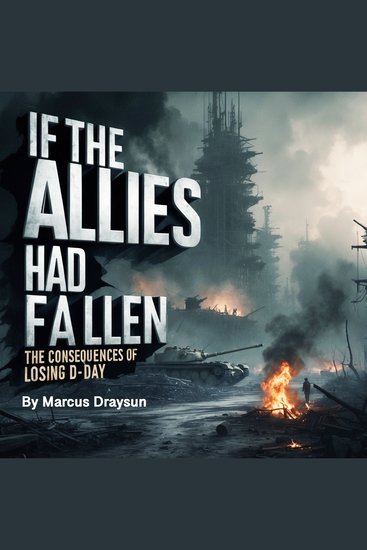
  • If the Allies Had Fallen - The Consequences of Losing D-Day - cover

    If the Allies Had Fallen - The...

    Marcus Draysun

    • 0
    • 0
    • 0
    The success of D-Day was never inevitable. The invasion of Normandy was the most ambitious military operation of the war, requiring precise coordination, secrecy, and an extraordinary amount of luck. The Allies knew that failure would not just be a setback—it could mean the prolonged survival of Nazi Germany and a vastly different world order. Every decision leading up to June 6, 1944, carried immense weight, as the fate of millions hung in the balance. 
    For months, Allied planners debated the best approach for opening a Western Front. The Soviets, engaged in brutal combat with German forces on the Eastern Front, pressured Britain and the United States to act quickly. Churchill, haunted by the disastrous Gallipoli campaign of World War I, feared the consequences of a premature landing. General Dwight D. Eisenhower, the Supreme Allied Commander, had to make the ultimate call: when and where to launch the largest amphibious invasion in history. 
    The chosen location—Normandy—was a calculated risk. Pas de Calais, the closest point between Britain and France, seemed like the most obvious target, and the Germans heavily fortified it. By contrast, Normandy’s beaches offered a less expected but still formidable challenge. Hitler’s Atlantic Wall, a vast network of bunkers, mines, and obstacles, was designed to repel any invasion. The Germans had tens of thousands of troops stationed along the coast, and if they had guessed the true landing site, they could have crushed the invasion before it gained a foothold.
    Show book