Join us on a literary world trip!
Add this book to bookshelf
Grey
Write a new comment Default profile 50px
Grey
Subscribe to read the full book or read the first pages for free!
All characters reduced
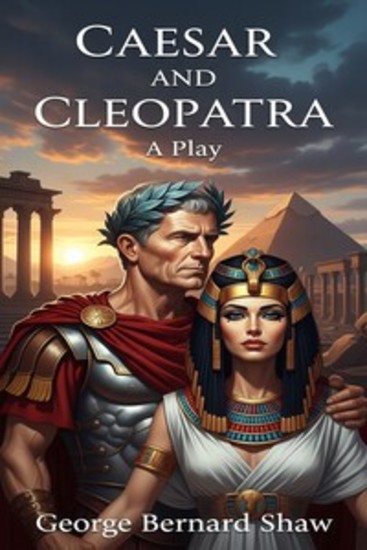
Caesar and Cleopatra - cover

Caesar and Cleopatra

George Bernard Shaw

Publisher: Bu Classics Books

  • 0
  • 0
  • 0

Summary

History is reimagined with razor-sharp wit as an aging Roman conqueror meets the young, ambitious queen of Egypt in a desert full of political maneuvering. Far from a tragic romance, this play dissects the nature of power and mentorship, revealing the human frailty behind legendary figures.
Available since: 03/05/2026.
Print length: 147 pages.

Other books that might interest you

  • Voices of Poetry Volume 2 - cover

    Voices of Poetry Volume 2

    Edna St. Vincent Millay, Ezra...

    • 0
    • 0
    • 0
    Hear rare recordings from some of the world's most-respected poets reading their own works: Ezra Pound, Old Men With Beautiful Manners; William Butler Yeats, The Lake Isle Of Innisfree; Robert Graves, A Last Poem; Edna St. Vincent Millay, The Harp-Weaver; Richard Eberhart, The Groundhog; Philip Levine, Blasting from Heaven; Marianne Moore, The Mind is an Enchanting Thing; Stephen Spender, What I Expected; Vachel Lindsay, An Interpolation by Mr. Lindsay. 
    Recording obtained and published by Rick Sheridan. 
    ©2009 Rick Sheridan (P)2009 Rick Sheridan
    Show book
  • The Poetry of Edwin Arlington Robinson - Three time Pultizer prize winner and four time Nobel prize nominee A true legend - cover

    The Poetry of Edwin Arlington...

    Edwin Arlington Robinson

    • 0
    • 0
    • 0
    Edwin Arlington Robinson was born on the 22nd December 1869 in Tide in Lincoln County, Maine.  
    His childhood was described by him as ‘stark and unhappy’.  His name was drawn out of a hat from a fellow vacationer from Arlington Massachusetts when fellow holiday makers decided that his parents had waited long enough at 6 months to name him.  It was a name he despised and reflects the station to which his parents had placed him; their great hope at his birth were that he was a girl to complement their two sons. 
    His pessimistic mood carried him to adulthood and a doomed encounter with Emma Loehen Shepherd who constantly encouraged his poetry.  Edwin was thought too young to be her companion and so his elder, middle brother, Herman was assigned to her.  It was a great blow to Edwin and during their marriage on February 12th, 1890, he stayed home and wrote ‘Cortege’ 
    In the fall of 1891 Edwin entered Harvard, taking classes in English, French and Shakespeare.  He felt at ease with the Ivy League and made great efforts to be published in one of the Harvard literary journals.  Indeed, the Harvard Advocate published ‘Ballade of a Ship’ but then his career appeared to stall.  His father died and although he returned to Harvard for a second year it was to be his last but also the start of some life-long friendships. 
    In 1893 he returned to Gardiner Maine as the man of the household.  Herman by this time had become an alcoholic, having suffered business failures, and was now to become estranged from Emma. 
    Edwin began farming whilst he wrote and quickly developed a close relationship with Emma who had now moved back to Gardiner after Herman’s death with her children. 
    Although he proposed twice, he was rejected and in consequence moved to New York to start afresh. 
    But it was a salutary experience. Although surrounded by artists he had little money and life was difficult. 
    In 1896 he published his own book, ‘The Torrent and the Night Before’, paying 100 dollars for 500 copies.  Edwin wanted it to be a surprise for his Mother, but days before its arrival she died of diphtheria. 
    His second volume, ‘The Children of the Night’, had a wider circulation.  At the behest of President Roosevelt, whose son was an avid admirer, he was given a job in 1905 at the New York Customs Office although it appears his real job was “to help American letters”. 
    Either way his success began to widen and his influence prosper.  During the 1920s he won the Pulitzer Prize for Poetry on three separate occasions. In 1922 for ‘Collected Poems’ again in 1925 for ‘The Man Who Died Twice’ and finally in 1928 for ‘Tristram’. 
    During the last twenty years of his life he became a regular summer resident at the MacDowell Colony in New Hampshire, where he became the object of fascination by several women.  But he never married. 
    Edwin Arlington Robinson died of cancer on the 6th April 1935 in the New York Hospital in New York. He was 65.
    Show book
  • Poems about Paintings - cover

    Poems about Paintings

    James Sey

    • 0
    • 0
    • 0
    This chapbook of poetry and prose pieces reflects philosophically and aesthetically on the relationships between art and the world, including through the global experience of Covid-related lockdowns. Though generally following an extended haiku-like format, some are longer prose poems, and an extended verse poem reflects on the city where the author lives, Johannesburg, South Africa.
    Show book
  • The Poet Who Sleeps - cover

    The Poet Who Sleeps

    Walter Savage Landor

    • 0
    • 0
    • 0
    LibriVox readers bring you 13 versions of The Poet Who Sleeps by Walter Savage Landor. This was the weekly poetry project for December 1, 2013.
    Show book
  • I Saw Satan at the 7-Eleven - cover

    I Saw Satan at the 7-Eleven

    Christopher Brett Bailey

    • 0
    • 0
    • 0
    This audiobook is performed by its author, Christopher Brett Bailey, a cult figure in experimental theatre, known for his 'vivid and vicious' (Guardian) storytelling. His original performance of this play onstage at Soho Theatre was acclaimed as 'a joyously lurid gonzo monologue . . . a sort of crazed neo-beatnik equivalent of Charles Dickens's celebrated recitals' by Time Out.
    
    'No one tells a story like Christopher Brett Bailey.' Guardian
    
    
    He was dressing low-profile, but it was definitely him: red skin, horns, barbed tail, cloven hoofs, black goatee. He was unmistakable. Satan was buying soy milk and forty bucks' worth of unleaded fuel.
    
    
    In a small town two miles north of Hell, our deadbeat narrator spots Satan filling up his red Corvette at the 7-Eleven. Satan's a washed-up has-been who's totally lost his edge . . . but when their eyes meet across the parking lot, the two embark on a torrid romance, by turns screwball, surreal, terrifying and tender.
    
    
    'As transgressive as it is playful . . . It's lurid and gruesome but also, in its way, an act of veneration: to language . . . We're in a world of dive bars, gas stations and seedy motels, a collectively recognisable America of the imagination, through which the devil dances.' Natasha Tripney
    
    
    'Christopher Brett Bailey could read the Argos catalogue and have an audience hang on his every word.' The Play's the Thing
    
    Portions of this audiobook contain mature language and graphic descriptions. Listener discretion is advised.
    
    
    Christopher Brett Bailey's electrifying monologue premiered at Soho Theatre, London, in April 2026.
    Show book
  • Tenebrae - A Memoir of Love and Death - cover

    Tenebrae - A Memoir of Love and...

    Dan Flanigan

    • 0
    • 0
    • 0
    Tenebrae is the ancient Latin word for darkness—the gradual extinguishment of light, one candle flame at a time. 
      
    In this memoir told in poems, Dan Flanigan follows that gradual dimming through the last illness and death of his wife. Written in free verse and prose poems, Tenebrae moves across the full arc of a long marriage. These poems refuse the familiar consolations. There is no posturing, no preciousness, no self-pity. A dying woman is rendered as fully human—strong, flawed, dignified, unmistakably herself—and the speaker does not cast himself as hero.  
      
    Other poems in the book reflect this same grappling with the fundamental issues of our lives—loss, hope, despair and acceptance, reflecting a compassionate embrace of the human condition. 
       
    If you think you don’t like poetry, Tenebrae may change your mind. 
    These are truly poems for the people—plain but exquisitely crafted and expressed in a language that is both elegant and easy to understand… They reach from the heart to the heart.
    Show book