Join us on a literary world trip!
Add this book to bookshelf
Grey
Write a new comment Default profile 50px
Grey
Subscribe to read the full book or read the first pages for free!
All characters reduced
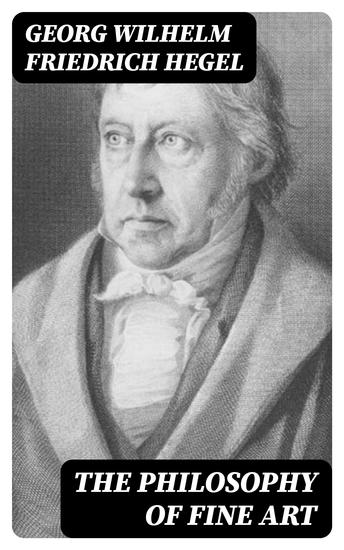
The Philosophy of Fine Art - Volume 1-3 - cover

The Philosophy of Fine Art - Volume 1-3

Georg Wilhelm Friedrich Hegel

Translator Francis Plumptre Beresford Osmaston

Publisher: DigiCat

  • 0
  • 0
  • 0

Summary

In "The Philosophy of Fine Art," Georg Wilhelm Friedrich Hegel offers a profound exploration of aesthetics and the nature of art within the framework of his idealist philosophy. This seminal work, published in the early 19th century, delves into the evolution of artistic expressions, examining how art embodies the unfolding of human consciousness and spirit. Hegel engages with various artistic forms—painting, sculpture, music, and poetry—analyzing their historical significance and inherent dialectical development. His literary style intertwines rigorous philosophical inquiry with a deep appreciation for the nuances of artistic creation, situating art as a crucial component in the pursuit of absolute knowledge and self-realization. Hegel, a pivotal figure in German idealism, was heavily influenced by contemporary philosophical currents as well as the socio-political upheavals of his time. His engagement with figures like Kant and Fichte, along with the Romantic movement, helped shape his views on art as an expression of the sublime and the metaphysical. Hegel's belief in the transformative power of art reflects his broader philosophical system, where reality is understood as a dynamic process of development and reconciliation through conflict. This book is highly recommended for those seeking a deeper understanding of art's philosophical underpinnings. Hegel's insights offer an enriching perspective not only for scholars of philosophy and aesthetics but also for artists and art enthusiasts eager to grasp the intricate connections between artistic expression and human experience. "The Philosophy of Fine Art" is essential reading for anyone interested in the profound questions surrounding beauty, creativity, and the human condition.
Available since: 11/13/2022.
Print length: 1368 pages.


Other books that might interest you

  • Public Sector Marketing Pro - The Definitive Guide to Digital Marketing and Social Media for Government and Public Sector - cover

    Public Sector Marketing Pro -...

    Joanne Sweeney

    • 0
    • 0
    • 0
    Do you need to transform your communications department into a specialist digital and social media team? The newly revised Public Sector Marketing Pro is the definitive guide for government and public sector agencies, politicians, political parties and NGOs on how to successfully reach and engage with the public in the Digital Age. With over 20 years' experience in journalism, digital marketing, and communications, Joanne Sweeney highlights how communication has changed in our post-pandemic world. New and updated chapters include case studies from public health officials on how they modified their tactics as the public demanded more information quicker than ever before. This crash course in digital public engagement will teach you how to: 
    - Transform outdated communications strategy into agile digital plans 
    - Respond to the public in real time on social media-even if you're understaffed 
    - Effectively respond to crises online 
    - Leverage digital communications to meet your organisation's larger objectives 
    - Understand and adapt to the changes that occurred during the pandemic 
    Public Sector Marketing Pro is your ultimate training manual to becoming a skilled leader in your field and online.
    Show book
  • Outsourcing Duty - The Moral Exploitation of the American Soldier - cover

    Outsourcing Duty - The Moral...

    Bradley J. Strawser, Michael J....

    • 0
    • 0
    • 0
    Are contemporary soldiers exploited by the state and society that they defend? More specifically, have America's professional service members disproportionately carried the moral weight of America's war-fighting decisions since the inception of an all-volunteer force? In this volume, Michael J. Robillard and Bradley J. Strawser examine the question of whether and how American soldiers have been exploited in this way. 


    Robillard and Strawser offer an original theory of "moral exploitation"—the notion that persons or groups can be wrongfully exploited by being made to shoulder an excessive amount of moral weight. They make the case that this exploitation accurately describes the relationship between the United States and the members of its military, and offer an in-depth analysis of some of the exploitative and misleading elements of present-day military recruitment, the moral burdens soldiers often bear, and the stifling effect that a "Thank You for Your Service" and "I support the troops" culture has had on serious public engagement about America's ongoing wars. Robillard and Strawser offer a critique of the pernicious divide between military members and the civilians who direct them. They conclude by arguing for several normative and prudential prescriptions to help close this ever-widening fissure between the US and its military, and within the US itself.
    Show book
  • The Enigma Story - The Truth Behind the 'Unbreakable' World War II Cipher - cover

    The Enigma Story - The Truth...

    Dermot Turing

    • 0
    • 0
    • 0
    The Enigma cipher was supposed to be the German's impenetrable defence for its military communications against prying eyes during World War II. All manner of secrets were entrusted to it. When the Allies finally managed to crack the code, it heralded a turning point in the war. 
     
    This is the fascinating story of how the code was created, adopted by the Nazis, and finally broken. Dermot Turing, the nephew of the great codebreaker Alan Turing, explores the twists and turns of German encryption efforts from the end of World War I through to Hitler's demise and the great lengths to which the Allies went to break it. 
     
    The Enigma Story reveals the efforts of the codebreakers at Bletchley Park, the machines called 'bombes' specially designed to break it, and the vast resources devoted in America to decrypting German messages. From the cloak-and-dagger heroics of men like Hans-Thilo Schmidt and Gustave Bertrand to the brilliant mathematical discoveries of men like Henryk Zygalski and Dilly Knox to the fraught decision-making of Allied High Command, the battle for the code was at the heart of the Allied victory in World War II. 
     
    This extraordinary tale of intrigue, ingenuity and courage brings to life the complete story of the Enigma in a lively and entertaining narrative.
    Show book
  • Enquiry Concerning the Principles of Morals An - cover

    Enquiry Concerning the...

    David Hume

    • 0
    • 0
    • 0
    An Enquiry Concerning the Principles of Morals by David Hume is a philosophical work that explores the nature of morality and its foundation. Hume argues that morality is derived from human sentiments rather than reason. He rejects the idea of a priori moral principles and suggests that our moral judgments are based on our emotions and experiences. 
    Hume emphasizes the role of sympathy and benevolence in moral decision-making. He contends that our moral judgments are influenced by our ability to empathize with others and our desire to promote human happiness. Hume also discusses the importance of virtue and vice, arguing that these concepts are rooted in our social and emotional nature.
    Show book
  • School as a community - Researching leadership in Waldorf schools - cover

    School as a community -...

    Hans Passenier

    • 0
    • 0
    • 0
    In search of leadership in Waldorf schools.
    Leadership in Waldorf schools has a specific history. Whereas 40 years ago it was hardly allowed to formally exist because it represented power and hierarchy, now it is commonplace to have a headmaster, rector or director. In this book, Hans Passenier examines the development of leadership and organisation in Waldorf schools. He starts at the origins and finds principles that can help develop school organisations and their leadership in the future. In four parts, he unfolds the foundations, the tools to develop leadership and organisations and finally describes exercises to support that development as a school community.
    His thesis is that education is about children being diverse, having different abilities. Also that the educator should not be a carpenter, but a gardener. The image of the school as an organism is guiding, in which the school community is a place for the inner development of each individual in that school community.
    The horizontal and vertical dimensions guide the view of both leadership and organisational design.
    Show book
  • How to English: Idioms - A Practical Guide to Common Idiomatic Phrases - cover

    How to English: Idioms - A...

    David Tobin

    • 0
    • 0
    • 0
    Make your English more natural, colorful, and expressive. 
    Unlock the power of English idioms with this engaging and practical guide. How to English: Idioms offers clear explanations, real-life examples, and a wide variety of expressions to help you sound more fluent and confident. 
    Perfect for intermediate to advanced learners, educators, or anyone who wants to add personality and depth to their English, this audiobook makes idioms easy to understand—and even easier to use. 
    Whether you're learning for fun, study, or everyday conversation, this guide brings English to life, one idiom at a time.
    Show book