Join us on a literary world trip!
Add this book to bookshelf
Grey
Write a new comment Default profile 50px
Grey
Subscribe to read the full book or read the first pages for free!
All characters reduced
The Logic of Hegel - cover

The Logic of Hegel

Georg Wilhelm Friedrich Hegel

Translator William Wallace

Publisher: DigiCat

  • 0
  • 0
  • 0

Summary

In "The Logic of Hegel," Georg Wilhelm Friedrich Hegel articulates a groundbreaking framework for understanding logic and metaphysics that transcends traditional dichotomies. Employing a dialectical method, Hegel explores concepts such as being, essence, and notion, revealing how these ideas evolve through contradictions and resolutions. His dense prose, often challenging yet rewarding, reflects the complexity of thought found in German Idealism, making the text not just a study of logic, but a profound inquiry into the nature of reality itself. The work situates itself within the broader philosophical landscape of the early 19th century, engaging critically with predecessors like Kant while laying the groundwork for modern philosophy. Hegel, a pivotal figure in German Idealism, was significantly influenced by the tumultuous European milieu of his time, marked by the Enlightenment and Romanticism. His experiences as a teacher and theologian shaped his perspectives on the interconnectedness of thought and existence. "The Logic of Hegel" emerges from Hegel's quest to reconcile subjective experience with objective reality, channeling the influence of his predecessors while forging a uniquely self-reflective system of thought. This book is invaluable for readers aspiring to grasp the intricacies of Hegelian philosophy and the evolution of Western thought. Scholars, students, and anyone curious about the foundations of logic and metaphysics will find in Hegel's work a compelling invitation to explore the dialectical progression of ideas, making it a timeless addition to the intellectual canon.
Available since: 08/15/2022.
Print length: 384 pages.

Other books that might interest you

  • The Māori and the Pākehā - A History of New Zealand's Indigenous and Colonial Past - cover

    The Māori and the Pākehā - A...

    Lillian Brooks

    • 0
    • 0
    • 0
    The history of New Zealand is deeply shaped by the complex and evolving relationship between the Māori, the country’s Indigenous people, and the Pākehā, the European settlers who arrived in the 18th and 19th centuries. This history is one of resilience, conflict, adaptation, and, ultimately, an ongoing quest for reconciliation. Understanding this shared past is essential to appreciating modern New Zealand’s identity and the challenges that continue to shape its future. 
    The Māori, skilled navigators and settlers from Polynesia, developed a rich and sophisticated culture long before the arrival of Europeans. Their societal structures, traditions, and connection to the land formed the foundation of a thriving civilization. When Pākehā explorers and settlers arrived, they brought not only new technologies and trade but also new challenges. The introduction of muskets, Christianity, and foreign diseases altered the balance of power and drastically reshaped Māori society. 
    One of the most defining moments in New Zealand’s history was the signing of the Treaty of Waitangi in 1840. This agreement, meant to establish a partnership between Māori and the British Crown, instead became a source of lasting controversy due to differences in interpretation and breaches of its promises. In the decades that followed, land disputes, armed conflicts, and government policies led to the large-scale alienation of Māori land, significantly impacting Māori communities and their way of life.
    Show book
  • Reconciling - A Lifelong Struggle to Belong - cover

    Reconciling - A Lifelong...

    Scott Steedman, Larry Grant

    • 0
    • 0
    • 0
    It's taken most of Larry Grant's long life for his extraordinary heritage to be appreciated. He was born in a hop field outside Vancouver in 1936, the son of a Musqueam cultural leader and an immigrant from a village in Guangdong, China. In 1940, when the Indian agent discovered that their mother had married a non-status man, Larry and his two siblings were stripped of their status. With one stroke of the pen, they were disenfranchised—no longer recognized as Indigenous. 
     
    Reconciling is a series of conversations between Larry and writer Scott Steedman as they visit pivotal geographical places together. Larry tells the story of his life, including his thoughts on reconciliation and the path forward for First Nations and Canada. His life echoes the barely known story of Vancouver and spans key events of the last two centuries, including Chinese immigration and the Head Tax, the ravages of residential school and now Indigenous revival and the accompanying change in worldview. 
     
    When Larry talks about reconciliation, he uses the verb reconciling, an ongoing, unfinished process we're all going through. "I have been reconciling my whole life, with my inner self," he explains. "To not belong was forced upon me by the colonial society that surrounded me. But reconciling with myself is part of all that."
    Show book
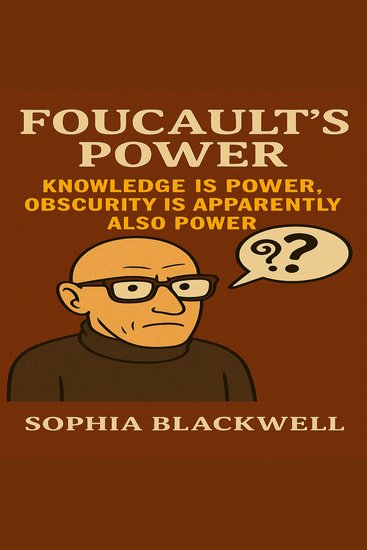
  • Foucault's Power - Knowledge Is Power Obscurity Is Apparently Also Power - cover

    Foucault's Power - Knowledge Is...

    Sophia Blackwell

    • 0
    • 0
    • 0
    Ever wondered why your college roommate wouldn't stop talking about "discursive formations" after one semester of critical theory? Curious how a bald Frenchman in a turtleneck became the patron saint of impenetrable academic writing? Want to understand Foucault without developing a migraine or a sudden urge to wear all black? 
    "Foucault's Power" is the antidote to pretentious philosophical obscurity you've been waiting for. This irreverent guide takes you on a sarcasm-soaked journey through Michel Foucault's most influential ideas—from his analysis of prisons and power to his baffling observations about sexuality and truth—all while mercilessly mocking the cult of incomprehensibility that has grown around him. 
    In these pages, you'll discover: 
    How Foucault transformed "people in power control information" into a revolutionary insight requiring 600 impenetrable pages 
    Why your open-plan office is actually a sophisticated surveillance mechanism (as if you needed another reason to hate it) 
    How Foucault managed to write extensively about sex without including a single useful tip 
    The convenient contradictions of a man who questioned all institutions while becoming the ultimate institutional insider 
    A bonus translation guide from Foucauldian jargon to human English! 
    Whether you're a confused student forced to read "Discipline and Punish," a curious reader wanting to understand what the fuss is about, or someone who enjoys watching intellectual pretension get skewered by razor-sharp wit, this book is your perfect introduction to the man who made simplicity unfashionable and gave academic writing permission to be terrible forever.
    Show book
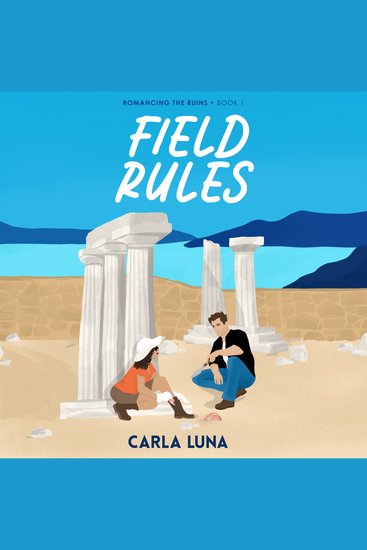
  • Field Rules - cover

    Field Rules

    Carla Luna

    • 0
    • 0
    • 0
    What happens in the field, stays in the field. Or does it? 
    After the disastrous way her first archaeological dig ended, graduate student Olivia Sanchez abandoned her dreams of working in the field. Now, thanks to a last-minute teaching opportunity in Cyprus, she’ll get another chance to explore ancient history firsthand. This time, failure isn’t an option. 
    But digging up the past takes on a whole new meaning when she’s forced to team up with her ex, shovel bum Rick Langston. 
    For years, Rick has proven his archaeological skills all over the Mediterranean. But with no graduate degree—and a habit of attracting trouble—his reputation could use a little rehab. All he has to do is play by the rules while he’s in Cyprus and he’ll secure a coveted recommendation for his next job. Until Olivia resurfaces like a cursed relic from the past. 
    Given that their last fling nearly led to their academic ruin, Olivia and Rick can’t afford to repeat their past mistakes. But as they work together under the scorching Mediterranean sun, the heat between them proves impossible to ignore.
    Show book
  • Are We Free Yet? - The Black Queer Guide to Divorcing America - cover

    Are We Free Yet? - The Black...

    Tina Strawn

    • 0
    • 0
    • 0
    "Liberation is ultimately a celebration of our deepest humanity, and our fight for it must include a deeper examination of how we relate to oppressive systems while centering our joy, peace, and pleasure." — Tina Strawn 
     
    Are We Free Yet? The Black Queer Guide to Divorcing America is simultaneously a personal reflection and a collective examination of our relationship to liberation and oppression. 
     
    In it, Tina Strawn, host of the Speaking of Racism podcast and Instagram platform of the same name, shares her intimate experiences of queerness and Blackness, heartbreak and loss, foreign and home, as she navigates and finds freedom. 
     
    Alongside Tina's personal journey through a year of challenging transitions, Are We Free Yet? offers an interactive guide to four pillars of activism: joy, liberation, pleasure, and connection. 
     
    From the role of cannabis to the importance of embracing our grief, this book offers a critical take on all it means to be an activist, offering deep reflection and discussions on race, social change, sex, and healing.
    Show book
  • Empedocles - The Four Elements and Cosmic Cycles - cover

    Empedocles - The Four Elements...

    Hector Davidson

    • 0
    • 0
    • 0
    Empedocles, a philosopher and poet from the ancient Greek city of Acragas (modern-day Agrigento, Sicily), lived during the 5th century BCE and is often regarded as one of the most original thinkers of his time. His life and works remain an intriguing fusion of science, mysticism, and poetry. Though much of what we know about Empedocles comes from fragments of his writings, his ideas have had a profound and lasting influence on philosophy, science, and even religion. 
      
    Empedocles is best known for his theory of the four elements—earth, air, fire, and water—which he posited as the fundamental building blocks of the universe. Unlike his predecessors, who sought to explain the world through a singular substance (such as water for Thales or air for Anaximenes), Empedocles argued that these four elements combined and separated through two cosmic forces: Love (Philia) and Strife (Neikos). Love brings the elements together, fostering harmony and unity, while Strife pulls them apart, creating division and chaos. This cyclical process of combination and separation underlies the ongoing changes in the cosmos. 
      
    In addition to his materialistic philosophy, Empedocles incorporated spiritual and mystical elements into his worldview. He believed in the transmigration of souls, suggesting that human beings and other living creatures are bound to an endless cycle of reincarnation. According to Empedocles, the soul is trapped in a cycle of birth, death, and rebirth, and it can achieve liberation through purification and virtuous living. His philosophical system thus integrated both natural and ethical concerns, urging individuals to live in harmony with the forces of the cosmos and pursue a life of virtue.
    Show book