Join us on a literary world trip!
Add this book to bookshelf
Grey
Write a new comment Default profile 50px
Grey
Subscribe to read the full book or read the first pages for free!
All characters reduced
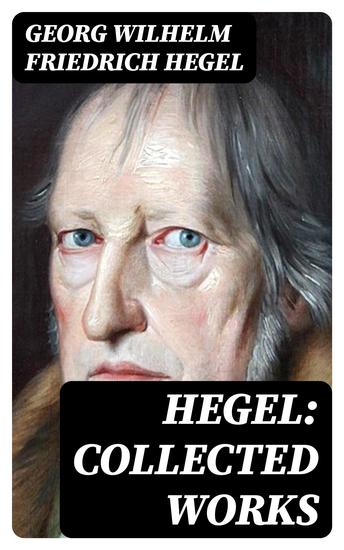
Hegel: Collected Works - Enriched edition Phenomenology of Mind Philosophy of Mind Aesthetics The Criticism of Hegle's Work and Hegelianism by Schopenhauer & Nietzsche Biography - cover

Hegel: Collected Works - Enriched edition Phenomenology of Mind Philosophy of Mind Aesthetics The Criticism of Hegle's Work and Hegelianism by Schopenhauer & Nietzsche Biography

Georg Wilhelm Friedrich Hegel

Translator William Wallace, J. B. Baillie, S. W. Dyde, F. P. B. Osmaston, Ebenezer Brown Speirs, Elizabeth Haldane

Publisher: DigiCat

  • 0
  • 0
  • 0

Summary

In 'Hegel: Collected Works', Georg Wilhelm Friedrich Hegel presents a comprehensive examination of dialectical reasoning and the development of human consciousness. This anthology reflects Hegel's profound engagement with themes such as history, art, religion, and philosophy, traversing through his signature dialectic method. Characterized by rigorous yet poetic prose, Hegel's writing challenges readers to grapple with abstract concepts while firmly rooting them in the socio-historical realities of his time, encouraging a more nuanced understanding of how individual and collective identities are formed. Hegel, a pivotal figure in German Idealism, was deeply influenced by the tumultuous intellectual and political climate of late 18th and early 19th century Europe, particularly the aftermath of the French Revolution. His philosophical endeavors were shaped by a desire to systematize the intricate relationships between freedom, ethics, and the unfolding of history. His background in theology and logic further informed his explorations, revealing the synthesis of thought and experience as central to his philosophical enterprise. I highly recommend 'Hegel: Collected Works' to any scholar or enthusiast seeking to delve into the complexities of Hegelian philosophy. This collection not only serves as an essential resource for understanding Hegel's contributions but also engages readers in a critical dialogue about the evolving nature of thought, making it a cornerstone for those exploring the realms of metaphysics and social theory.

In this enriched edition, we have carefully created added value for your reading experience:
- An Introduction draws the threads together, discussing why these diverse authors and texts belong in one collection.
- Historical Context explores the cultural and intellectual currents that shaped these works, offering insight into the shared (or contrasting) eras that influenced each writer.
- A combined Synopsis (Selection) briefly outlines the key plots or arguments of the included pieces, helping readers grasp the anthology's overall scope without giving away essential twists.
- A collective Analysis highlights common themes, stylistic variations, and significant crossovers in tone and technique, tying together writers from different backgrounds.
- Reflection questions encourage readers to compare the different voices and perspectives within the collection, fostering a richer understanding of the overarching conversation.
Available since: 05/18/2022.
Print length: 4992 pages.
Other books that might interest you

  • Let's Talk - An Essential Guide to Skillful Communication - cover

    Let's Talk - An Essential Guide...

    Mudita Nisker, Dan Clurman

    • 0
    • 0
    • 0
    Communication is the bedrock of our interactions, yet few of us are taught to talk and listen in a way that fosters clarity and connection. Too often, our communication habits lead to misunderstandings, bruised feelings, damaged relationships, and avoidable conflict. 
    Let’s Talk aims to change that. This practical guide gives you a wealth of skills you can use right now to improve your everyday conversations with loved ones, colleagues, and friends—no matter what you’re talking about. 
    These skills will help you: 
    • Address challenging topics with less stress and anxiety. 
    • Feel more confident expressing yourself. 
    • Influence others in respectful ways. 
    • Reduce friction in personal and professional relationships. 
    • Handle conflicts more constructively and with less messy fallout. 
    • Understand others more easily. 
    • Offer helpful support during tough times. 
    Drawing from psychology, sociology, learning theory, and spiritual traditions, Mudita Nisker and Dan Clurman’s unique, comprehensive approach to one-on-one communication is designed to be highly effective, yet easy to understand and to use. 
    Let’s Talk invites you to transform the way you relate to others—one conversation at a time.
    Show book
  • Developing and Implementing Effective Discipline Policies - A Practical Guide for Early Childhood Consultants Coaches and Leaders - cover

    Developing and Implementing...

    Sascha Longstreth, Sarah...

    • 0
    • 0
    • 0
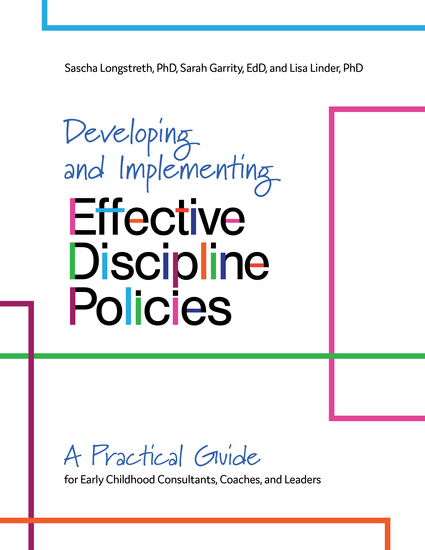
    Developing and Implementing Effective Discipline PoliciesA Practical Guide for Early Childhood Consultants, Coaches, and LeadersSascha Longstreth, PhD, Sarah Garrity, EdD, and Lisa Linder, PhD​Learn how to rethink discipline policies, strengthen team spirit, and implement policy changes with Developing and Implementing Effective Discipline Policies, the workbook companion to the award-winning book Effective Discipline Policies. Written for early childhood administrators and principals, trainers, coaches, and consultants, this book can help guide your policies to success!Using the five-step model, discover how to use the data gained from the unique Teaching and Guidance Policy Essentials Checklist (TAGPEC) tool to:• build teams• rethink discipline approaches• develop young children’s social-emotional competence to reduce challenging behaviors• train staff• implement school-wide policies• support continuous quality improvement effortsSuccessful behavior-guidance approaches in early childhood programs aren’t only possible, they are also highly successful! With this book you can ensure your students get the best guidance possible under thoughtful discipline policies aimed toward skill development and growth.
    Show book
  • Yuan Dynasty - Mongol Rule and the Blending of Cultures - cover

    Yuan Dynasty - Mongol Rule and...

    Rolf Hedger

    • 0
    • 0
    • 0
    The Yuan Dynasty emerged from the ambitions of Kublai Khan, the grandson of Genghis Khan, who sought to consolidate Mongol rule over China. Before the establishment of the Yuan, the Mongols had waged a relentless military campaign against the Song Dynasty, the ruling power in southern China. After decades of conflict, Kublai Khan successfully defeated the Song in 1279, marking the first time in history that all of China was under foreign rule. His ascension to the throne not only signified the dominance of the Mongols but also introduced a new era of governance that blended Mongol traditions with Chinese administration. 
    Kublai Khan declared himself emperor in 1271 and named his dynasty "Yuan," meaning "Great Origin," a term rooted in Chinese philosophy and symbolic of the vast scope of Mongol rule. Unlike his predecessors, who maintained a nomadic lifestyle, Kublai recognized the necessity of adopting Chinese customs to effectively govern a vast and diverse population. He moved the capital from Karakorum to Dadu, present-day Beijing, reinforcing his commitment to ruling as a Chinese emperor while still maintaining Mongol authority. His reign sought to balance the military-driven expansion of his ancestors with the complexities of ruling a settled, bureaucratic society. 
    Despite his efforts to integrate into Chinese political traditions, Kublai faced challenges in legitimizing his rule. Many Han Chinese viewed the Mongols as outsiders and resisted their authority. To solidify his claim, Kublai adopted Confucian principles and retained elements of the Chinese imperial structure, appointing Chinese officials in lower government positions while keeping key positions reserved for Mongols and trusted foreign allies. This approach ensured Mongol dominance while utilizing the administrative expertise of the Chinese.
    Show book
  • Michelangelo Buonarroti: A short biography - 5 Minutes: Short on time - long on info! - cover

    Michelangelo Buonarroti: A short...

    5 Minutes, 5 Minute Biographies,...

    • 0
    • 0
    • 0
    Michelangelo Buonarroti, painter and sculptor: Life and works in a short biography! Everything you need to know, brief and concise. Infotainment, education and entertainment at its best!
    Show book
  • Francis Drake: A short biography - 5 Minutes: Short on time - long on info! - cover

    Francis Drake: A short biography...

    5 Minutes, 5 Minute Biographies,...

    • 0
    • 0
    • 0
    Francis Drake, discoverer and His Majesty's privateer: Life and work in a short biography! Everything you need to know, brief and concise. Infotainment, education and entertainment at its best!
    Show book
  • The Importance of Being Urban - Designing the Progressive School District 1890-1940 - cover

    The Importance of Being Urban -...

    David A. Gamson

    • 0
    • 0
    • 0
    From the 1890s through World War II, the greatest hopes of American progressive reformers lay not in the government, the markets, or other seats of power but in urban school districts and classrooms. The Importance of Being Urban focuses on four western school systems—in Denver, Oakland, Portland, and Seattle—and their efforts to reconfigure public education in the face of rapid industrialization and the perceived perils of the modern city. In an era of accelerated immigration, shifting economic foundations, and widespread municipal shake-ups, reformers argued that the urban school district could provide the broad blend of social, cultural, and educational services needed to prepare students for twentieth-century life. These school districts were a crucial force not only in orchestrating educational change, but in delivering on the promise of democracy. David A. Gamson’s book provides eye-opening views of the histories of American education, urban politics, and the Progressive Era.
    Show book