Join us on a literary world trip!
Add this book to bookshelf
Grey
Write a new comment Default profile 50px
Grey
Subscribe to read the full book or read the first pages for free!
All characters reduced
Superiority and Subordination as Subject-Matter of Sociology - cover

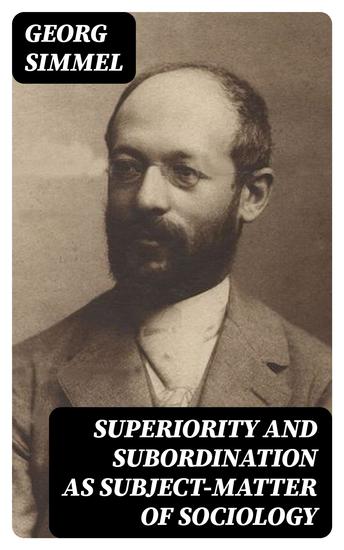
Superiority and Subordination as Subject-Matter of Sociology

Georg Simmel

Translator Albion Woodbury Small

Publisher: DigiCat

  • 0
  • 0
  • 0

Summary

In "Superiority and Subordination as Subject-Matter of Sociology," Georg Simmel presents a profound exploration of social hierarchies and the intricate dynamics of power within human relationships. Simmel employs a distinctive literary style that integrates philosophical inquiry with sociological analysis, meticulously dissecting the interplay of superiority and subordination as a core aspect of social life. This work is situated within the broader context of early 20th-century sociology, where thinkers began to examine societal structures beyond mere economic determinism, thus positioning Simmel as a pioneer in the field of social interaction and individual agency. Georg Simmel, a prominent German sociologist, philosopher, and cultural critic, was deeply influenced by the rapid social changes of his time, including modernity, urbanization, and industrialization. His diverse scholarly background encompassed philosophy and art, which shaped his unique perspective on society and individual experiences. Simmel's work often reflects his engagement with existentialism and aesthetics, making "Superiority and Subordination" a crucial text to understand the nuanced social constructs of power and identity. This book is highly recommended for students and scholars of sociology, as well as anyone interested in the complexities of social dynamics and power relations. Simmel's incisive analysis invites readers to reflect on the ubiquitous nature of superiority and subordination, fostering a deeper understanding of the implications these concepts have on contemporary societal interactions.
Available since: 09/15/2022.
Print length: 46 pages.


Other books that might interest you

  • Sounds of Other Shores - The Musical Poetics of Identity on Kenya's Swahili Coast - cover

    Sounds of Other Shores - The...

    Andrew J. Eisenberg

    • 0
    • 0
    • 0
    Sounds of Other Shores takes an ethnographic ear to the history of transoceanic stylistic appropriation in the Swahili taarab music of the Kenyan coast. Swahili taarab, a form of sung poetry that emerged as East Africa's first mass-mediated popular music in the 1930s, is a famously cosmopolitan form, rich in audible influences from across the Indian Ocean. But the variants of the genre that emerged in the Kenyan coastal city of Mombasa during the twentieth century feature particularly dramatic, even flamboyant, appropriations of Indian and Arab sonic gestures and styles. Combining oral history, interpretive ethnography, and musical analysis, Sounds of Other Shores explores how Swahili-speaking Muslims in twentieth-century Mombasa derived pleasure and meaning from acts of transoceanic musical appropriation, arguing that these acts served as ways of reflecting on and mediating the complexities and contradictions associated with being "Swahili" in colonial and postcolonial Kenya. The result is a musical anthropology of Kenyan Swahili subjectivity that reframes longstanding questions about Swahili identity while contributing to broader discussions about identity and citizenship in Africa and the Indian Ocean world.
    Show book
  • Life Skills For The Teenage Soul - The Ultimate Guide To Building Resilience and Independence - cover

    Life Skills For The Teenage Soul...

    Elizabeth E James

    • 0
    • 0
    • 0
    This audiobook is narrated by an AI Voice.   
    Navigating the teenage years isn’t easy, but you don’t have to do it alone. Life Skills for the Teenage Soul is your ultimate guide to mastering the essential skills every teenager needs for a fulfilling and successful life. Packed with practical advice, engaging activities, and relatable stories, this book covers everything from building self-awareness and managing emotions to creating healthy relationships and setting meaningful goals. 
    In a world filled with constant pressure and endless choices, this book is here to help you find your path, make confident decisions, and build the life you want. Learn how to: 
    - Understand yourself better and develop a strong sense of self-worth. 
    - Navigate the complexities of friendships, family dynamics, and social media. 
    - Master time management, financial literacy, and decision-making skills. 
    - Cultivate physical and mental well-being, building resilience and grit. 
    - Plan for your future, whether that means exploring career options or preparing for college. 
    Life Skills for the Teenage Soul is more than a self-help book—it’s a toolkit for personal growth, designed specifically for today’s teens. Whether you’re feeling overwhelmed or simply looking to level up your life, this book will guide you every step of the way. 
    Get ready to discover your true potential and take charge of your future. Your journey to a happier, healthier, and more confident you starts here.
    Show book
  • The Secrets of the Federal Reserve - cover

    The Secrets of the Federal Reserve

    Eustace Mullins

    • 0
    • 0
    • 0
    The Secrets of the Federal Reserve* by Eustace Mullins investigates the origins, structure, and influence of the U.S. Federal Reserve System, arguing that it was created not solely to stabilize the economy but to serve the interests of an elite banking group. Mullins traces the Reserve’s formation back to a secret meeting on Jekyll Island and explores how this institution has impacted U.S. and global economics. The book examines key figures, banks, and historical contexts behind the Reserve, presenting a controversial view that challenges mainstream narratives about its purpose and control. This work is often cited by those critical of centralized banking power and has sparked much debate in economic and historical circles.
    Show book
  • PMP Pro: Transform Your Exam Success with Game-Changing Secrets - "Elevate your PMP exam results! Dive into transformative audio lessons for peak performance on test day" - cover

    PMP Pro: Transform Your Exam...

    Arden Blakewood

    • 0
    • 0
    • 0
    PMP Pro: Transform Your Exam Success with Game-Changing Secrets 
    ⭐⭐ Simplified Guide & Explanations Included ⭐⭐ 
    Are you eager to advance in your career and solidify your knowledge by successfully passing the PMP Exam 2024-2025?  
    In search of a complete guide that offers everything needed to conquer the PMP Exam 2024-2025? 
    Your quest concludes here! 
    This guide acts as your ultimate companion for enhancing your understanding, honing your skills, and engaging in practical exercises. With this resource, you’re on the path to success. 
    Updated for the PMP 2024-2025 Exam Structure. 
    Key features of this comprehensive guide: 
    - In-depth insights into the PMP Exam 2024-2025 Certification 
    - Thorough explanation of mastering project management skills for career advancement success 
    - Effective strategies for exam preparation and problem-solving 
    Our guide stands out due to its extensive coverage, which is crucial for your exam triumph. Concepts are explored in-depth, ensuring clarity and comprehension. 
    Please be aware that this guide is independent and not affiliated with any official PMP organization. It serves solely for your benefit. 
    Crafted with a straightforward structure and accessible language, our PMP Exam Guide 2024-2025 ensures seamless transitions between topics. Bid farewell to complex jargon and embrace clear, accurate, and technically sound content.  
    So, why hesitate? Click the BUY NOW button, secure your guide, and embark on your journey to success in the PMP Exam 2024-2025!
    Show book
  • How We Got Our Antiracist Constitution - Canonizing Brown v Board of Education in Courts and Minds - cover

    How We Got Our Antiracist...

    Jesse Merriam

    • 0
    • 0
    • 0
    Over the past decade, several American cities have been rocked by race riots. With each passing year, a new racial agenda emerges—from police defunding to education reform to reparations—inciting more and more division and radicalization along racial lines. What started all of this? The roots of this pathology run much deeper than the recent symptoms suggest. The civil rights revolution unleashed an assault on the US Constitution, and the sacralization of that revolution, marked by the canonization of Brown v. Board of Education (1954), has transformed our constitutional order. A system once rooted in local self-governance and natural rights now operates along new moral axes, entirely foreign to the American way of life. The choice is increasingly obvious: Either the traditional American order or the new civil rights regime will prevail.
    Show book
  • Herod the Great - Jewish King in a Roman World - cover

    Herod the Great - Jewish King in...

    Martin Goodman

    • 0
    • 0
    • 0
    A vivid account of the political triumphs and domestic tragedies of the Jewish king Herod the Great during the turmoil of the Roman revolution 


    Herod the Great (73–4 BCE) was a phenomenally energetic ruler who took advantage of the chaos of the Roman revolution to establish himself as a major figure in a changing Roman world and transform the landscape of Judaea. Both Jews and Christians developed myths about his cruelty and rashness: in Christian tradition he was cast as the tyrant who ordered the Massacre of the Innocents; in the Talmud, despite fond memories of his glorious Temple in Jerusalem, he was recalled as a persecutor of rabbis. 


    The life of Herod is better documented than that of any other Jew from antiquity, and Martin Goodman examines the extensive literary and archaeological evidence to provide a vivid portrait of Herod in his sociopolitical context: his Idumaean origins, his installation by Rome as king of Judaea and cultivation of leading Romans, his massive architectural projects, and his presentation of himself as a Jew, most strikingly through the rebuilding of the Jerusalem Temple. Goodman argues that later stories depicting Herod as a monster derived from public interest in his execution of three of his sons after dramatic public trials foisted on him by a dynastic policy imposed by the Roman emperor.
    Show book