Join us on a literary world trip!
Add this book to bookshelf
Grey
Write a new comment Default profile 50px
Grey
Subscribe to read the full book or read the first pages for free!
All characters reduced
Addresses in America 1919 - Exploring Democracy and Social Justice Through Literary Insights - cover

Addresses in America 1919 - Exploring Democracy and Social Justice Through Literary Insights

Galsworthy John

Publisher: Good Press

  • 0
  • 0
  • 0

Summary

In "Addresses in America, 1919," John Galsworthy presents a compelling collection of speeches and lectures that reflect not only his literary prowess but also the socio-political climate of post-World War I America. Galsworthy employs a keenly observant and articulate style, merging narrative grace with a persuasive rhetorical approach. This work transcends mere documentation; it delves into themes of democracy, social justice, and the human condition, resonating with the burgeoning modernist movements of the early 20th century. His reflections serve as a poignant commentary on the shifting landscape of American society amid profound global change. John Galsworthy, an eminent British author known for his insights into social issues, was moved by the aftermath of the Great War and the evolving American ethos. His experiences traveling through a transformative America in the wake of the conflict, along with his own inquiries into the societal challenges of his time, spurred him to confront pressing issues through the lens of his sharp intellect and humane sensibility. Galsworthy's literary background, including the creation of the Forsyte Saga, underlines his ability to engage readers in thoughtful discourse. This work is essential for those seeking a nuanced understanding of early 20th-century America and its challenges. Galsworthy's eloquence and insightful observations encourage readers to reflect on the relevance of his messages today. Whether one is a student of literature, history, or sociology, "Addresses in America, 1919" promises to enrich your perspective and provoke thoughtful dialogue.
Available since: 07/10/2023.
Print length: 52 pages.

Other books that might interest you

  • Reclaim Your Life After Trauma - The Power of Goal Setting - cover

    Reclaim Your Life After Trauma -...

    PhD Stephanie M. Hutchins

    • 0
    • 0
    • 0
    Trauma is stealing so much from you. Enough is enough! 
    Do you feel like the gut-wrenching heartache from your trauma will never end? Do you want to move forward but don’t know where to begin? This book will provide you the tools and strategies you need to break free from the shackles of your traumatic past. You’ll discover the power of goal setting and how it allows you to envision a life that is different from the one you’re familiar with. 
    Regardless of where you're at in your healing journey, Reclaim Your Life After Trauma will provide you with practical tools that you can begin utilizing immediately to change how you’re experiencing life. This book will walk you through the steps on how to:Choose one aspect of your life to work on first.Create a plan for tackling your chosen goal.Prepare yourself for the roadblocks along the way.Replace habits and beliefs that will impede your progress. 
    Whether your goal is to brush your teeth each day, stop a destructive habit, change careers, or climb Mount Everest, you’ll finish feeling filled with hope and the belief that you can tackle any obstacle that life throws at you, including your trauma.
    Show book
  • Playing Possum - How Animals Understand Death - cover

    Playing Possum - How Animals...

    Susana Monsó, Mark Rowlands

    • 0
    • 0
    • 0
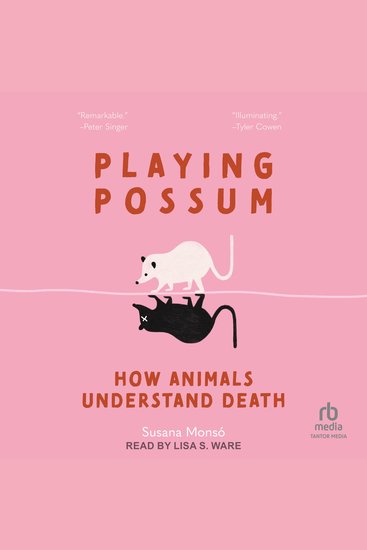
    When the opossum feels threatened, she becomes paralyzed. Her body temperature plummets, her breathing and heart rates drop to a minimum, and her glands simulate the smell of a putrefying corpse. Playing Possum explores what the opossum and other creatures can teach us about how we and other species understand mortality, and demonstrates that the concept of death, far from being a uniquely human attribute, is widespread in the animal kingdom. 


    With humor and empathy, Susana Monsó tells the stories of ants who attend their own funerals, chimpanzees who clean the teeth of their dead, dogs who snack on their caregivers, crows who avoid the places where they saw a carcass, elephants obsessed with collecting ivory, and whales who carry their dead for weeks. Monsó, one of today's leading experts on animal cognition and ethics, shows how there are more ways to conceive of mortality than the human way, and challenges the notion that the only emotional reactions to death worthy of our attention are ones that resemble our own. 


    Blending philosophical insight with new evidence from behavioral science and comparative psychology, Playing Possum dispels the anthropocentric biases that cloud our understanding of the natural world, and reveals that, when it comes to death and dying, we are just another animal.
    Show book
  • Circus Maximus and the Colosseum The: The History of Ancient Rome’s Most Famous Sports Venues - cover

    Circus Maximus and the Colosseum...

    Editors Charles River

    • 0
    • 0
    • 0
    The ambitious and fearless emperors that built the legendary Roman Empire from scratch, the broad-shouldered and bronzed gladiators with their iconic plume helmets and glinting swords, and elaborate parties attended by toga-wearing Romans fueled by alcohol, violence, orgies, and other godless acts all paint a picture of Roman life. 
    At the Circus Maximus, the guttural cheers of the spectators reverberated across the enormous open space, but their cries could hardly be heard over the rumble of the ground. On the ellipse-shaped track, 5 charioteers would skew their bodies and steer their magnificent vehicles around the curves. Gusts of sand and dirt flew up from the whizzing wheels and encircled the pounding hooves of the stunning stallions. Distracted personnel and guards dragging their feet were considered fair game. As one chariot careened to the side, preparing to collide with another chariot, a row of guards might have to try to duck out of the way in the nick of time. Some would be trampled by hooves. Chariot races were dangerous for participants too. A charioteer could become disoriented and fail to position himself as his horses moved instinctively, sending his body catapulting forward out of the chariot. Needless to say, chariot racing in Rome was a nail-biting spectacle. 
    When the Colosseum was built in the late 1st century A.D., the Romans, a people known for their architectural acumen, managed to amaze themselves. Martial believed the Colosseum was so grand a monument that it was even greater than the other Wonders of the Ancient World, which had been written about and visited endlessly by the Romans and Greeks in antiquity. The Colosseum was a spectacular achievement in architecture, something new and innovative, and therefore an amazing “Wonder” in its own way. The Colosseum is a large stadium even by today’s standards, and its great size conveys the power of the empire as it dominates the landscape and towers over nearby buildings.
    Show book
  • The Moral Sayings of Publius Syrus - cover

    The Moral Sayings of Publius Syrus

    Publius Syrus

    • 0
    • 0
    • 0
    The Moral Sayings of Publius Syrus, A Roman Slave is a collection of proverbs and aphorisms pulled from the many mimes and plays of Publius Syrus. Enslaved by the Romans in his youth, this witty man went on to conquer the Roman stage. These maxims, believed to have been collected in the 1st century AD, are all that remain of the great playwright’s work. Born in Syria in the 1st century BC, Publius Syrus was enslaved and brought to Rome by an army officer after the Romans conquered his native country. It was in Rome that he was given the name of Syrus, for his place of origin. He was then around 12 years old.This soldier had a patron who was delighted with the boy and requested that the soldier give Syrus to him. The soldier complied. Syrus’ new master found the boy witty and bright and was often entertained with his commentary. With such promise, the master provided Syrus with an education and later freed him. Syrus was immensely grateful and remained friends with his former master for the rest of his life. He took the surname Publius, which was probably the surname of his master.Newly free, Syrus traveled to Italy and began composing mimes—comical farces often used to “represent the failings and eccentricities of the higher classes, and the vulgar language and solecisms of the lower.” This combination of humor and moralism was widely popular among the Romans of the time, and Syrus earned great acclaim as a poet and actor. None of the great master’s plays have survived the ensuing centuries. But fortunately, many of his pithy maxims were collected from his plays, probably in the 1st century AD, and gathered into a single volume. This collection was translated from the Latin and first published in 1856.Included among the 1,087 proverbs are some that appear to be the foundation—or at least an early version—of sayings we still use today. While additional context regarding these quotes would be useful, they still have value on their own. These 1,087 proverbs
    Show book
  • Take Charge and Move Out: The Founding Fathers of TACAMO - True Believers and the Rise of Navy Strategic Communications - cover

    Take Charge and Move Out: The...

    Lewis McIntyre

    • 0
    • 0
    • 0
    The birth of the US Navy’s “Take Charge and Move Out” (TACAMO) mission which provides essential airborne communications to the US nuclear deterrence forces.The US Navy’s “Take Charge and Move Out” (TACAMO) mission provides essential airborne communications to the US nuclear deterrence forces. Today it is a thriving community, respected by the Navy and the US strategic defense forces. But it wasn’t always so. Despite the enormous importance of the mission, for the first decade of their existence, the TACAMO squadrons did not provide a viable career path for officers, instead being a “one and done” tour for the junior officers who found themselves unluckily so assigned. A second tour in the squadrons was considered to be professional suicide. But in 1975, inspired by a significant commanding officer, a handful of lieutenants put their faith in a community that did not yet exist, betting their careers on that second tour. From their faith and courage was born the TACAMO community. This is the story of the birth of TACAMO, in the words of those who built the community from scratch.
    Show book
  • Belonging - A History of Indian South Africans - cover

    Belonging - A History of Indian...

    Ashwin Desai, Goolam Vahed

    • 0
    • 0
    • 0
    What does it mean to belong?Across oceans and centuries, this sweeping narrative shuttles between the corridors of the Colonial Office in London, the contested streets of Durban, and the changing power dynamics within the British Raj. The first boatload of indentured Indians arrived in Natal in 1860. Thousands were to follow. In haunting detail, the book captures the plight of these labourers as well as the vicious onslaught faced by the merchant class for daring to outpace their colonial rivals. At its core are the untold struggles of Indian South Africans as they confront the ever-present threat of repatriation.Sensitive to shifting political terrains, the book weaves together seismic events – the independence of India, the coming of apartheid and the threat once more of mass expulsions – with the texture of everyday life. The granting of citizenship in 1961 is accompanied by mass relocations as the Group Areas Act rips communities from their roots. Yet, out of this despair, barren townships on the edges of cities are turned into places of hope.In the final chapters, the fall of apartheid offers a moment of transcendence. Yet it also asks: what does it mean, at last, to belong? It is a fascinating story of the global and the local, of resistance and collaboration, and undefeated optimism. This is a book for anyone who has ever sought a place to
    Show book