Join us on a literary world trip!
Add this book to bookshelf
Grey
Write a new comment Default profile 50px
Grey
Subscribe to read the full book or read the first pages for free!
All characters reduced
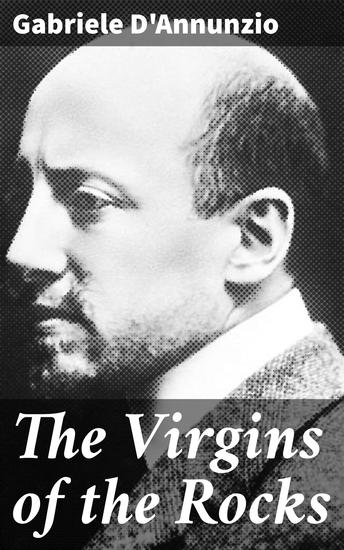
The Virgins of the Rocks - Decadence Desire and Dark Secrets in 19th Century Italy - cover

The Virgins of the Rocks - Decadence Desire and Dark Secrets in 19th Century Italy

Gabriele D'Annunzio

Translator Agatha Hughes

Publisher: Good Press

  • 0
  • 0
  • 0

Summary

Gabriele D'Annunzio's "The Virgins of the Rocks" is a provocative exploration of sensuality, spirituality, and the intersection of nature and human desire, written in lush, poetic prose that characterizes D'Annunzio's literary style. This work reflects the author'Äôs fascination with the Art Nouveau movement and its emphasis on beauty and aesthetic experience, delving into themes of idealized femininity and the psychological contours of art. The book, set against a backdrop of vivid, natural imagery, evokes a kaleidoscopic vision of eroticism intertwined with the divine, capturing the tensions of early 20th-century Italian society and culture within its richly textured narrative. D'Annunzio, a central figure in the Italian literary scene, was not only a poet and playwright but also a political figure and a fervent nationalist, whose experiences shaped his artistic vision. His life, marked by personal tragedy, passionate relationships, and profound artistic ambition, infused his writing with a sense of urgency and existential inquiry. "The Virgins of the Rocks" can be seen as a culmination of D'Annunzio's earlier works and his relentless quest for artistic and spiritual transcendence. Readers interested in the interplay of art, love, and nature will find "The Virgins of the Rocks" to be a compelling addition to their literary exploration. Its rich tapestry of themes and intricate characterizations invites deep contemplation on the nature of beauty and desire. Highly recommended for those seeking not only to understand D'Annunzio'Äôs contributions but also to engage with the broader currents of European literary modernism.
Available since: 08/21/2022.
Print length: 155 pages.
Other books that might interest you

  • Mouse the Bird and the Sausage The - Story Time Episode 41 (Unabridged) - cover

    Mouse the Bird and the Sausage...

    Brothers Grimm

    • 0
    • 0
    • 0
    The Mouse, the Bird, and the Sausage live happily together. The Bird brings home wood from the forest; the Mouse delivers water, makes the cooking fire, lays the table; and the Sausage cooks. One day, the Bird has a chat with some other birds. They make fun of the Bird, saying that it was doing all the work and that he was like a slave. The next day, the Bird suggests that they switch roles and refuses to go to the forest.
    Show book
  • The Ugly Duckling and Other Stories - cover

    The Ugly Duckling and Other Stories

    Hans Christian Andersen

    • 0
    • 0
    • 0
    First published as "Den Grimme Ælling" in 1843, The Ugly Duckling is one of the best-known and well-loved fairy tales of the Danish poet and author Hans Christian Andersen. An unusual looking young duck is bullied by the other barnyard inhabitants and wanders the world trying to find where he can fit in. This collection also includes The Naughty Boy, The Leaping Match and Sunshine Stories.
    Show book
  • Aristopia: a Romance-History of the New World - cover

    Aristopia: a Romance-History of...

    Castello Newton Holford

    • 0
    • 0
    • 0
    "Aristopia: A Romance-History of the New World is an 1895 utopian novel written by Castello Holford. It holds the distinction of being considered the first novel-length alternate history in English and is among the earliest examples of alternate histories in general1.    In this captivating tale, Ralph Morton, an early settler in Virginia, stumbles upon a reef made of solid gold. Rather than squandering his newfound wealth, Morton shrewdly uses it to establish a planned society called Aristopia (derived from the Greek word for "the best place"). Drawing inspiration from Sir Thomas More's Utopia, Morton introduces his own innovations and adaptations.    Here are some key features of Aristopia:    Land Ownership: In Aristopia, all land is owned by the government, which then leases it to businesses and private citizens.  Monopolized Trade: Large-scale trade is monopolized by the state.  Wealth Limitations: Inherited wealth is limited.  Productive Refugees: Morton welcomes productive refugees from European conflicts, including Huguenots, Irish fugitives, and skilled artisans from northern Italy and Switzerland.  Prosperity and Expansion: The colony thrives, expands westward, and even supports the American Revolution. Eventually, Aristopia conquers Canada and comes to dominate all of North America north of Mexico.  This novel offers a unique twist on the utopian genre by imagining an alternate history where the United States was founded under different circumstances, leading to a superior society in the author's own time"
    Show book
  • Manon Lescaut - cover

    Manon Lescaut

    Abbé Prevost

    • 0
    • 0
    • 0
    ‘The sweetness of her glance – or rather, my evil star already in its
    ascendant and drawing me to my ruin – did not allow me to hesitate
    for a moment...’ So begins the story of Manon Lescaut, a tale of
    passion and betrayal, of delinquency and misalliance, which moves
    from early 18th-century Paris – with its theatres, assemblies, and
    gaming-houses – via prison and deportation to a tragic denouement
    in the treeless wastes of Louisiana. It is one of the great love stories,
    and also one of the most enigmatic: how reliable a witness is Des
    Grieux, Manon’s lover, whose tale he narrates? Is Manon a thief and
    a whore, the image of love itself, or a thoroughly modern woman?
    Prévost is careful to leave the ambiguities unresolved, and to lay bare
    the disorders of passion.
    Show book
  • Men Without Women - cover

    Men Without Women

    Ernest Hemingway

    • 0
    • 0
    • 0
    Experience the poignant brilliance of Ernest Hemingway's Men Without Women, a masterful collection of short stories exploring the complexities of masculinity, isolation, and emotional resilience. These narratives capture lives defined by longing, courage, and the aching void of love lost or unattained. 
    This collection includes some of Hemingway’s finest work, each story a gem of his minimalist style and sharp emotional insight:The UndefeatedIn Another CountryHills Like White ElephantsThe KillersChe Ti Dice La Patria?Fifty GrandA Simple EnquiryTen IndiansA Canary for OneAn Alpine IdyllA Pursuit RaceToday Is FridayBanal StoryNow I Lay Me 
    Each story invites listeners into a world of raw emotion, deep introspection, and Hemingway's timeless prose. From the tension of bullfighting arenas to the quiet pain of human disconnection, Men Without Women resonates with themes of love, loss, and the indomitable spirit. 
    This audiobook brings these classic tales to life, making it an essential addition to any literary enthusiast’s collection.
    Show book
  • The Picture of Dorian Gray - cover

    The Picture of Dorian Gray

    Oscar Wilde

    • 0
    • 0
    • 0
    The Picture of Dorian Gray by Oscar Wilde is a captivating tale of beauty, moral corruption, and the pursuit of eternal youth. This classic novel follows the story of Dorian Gray, a young man whose life takes a dark turn when he becomes the subject of a portrait painted by the talented artist Basil Hallward. Enchanted by his own beauty, Dorian wishes that he could remain forever young while the portrait ages in his place. 
    As Dorian delves deeper into a life of indulgence and hedonism, he is influenced by the charismatic and cynical Lord Henry Wotton, who encourages him to embrace a lifestyle devoid of morals. With each act of vice, the portrait reveals the true cost of Dorian’s choices, reflecting the degradation of his soul while he remains outwardly unchanged. 
    Wilde’s novel explores themes of vanity, the consequences of a life lived without accountability, and the complexities of human nature. It serves as a profound commentary on the superficiality of society and the dangers of sacrificing one’s integrity for pleasure. 
    This audiobook version brings to life Wilde’s rich prose and sharp wit, inviting listeners to experience Dorian’s mesmerizing journey and moral descent. Perfect for lovers of gothic fiction and philosophical literature, The Picture of Dorian Gray is a timeless exploration of the duality of man and the price of vanity. 
    Start Listening to The Picture of Dorian Gray today and immerse yourself in Oscar Wilde’s timeless exploration of beauty, art, and morality!
    Show book