Join us on a literary world trip!
Add this book to bookshelf
Grey
Write a new comment Default profile 50px
Grey
Subscribe to read the full book or read the first pages for free!
All characters reduced
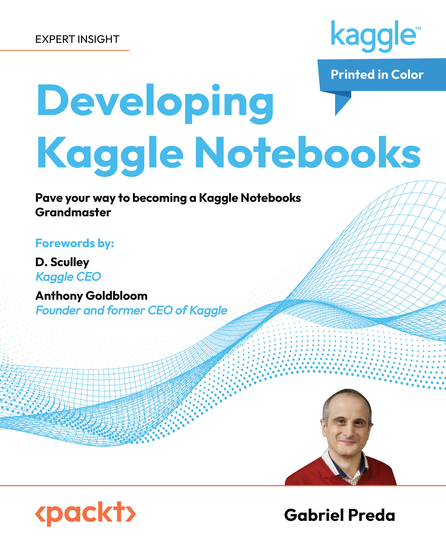
Developing Kaggle Notebooks - Pave your way to becoming a Kaggle Notebooks Grandmaster - cover

Developing Kaggle Notebooks - Pave your way to becoming a Kaggle Notebooks Grandmaster

Gabriel Preda

Publisher: Packt Publishing

  • 0
  • 0
  • 0

Summary

Developing Kaggle Notebooks introduces you to data analysis, with a focus on using Kaggle Notebooks to simultaneously achieve mastery in this fi eld and rise to the top of the Kaggle Notebooks tier. The book is structured as a sevenstep data analysis journey, exploring the features available in Kaggle Notebooks alongside various data analysis techniques.For each topic, we provide one or more notebooks, developing reusable analysis components through Kaggle's Utility Scripts feature, introduced progressively, initially as part of a notebook, and later extracted for use across future notebooks to enhance code reusability on Kaggle. It aims to make the notebooks' code more structured, easy to maintain, and readable.Although the focus of this book is on data analytics, some examples will guide you in preparing a complete machine learning pipeline using Kaggle Notebooks. Starting from initial data ingestion and data quality assessment, you'll move on to preliminary data analysis, advanced data exploration, feature qualifi cation to build a model baseline, and feature engineering. You'll also delve into hyperparameter tuning to iteratively refi ne your model and prepare for submission in Kaggle competitions. Additionally, the book touches on developing notebooks that leverage the power of generative AI using Kaggle Models.
Available since: 12/27/2023.
Print length: 370 pages.


Other books that might interest you

  • Cytology - The Cell A Journey into the Building Blocks of Life - cover

    Cytology - The Cell A Journey...

    Mike Crawford

    • 0
    • 0
    • 0
    Cytology, the study of cells, is a cornerstone of biological science that provides essential insights into the structure, function, and behavior of living organisms. At the heart of cytology lies the cell, the fundamental unit of life, serving as the building block of all living organisms. This field of study plays a crucial role in advancing our understanding of life processes and offers foundational knowledge for various biological disciplines such as genetics, biochemistry, and molecular biology. The ability to investigate and analyze cells has paved the way for numerous medical, scientific, and technological breakthroughs, profoundly impacting fields like medicine, genetics, and biotechnology. 
    The exploration of cells began long before the term cytology was even coined, rooted in the development of microscopy. Early scientists, using rudimentary microscopes, made significant strides in observing the previously unseen world of cells. One of the most notable discoveries was by Robert Hooke in 1665, who, through his microscope, first identified cells in cork tissue. This groundbreaking observation sparked the development of cell theory, which asserts that all living organisms are composed of cells. Over time, advances in microscopy and staining techniques have allowed scientists to gain deeper insights into the intricate details of cellular structure and function, transforming cytology into a crucial branch of modern biology.
    Show book
  • Ethical Hacking for Beginners - A Beginner's Guide to Cybersecurity - cover

    Ethical Hacking for Beginners -...

    Daniel Green

    • 0
    • 0
    • 0
    Unlock the secrets of cybersecurity and embark on a thrilling journey into the world of ethical hacking with "Ethical Hacking Unveiled: A Beginner's Guide to Cybersecurity." In this comprehensive and accessible book, you'll discover the essential skills, tools, and ethical considerations that define the art of ethical hacking. 
    Secure the future—ethically. Welcome to the world of ethical hacking! 
     
    Show book
  • Machine Learning with Python Guide for Beginners - A Beginner's Roadmap - cover

    Machine Learning with Python...

    Robert Francis

    • 0
    • 0
    • 0
    Dive into the fascinating realm of Machine Learning with 'Machine Learning with Python Guide for Beginners.' This comprehensive guide is crafted for individuals eager to embark on a journey into the dynamic field of machine learning using the versatile programming language, Python. 
    'Machine Learning with Python Guide for Beginners' is your passport to mastering the art and science of machine learning with Python. Unlock the potential of data and algorithms, and empower yourself to make a lasting impact in the world of technology. 
      
     
    Show book
  • HowExpert Guide to Microbiology - 101 Tips to Learn about the History Applications Research Universities and Careers in Microbiology - cover

    HowExpert Guide to Microbiology...

    HowExpert, Sehrish Siddique

    • 0
    • 0
    • 0
    If you want to learn about the history, applications, research, universities, and careers in microbiology, then check out HowExpert Guide to Microbiology. 
    HowExpert Guide Microbiology is a compilation of all the major aspects of microbiology for one to get to know microbiology in the best way possible. It includes all minor and major points regarding Microbiology, from a basic introduction to depth and complexity. A very simple yet scientific writing style is adopted for the better understanding of the readers because the main aim of this book is to acknowledge every individual irrespective of the scientific background, to grasp the beauty of microbiology. 
    This book consists of 5 chapters, i.e., Introduction to Microbiology, History of Microbiology, Applications of Microbiology, Research (which is real-life and detailed research under the category food microbiology), Scope and Career in Microbiology. Chapter No 1, “Introduction to Microbiology,” contains most of the weightage of this book as this is the most vital and comprehensive chapter; it lays the base of this book. One can get most of the important and basic knowledge in this chapter. While Chapter No 4, “Research,” is the most complex part of the book and the most interesting one too. By going through it, you’ll feel like a researcher. This is a complete and detailed sample for you to learn about the research. This book is a complete guide for Microbiology. 
    Check out HowExpert Guide to Microbiology to learn about the history, applications, research universities, and careers in microbiology!
    Show book
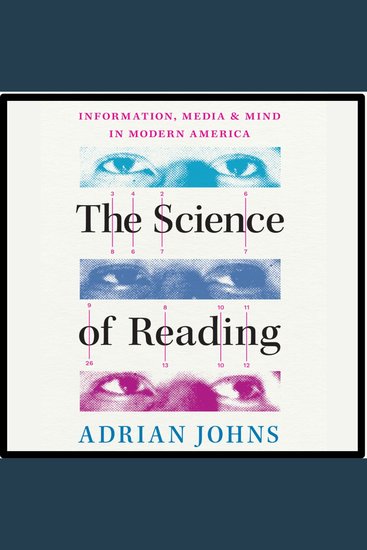
  • The Science of Reading - Information Media and Mind in Modern America - cover

    The Science of Reading -...

    Adrian Johns

    • 0
    • 0
    • 0
    For the first time, the story of how and why we have plumbed the mysteries of reading, and why it matters today. 
      
    Reading is perhaps the essential practice of modern civilization. For centuries, it has been seen as key to both personal fulfillment and social progress, and millions today depend on it to participate fully in our society. Yet, at its heart, reading is a surprisingly elusive practice. This book tells for the first time the story of how American scientists and others have sought to understand reading, and, by understanding it, to improve how people do it. 
     
    Starting around 1900, researchers—convinced of the urgent need to comprehend a practice central to industrial democracy—began to devise instruments and experiments to investigate what happened to people when they read. They traced how a good reader’s eyes moved across a page of printed characters, and they asked how their mind apprehended meanings as they did so. In schools across the country, millions of Americans learned to read through the application of this science of reading. At the same time, workers fanned out across the land to extend the science of reading into the social realm, mapping the very geography of information for the first time. Their pioneering efforts revealed that the nation’s most pressing problems were rooted in drastic informational inequities, between North and South, city and country, and white and Black—and they suggested ways to tackle those problems. 
     
    Today, much of how we experience our information society reflects the influence of these enterprises. This book explains both how the science of reading shaped our age and why, with so-called reading wars still plaguing schools across the nation, it remains bitterly contested.
    Show book
  • Seismology - Earthquakes: Understanding and Predicting Seismic Events - cover

    Seismology - Earthquakes:...

    Mike Crawford

    • 0
    • 0
    • 0
    Seismology is the scientific study of earthquakes and the propagation of seismic waves through the Earth. It plays a crucial role in understanding the planet’s internal structure, predicting seismic hazards, and developing mitigation strategies. The field has evolved over centuries, combining geological observations with advanced instrumentation to analyze the forces that shape the Earth's surface. 
    The Earth's internal structure consists of the crust, mantle, outer core, and inner core. These layers play a fundamental role in the behavior of seismic waves. The crust, the outermost layer, is broken into tectonic plates that move slowly over the more fluid mantle beneath. This movement generates stress along fault lines, eventually leading to earthquakes. The mantle, composed of semi-solid rock, allows for convection currents that drive plate tectonics. The outer core, a molten iron layer, generates Earth's magnetic field, while the solid inner core remains a mystery due to its extreme conditions. 
    Seismic waves are the energy waves generated by earthquakes and other seismic events. They are classified into body waves and surface waves. Body waves, which travel through the Earth’s interior, include primary (P) waves and secondary (S) waves. P-waves are the fastest and travel through both solids and liquids, while S-waves move slower and can only propagate through solids. Surface waves, which travel along the Earth's crust, are responsible for most of the destruction during an earthquake.
    Show book