Join us on a literary world trip!
Add this book to bookshelf
Grey
Write a new comment Default profile 50px
Grey
Subscribe to read the full book or read the first pages for free!
All characters reduced
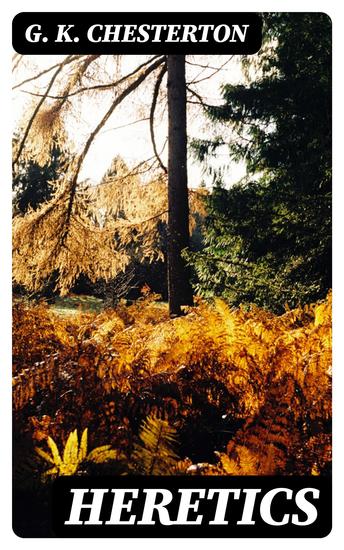
Heretics - cover

Heretics

G. K. Chesterton

Publisher: DigiCat

  • 0
  • 0
  • 0

Summary

In "Heretics," G. K. Chesterton presents a series of provocative essays that challenge the prevailing intellectual currents of early 20th-century thought. With his characteristic wit and incisive reasoning, Chesterton critiques the dogmas of modernism, liberalism, and other philosophical trends, advocating for a return to a more orthodox and whimsical view of life. His literary style is marked by paradox, humor, and a spirited defense of traditional beliefs, drawing on a diverse array of subjects from literature to psychology. This work stands as a vital contribution to the literature of faith and rational inquiry, illuminating the tensions between skepticism and belief in an age increasingly dominated by empiricism and materialism. G. K. Chesterton, an influential English writer, lay theologian, and social critic, drew inspiration from his own journey of faith and literary exploration. Born in 1874, Chesterton's background in art and literature enabled him to engage deeply with complex societal issues, often contrasting the vitality and richness of faith with the starkness of modern nihilism. His experiences and encounters with various thinkers provided the impetus for "Heretics," marking his foray into public intellectual discourse and establishing him as a defender of traditional Christian values. "Heretics" serves not only as a powerful critique of contemporary thought but also as a clarion call for readers to reassess their own beliefs. Recommended for those intrigued by philosophy, theology, and literary criticism, this book promises to challenge presuppositions and inspire rigorous reflection. Chesterton's eloquence and incisive arguments make this work a timeless exploration of the intellectual battles that rage within the human heart.
Available since: 08/10/2022.
Print length: 216 pages.

Other books that might interest you

  • Eleanor of Aquitaine and Richard the Lionheart: The History of the Mother and Son Who Shaped Medieval Europe - cover

    Eleanor of Aquitaine and Richard...

    Charles River Editors

    • 0
    • 0
    • 0
    Laying next to the tomb effigy of King Henry II of England in France's Fontevraud Abbey is a curious coffin chiseled in the shape of a young woman in repose. The once vibrant paint on the effigy is flaking, and several areas of the centuries-old tombs are chipped, but her general features are still somewhat recognizable. The beautiful, crowned queen, depicted with a soft smile on her face, was dressed in a simple, but elegant gown in white and blue, and an open book in her arms. The effigy is for none other than Duchess Eleanor of Aquitaine. 
    	Over the years, this mysterious 12th century figure has been portrayed in countless ways, from a valiant warrior queen and resourceful politician to a control-obsessed and manipulative siren whose only objective in life was power. What is clear is that during her long life, Eleanor she played an outsized role in both French and English history, and she also had an impact on the course of the Crusades, not just with her first husband, France’s King Louis VII, but also through her offspring with her second husband, Henry II.  
    	The enduring figure of the Middle Ages is the chivalrous knight who served as a hero across much of Europe, and nobody played a more defining role in casting the popular image of medieval knights than Eleanor’s son Richard the Lionheart, one of the most famous English kings and crusaders. In many respects, it was ironic that Richard became one of the central characters of the Middle Ages, and his very popular legacy today belies centuries of controversy. Richard I Plantagenet, better known by his nickname “Coeur de Lion” (Lionheart), eventually became King of England, Grand Duke of Aquitaine, Duke of Poitou, and Duke of Anjou, but as the third son in a large family, he did not expect to or even want to rule England. Nevertheless, it was he who eventually came to the throne upon his father's death, assisted in great measure by his statesmanlike mother Eleanor.
    Show book
  • Cinder Girl - Growing Up on America's Fringe - cover

    Cinder Girl - Growing Up on...

    Holly Thompson Rehder

    • 0
    • 0
    • 0
    Cinder Girl sits in the rarest class of memoir—a towering literary triumph which melds searing and tragic personal history with an incredible story of resilience, hope, and civic success. 
     
    Growing up on welfare, food stamps, and Greyhound buses, Holly Thompson Rehder quit school at fifteen to help take care of her mother and younger sister after a devastating car accident. Getting married and pregnant soon thereafter,  
    like so many other young girls caught in the poverty-cycle, Holly decided that the life she had been born into was not what she intended to give her child. 
     
    But unlike others who wind up mired in a lifetime of poverty, dysfunction, and despair, Holly used her resourcefulness, faith, and sheer stubborn American grit to fight her way out of the gutter. 
     
    Two decades later she was a successful businesswoman. And today, she is a rising political star who serves as an inspiration to young women across the state of Missouri—and indeed, the entire nation—all while never forgetting where she  
    came from. She worked her butt off to help so many others born into seemingly helpless circumstances. 
     
    As a rare lawmaker who speaks candidly from raw personal experience, in Cinder Girl, Rehder rises above standard political prose to provide an unvarnished look inside the worst of American poverty––those living in the margins. Rehder  
    challenges us to recall the plight of those far less fortunate, who struggle without the opportunities most of us take for granted.
    Show book
  • The Hop About - cover

    The Hop About

    Stephen Mackelprang

    • 0
    • 0
    • 0
    A man, an amputee, a dual amputee, wanders the West alone on half of a foot to discover what life has to offer. He takes off, running the only way he still knows how, in a car. A car procured from selling his prosthetic leg (the expensive one) on eBay. 
    This true tale follows him on an adventure to angelic views in Zion National Park, to the top of the world in Death Valley, to mingling with the rainbow people, to pushing himself around in a wheelchair on the streets of Las Vegas, Nevada. The story turns back to how he found himself ‘hopping’ about and the drug addiction which caused it. 
    While purposely estranged from his family, he learns mingling with others to accept differences and to resist judgement. Also, the deep importance of family. And most importantly that ‘we are not defined by our mistakes’.
    Show book
  • The Olive Season - Amour a New Life and Olives Too! - cover

    The Olive Season - Amour a New...

    Carol Drinkwater

    • 0
    • 0
    • 0
    “A lovely balance of memoir, travelogue and olive-growing how-to . . . Some of her adventures are quite funny.” —Publishers Weekly In this memoir, the author of The Olive Farm returns to the ten-acre property for which she and her fiancé scraped together their savings to buy—just back from their wedding on a tiny Polynesian island, loaded down with luggage and a large hand-painted didgeridoo. As Carol and Michel settle in as husband and wife, they experience the glamor of southern France at dinner parties in the company of aristocrats and at the world-renowned Cannes film festival, as well as the dirt-caked, sun-baked life of farmers—especially after their gardener heads to Algiers to arrange his youngest son’s wedding. For Carol, though, what matters most is that her longtime dream of motherhood finally promises to come true—and over the course of The Olive Season, she shares the story of her hopes and fears as she anticipates another kind of growth and nurturing. Alternately entertaining and emotionally poignant, this memoir is a rich portrait of love, longing, and the constant uncertainties of the cycle of life.
    Show book
  • Stree Purush - cover

    Stree Purush

    Premchand Munshi

    • 0
    • 0
    • 0
    Delve into the complexities of gender and societal norms with Munshi Premchand’s “Stree Purush.” This compelling narrative explores the life of Vipin Babu, a poet whose idealization of women is challenged by the realities of marriage and expectations. Premchand’s masterful storytelling weaves a tale that questions the superficiality of beauty and the depth of relationships. 
    As Vipin Babu confronts his preconceived notions of the perfect partner, readers are taken on a journey through the emotional turmoil of disillusionment and the search for true connection. “Stree Purush” is not just a story; it’s a mirror reflecting the societal constructs that shape our perceptions and interactions.
    Show book
  • A Scene from the Ghetto of Venice - From their pens to your ears genius in every story - cover

    A Scene from the Ghetto of...

    Rainer Maria Rilke

    • 0
    • 0
    • 0
    René Karl Wilhelm Johann Josef Maria Rilke was born into a troubled marriage on the 4th December 1875 in Prague, then part of the Austro-Hungarian Empire.  His mother, having previously lost a baby girl, would dress the young boy up in girl’s clothing.   
    Later his father dispatched him to a military academy at age 10 but after a miserable 5 years the young Rilke left due to illness and instead entered first Prague and then Munich and finally Berlin university to study art history, philosophy and literature. 
    His initial forays into literature was in poetry.  His intense, mystical and lyrical style was much admired and over time inspired many in succeeding generations.    
    His short prose collection ‘Stories of God’, written in an impassioned burst over several nights was published in 1900 and offers a beguiling view of much of Rilke’s influences and outlook.  
    The following year he married the pioneering sculptor and artist Clara Westhoff.  The union produced one child, a daughter Ruth.   
    He lived in Paris for most of the Century’s first decade where he mixed with many great minds of the time.  Although he continued to write he also worked as a secretary to the sculptor, Rodin.   
    It was only after they settled in Switzerland in 1919 that his writing output was in full flow.  Here he wrote profusely in both German and French, which included much on his previous travels, his left-wing sympathies, his religious and existential thoughts, all part of a unique and consummate style. 
    From 1923 on, Rilke increasingly struggled with his health which was now in constant decline and often spent time rehabilitating at a sanatorium.   
    Rainer Maria Rilke died of leukaemia on the 29th December 1926 in Montreux, Switzerland.  He was 51.
    Show book