Join us on a literary world trip!
Add this book to bookshelf
Grey
Write a new comment Default profile 50px
Grey
Subscribe to read the full book or read the first pages for free!
All characters reduced
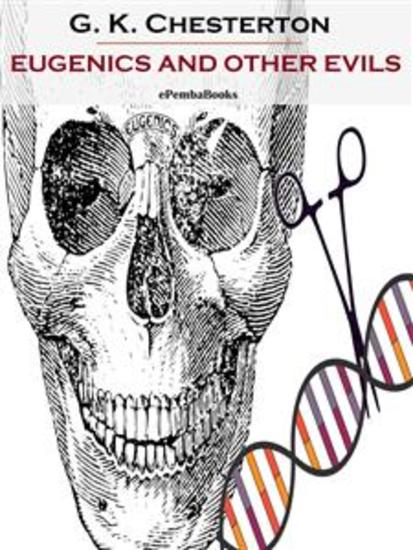
Eugenics and Other Evils (Annotated) - cover

Eugenics and Other Evils (Annotated)

G. K. Chesterton

Publisher: ePembaBooks

  • 0
  • 0
  • 0

Summary

This edition includes the following editor's introduction: G. K. Chesterton, the man beyond the writer


The early twentieth-century was a time when many works, including popular essays, were written on eugenics and eugenic theory, usually to promote the ideas. However, significant anti-eugenic essays also circulated, the most famous of which is “Eugenics and Other Evils” (AKA Eugenics and Other Evils: an argument against scientifically organized state), written by English author and philosopher G. K. Chesterton and originally published in 1922, just a few years after the close of the 'Great War.'
In “Eugenics and Other Evils,” Chesterton argues that eugenic laws are a means of suppressing the poor, and predicts the abuse of eugenics. The book was influential enough that the British Parliament began to question eugenic legislation, and indeed eugenic legislation as existed in the United States was never passed in Great Britain.
Available since: 09/21/2022.
Other books that might interest you

  • How Nations Escape Poverty - Vietnam Poland and the Origins of Prosperity - cover

    How Nations Escape Poverty -...

    Rainer Zitelmann

    • 0
    • 0
    • 0
    During the twentieth century, Vietnam and Poland were both victims not only of devastating wars, but also of socialist planned economies that destroyed whatever war hadn’t already. In 1990, Vietnam was still one of the poorest countries in the world, while Poland was one of the poorest in Europe. But in the three decades since then, both countries have drastically improved their citizens’ standards of living and escaped the vicious cycle of national poverty. 


    In this book, Rainer Zitelmann identifies the reasons behind the sensational growth of both nations' economies, drawing out the lessons that other countries can learn from these two success stories. To explain the source of their success, he returns to Adam Smith's 1776 treatise, The Wealth of Nations: the only way to overcome poverty is through economic growth, and economic freedom is the crucial prerequisite for such growth. Developments over the past 250 years have proved Smith right. 


    Despite these strides, almost ten percent of the world's population still lives in extreme poverty. So, what measures actually help to alleviate poverty today? Through a wealth of data and stories from the everyday lives of Polish and Vietnamese people who experienced reforms, Zitelmann demonstrates the persistent relevance of Smith's ideas to economic flourishing in the twenty-first century.
    Show book
  • Huey P Newton - Smoking Out Fascist America - cover

    Huey P Newton - Smoking Out...

    Geoffrey Giuliano

    • 0
    • 0
    • 0
    Huey Newton was born on February 17, 1942. He was an African-American revolutionary, notable as the founder of the Black Panther Party. Newton crafted the Party's ten-point manifesto with Bobby Seale in 1966. 
     
    The Black Panther Party founded over 60 community support programs including food banks, medical clinics, sickle cell anemia tests, prison busing for families of inmates, legal advice seminars, clothing banks, housing cooperatives, and their own ambulance service. The most famous of these programs was the Free Breakfast for Children program which fed thousands of impoverished children daily during the early 1970s. Newton also co-founded the Black Panther newspaper service, which became one of America's most widely distributed African-American newspapers. 
     
    In 1989, he was murdered in Oakland, California, by Tyrone Robinson, a member of the Black Guerrilla Family. Newton was known for being an advocate of self-defense and used his position as a leader within the Black Panther Party to welcome women and LGBT people into the party, holding the belief that homosexuals "might be the most oppressed people". 
     
    Huey Newton was never shy in talking to the media because after all the powerful movement he started with bobby Seale was all about communication and understanding leading to meaningful change. 
     
    What follows is a collection of interviews with the controversial charismatic leader commencing from his prison cell in 1968 right up until 1989 just weeks before his tragic death. Here is a chance to get to know and understand not only Huey the forward-thinking and intractable black rights advocate but also the sensitive and sensible intellectual ultimately compassionate and caring man.
    Show book
  • Summary of Eric Bolling's Wake Up America - cover

    Summary of Eric Bolling's Wake...

    Falcon Press

    • 0
    • 0
    • 0
    Buy now to get the main key ideas from Eric Bolling's Wake Up America 
      
    In Wake Up America (2016), Eric Bolling warns that the Left is out to destroy all the core values that made America the greatest nation on earth. 
    Bolling argues that fear, guilt, and class conflict have been utilized by the socialist Left to divide us in their quest to dramatically transform American society. They understand that doing so would result in the annihilation of the numerous characteristics that have distinguished America since its establishment, which is what they want. The attributes that characterize America include grit, profit, manliness, thrift, individuality, dominion, merit, pride, and providence. These attributes were critical to success, and regaining their dominance is critical to reclaiming the American dream. Now is the moment for America to wake up. 
     
    Show book
  • Ancient Greece - cover

    Ancient Greece

    Nicolas Sofos

    • 0
    • 0
    • 0
    Ancient Greece, widely recognized as the birthplace of western civilization thrived from 800 BCE to 146 BCE. It is renowned for its contributions, to domains, including literature, philosophy, politics, arts and sciences. These contributions have had an impact on societies. 
    The civilization was characterized by a multitude of city states with Athens and Sparta being particularly notable. Athens, considered the cradle of democracy prioritized philosophy, education and cultural pursuits. It gave rise to thinkers like Socrates, Plato and Aristotle. In contrast Sparta embraced a society that emphasized training and excellence. 
    The Ancient Greeks practiced a religion with a connection to their daily lives. One of their religious and sporting events was the Olympic Games held every four years in honor of Zeus. 
    Greek literature holds status due to works like Homers poems The Iliad and The Odyssey. Playwrights such, as Sophocles, Euripides and Aristophanes created enduring tragedies and comedies that delved into the complexities of existence. 
    In the realm of science and mathematics the Greeks achieved significant breakthroughs. 
    Prominent individuals such, as Pythagoras, Euclid and Archimedes played roles in advancing the fields of geometry and calculus. Meanwhile philosophers, like Thales and Democritus laid the foundations for reasoning. 
    Turning to politics Ancient Greece primarily relied on city states, each governed by its system. Athens implemented a form of democracy where citizens actively participated in decision making processes while Sparta had an disciplined structure. 
    Ancient Greece's influence can still be seen in various aspects of modern society, including government, philosophy, language, art, and sports. Its legacy continues to resonate in the Western world, making it one of the most impactful civilizations in history.
    Show book
  • Trajectory of Power - The Rise of the Strongman Presidency - cover

    Trajectory of Power - The Rise...

    William G. Howell, Terry M. Moe

    • 0
    • 0
    • 0
    In Trajectory of Power, leading political scientists William Howell and Terry Moe provide a sweeping account of the historical rise of presidential power, arguing that it has now grown to the point where, in the wrong hands, it threatens to subvert American democracy and replace it with a de facto system of strongman rule, whether led by Donald Trump or someone else. 


    For much of the twentieth century, Republican and Democratic presidents pursued power in very similar ways and almost always within democratic bounds. But Republican presidents since Ronald Reagan, in a transformation that has grown increasingly extreme over time, have gone beyond the "normal" incentives that have traditionally shaped presidential behavior—and still shape the behavior of Democratic presidents—to pursue a presidency of such expansive unilateral power, and with such disregard for basic democratic requirements, that it puts democracy at serious risk. 


    The book traces this divergence in approach to the backlash of conservatives against the administrative state, and to their epiphany that a war on big government could only be waged through a presidency of extraordinary power. Timely, urgent, and original, Trajectory of Power reveals how the presidency has been profoundly transformed during the modern era—and why it now puts our democracy in imminent danger.
    Show book
  • Rights of Man The: Book Summary & Analysis - cover

    Rights of Man The: Book Summary...

    Briefly Summaries

    • 0
    • 0
    • 0
    This is a concise summary and analysis of The Rights of Man, by Thomas Paine.
    It is not the original book and is not affiliated with or endorsed by 
    Thomas Paine.
    Ideal those seeking a quick and insightful overview.
     
    "The Rights of Man" is a groundbreaking treatise that passionately defends the ideals of liberty, equality, and democracy. Written in response to the political turbulence of the 18th century, it presents a compelling argument for the natural rights of individuals and the necessity of government as a social contract derived from the consent of the governed. The book boldly critiques hereditary monarchy and aristocracy, championing revolution as a legitimate means to achieve justice. With its incisive reasoning and universal appeal, this work remains a cornerstone of political philosophy and a rallying cry for human rights.
    Show book