Join us on a literary world trip!
Add this book to bookshelf
Grey
Write a new comment Default profile 50px
Grey
Subscribe to read the full book or read the first pages for free!
All characters reduced
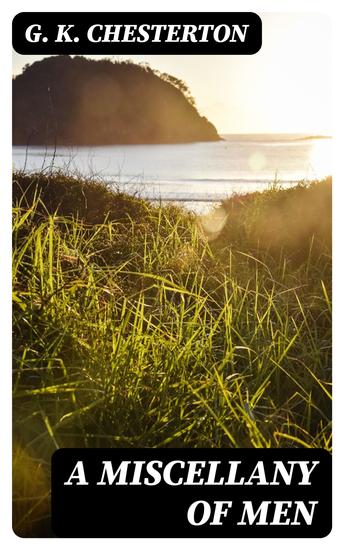
A Miscellany of Men - cover

A Miscellany of Men

G. K. Chesterton

Publisher: DigiCat

  • 0
  • 0
  • 0

Summary

In "A Miscellany of Men," G. K. Chesterton presents a collection of essays that delve into a rich tapestry of human experience, illustrating his signature blend of wit and wisdom. The work, written in Chesterton's characteristic exuberant style, employs vivid imagery and incisive argumentation to explore diverse topics, from philosophy to the nature of man. The literary context of this collection situates it within the early 20th century, a time marked by social upheaval and philosophical questioning, inviting readers to ponder the complexities of humanity through Chesterton's thought-provoking lens. G. K. Chesterton, an English writer, philosopher, and theologian, became a prominent figure in literary circles due to his keen insights and distinctive voice. His background in journalism and his deep-rooted interest in the mysteries of faith and humanity profoundly influenced his writings. The essays in this collection reflect his admiration for the commonplace and his belief in the extraordinary potential of the human spirit, shaped by his experiences in a rapidly changing world. "A Miscellany of Men" is an essential read for those seeking to understand the interplay between humanity's virtues and vices. Chesterton's engaging prose and philosophical musings invite readers to reflect on their perceptions of the world, making this collection a timeless exploration of the intricacies of being human.
Available since: 08/10/2022.
Print length: 128 pages.
Other books that might interest you

  • Actors and Singers - The Lives of Marilyn Monroe and Elvis Presley - cover

    Actors and Singers - The Lives...

    Kelly Mass

    • 0
    • 0
    • 0
    This is a compilation of 2 different titles, which are about the following topics: 
    1: Marilyn Monroe has been part of the sexual revolution during the mid-20th century. Her influence in the movie industry, as an icon for attractiveness and femininity, have been noticed by hundreds of millions, even after her death. 
      
    Did Marilyn Monroe have success? Yes. Was her life easy? Not by far. Her failed marriages, early childhood trauma, mood disorder, and some of the struggles with her sexuality, contracts, and Hollywood producers have made her life go up and down so much that I’m sure she would describe some moments as the ultimate bliss and others as a living hell. 
      
    To understand such a complicated mess, a life covered in glamor and at the same time, tainted by manipulative individuals and her own weaknesses, addictions, and imperfections, we have to take a closer look. This way, we can understand why the world’s eyes were on her, and why she is still recognized as a symbol of attractiveness. 
    2: Elvis Presley is the famous singer who caused so much controversy that he was hated and loved among most of the American people. His sexual moves, his novel way of putting songs together… there was just something about him that attracted the ladies and the media attention at the same time. 
      
    Elvis didn’t grow up with wealth and fame. In a way, you could say he was living the American dream. However, he was kind of a bad boy as well, facing legal troubles, broken relationships and drug abuse. His death was lamented by many but his music lived on. Explore the era and methods of Elvis with us in this concise book/biography about his life.
    Show book
  • The Complete Warrior’s Mindset Collection - The Art of War by Sun Tzu Meditations by Marcus Aurelius Thus Spoke Zarathustra by Friedrich Nietzsche and More of History’s Greatest Military Minds on Power Discipline and Mental Toughness - cover

    The Complete Warrior’s Mindset...

    Sun Tzu, Miyamoto Musashi,...

    • 0
    • 0
    • 0
    What if you could cultivate an unbreakable mindset, combining strategic acumen with emotional resilience and philosophical depth?What You’ll Discover in This Newly Translated Essential Anthology:The Art of War – Sun Tzu’s strategic guide to warfare, leadership, and success.The Book of Five Rings – Miyamoto Musashi’s teachings on combat, discipline, and mastery.Meditations – Marcus Aurelius’ Stoic reflections on resilience and personal virtue.Letters from a Stoic – Seneca’s wisdom on inner strength and self-control.The Maxims of War – Napoleon Bonaparte’s insights on discipline and strategic command.Instructions to His Generals – Frederick the Great’s advice on leadership and military excellence.The Commentaries of Julius Caesar – Firsthand accounts of war and political strategy.Fear and Trembling – Søren Kierkegaard’s exploration of faith, courage, and personal transformation.Thus Spoke Zarathustra – Friedrich Nietzsche’s poetic philosophy of self-overcoming.Beyond Good and Evil – Nietzsche’s critique of morality and power dynamics.The Will to Power – Nietzsche’s reflections on ambition, strength, and self-mastery.Daybreak – Nietzsche’s insights on breaking free from societal constraints and cultivating inner resilience. 
    Embrace the power of a disciplined and enlightened mind. Get your copy now and transform how you confront life’s challenges.
    Show book
  • No Way Down - Life and Death on K2 - cover

    No Way Down - Life and Death on K2

    Graham Bowley

    • 0
    • 0
    • 0
    "No Way Down is both a gripping read and a clear-eyed investigation of the hubris, politics, and bad luck that brought on one of the worst disasters in modern mountaineering history." —Michael Kodas, author of High Crimes: The Fate of Everest in an Age of Greed 


    "Graham Bowley's No Way Down does a great job of putting you on the mountain. It is a refreshingly unadorned account of the true brutality of climbing K2, where heroes emerge and egos are stripped down, and the only thing achieving immortality is the cold ruthless mountain." —Norman Ollestad, author of Crazy for the Storm 


    In the tradition of Into Thin Air and Touching the Void, No Way Down by New York Times reporter Graham Bowley is the harrowing account of the worst mountain climbing disaster on K2, second to Everest in height . . . but second to no peak in terms of danger. From tragic deaths to unbelievable stories of heroism and survival, No Way Down is an amazing feat of storytelling and adventure writing, and, in the words of explorer and author Sir Ranulph Fiennes, "the closest you can come to being on the summit of K2 on that fateful day."
    Show book
  • Russian Short Story The - Volume 4 - Nikolai Lyeskov to Anton Chekhov - cover

    Russian Short Story The - Volume...

    Anton Chekhov, Helena Blavatsky,...

    • 0
    • 0
    • 0
    The Russian novel has a reputation that is immense, both in narrative and in length.  Unquestionably though the ideas, themes and characters make many novels rightly revered as world class, as icons of literature. 
     
    Perhaps an easier way to enjoy a wider selection of the Russian heritage, with its varied and glorious literary talents, is with the short story.  These gems sparkle and beguile the mind with their characters and narrative, exploring facets of society and the human condition that more Western authors somehow find more difficult to navigate, or to explore, explain and relate to.   
     
    The Russian short story is, in many respects, in a genre of its own.  It is at its captivating best whether it’s an exploration of real-life experiences, through fantasy and fables and on to total absurdity. 
     
    In a land so vast it is unsurprising that it is a world almost unto itself. Cultures and landscapes of differing hues are packed together bound only by the wilful bonds and force of Empire. 
     
    The stories in this collection traverse the decades where one might be a serf under an absolute monarch, and the reality of that was pretty near to slavery, into an emancipation of sorts in the fields, or towns under the despotic will of landowners and the rich into the upheavals of Empire and then the overthrow of the ruling class and its replacement by the communists, who promised equality for all and delivered a society where the down-trodden remained the lowest yet vital cog of the state machine and its will.  
     
    Whilst Tolstoy, Gogol, Dostoevsky, Pushkin and Chekhov are a given in any Russian collection we also explore and include Andreyev, Korolenko, Turgenev, Blavatsky and many others to create a world rich and dense across a sprawling landscape of diverse people, riddled with the class and unfairness in perhaps some of the most turbulent times that Russia has ever experienced. 
     
    01 - The Russian Short Story - Volume 4 - An Introduction 
    02 - The Sentry by Nikolai Lyeskov 
    03 - A Witch's Den by Helena Blavatsky 
    04 - The General's Will by Vera Jelihovsky 
    05 - The Old Bell Ringer by Vladimir Korolenko 
    06 - The Shades, A Phantasy by Vladimir Korolenko 
    07 - The Signal by Vsevolod Garshin 
    08 - Dethroned by I N Potapenko 
    09 - The Kiss by Anton Chekhov 
    10 - The Lady with the Dog by Anton Chekhov 
    11 - The Bet by Anton Chekhov 
    12 - Gooseberries by Anton Chekhov
    Show book
  • Chelkash by Maxim Gorky - A small time thief is caught up in a larger scheme testing his willpower and showing the dangers of greed - cover

    Chelkash by Maxim Gorky - A...

    Maxim Gorky

    • 0
    • 0
    • 0
    Alexei Maximovich Peshkov was born on 28th March 1868, in Nizhny Novgorod, Russia. 
     
    Better known as Maxim Gorky he was orphaned at 11 and ran away from home at 12.  At 19 he had already attempted suicide and thereafter travelled, by foot, across the Russian Empire for 5 years. 
     
    His first book ‘Essays & Stories’ in 1898 was a sensation and so began a long career as an author of short stories, novels and plays.  Gorky saw writing as a moral and political act that would help to change the unjust world around him.  He was an ardent early advocate of the emerging Marxist movement and publicly opposed the Tsarist regime leading several times to his arrest.  
     
    In 1904 he began his own theatre but the censor banned every play and Gorky was forced to abandon the project. 
     
    But Gorky was a financially successful author, editor, and playwright and gave monies to political parties as well as for civil rights and social reform.  The brutal shooting of workers, which set in motion the Revolution of 1905, pushed Gorky more decisively toward radical solutions.  
     
    In 1906 he went to the United States to raise funds for the Bolsheviks. Those experiences including a scandal over travelling with his lover and not his wife deepened his contempt for the ‘bourgeois soul.’ 
     
    Gorky now moved to Capri in Italy, both for health reasons and to escape the increasingly repressive times in Russia.  
     
    An amnesty for the 300th anniversary of the Romanov dynasty saw him return to Russia in 1914. His politics remained close to the Bolshevik cause.  But soon, after the 1918 revolution, his essays referred to Lenin as a tyrant for his senseless arrests and repression.  He was soon appealing to the outside world for food aid after the catastrophic crop failure. 
     
    In October 1921 Gorky returned to Italy, now in Fascist hands, and settled in Sorrento until 1932.  His health worsened with the onset of tuberculosis. 
     
    He wrote several successful books there but now decided to find an understanding with the communist regime. Stalin invited him home and his return was hailed as a major propaganda victory.  He was decorated with the Order of Lenin, and a province, a park, and various streets re-named in his honour. 
     
    But he had his faults too.  In 1933, Gorky co-edited a book on the White Sea-Baltic Canal and denied even a single prisoner died during its construction, but thousands had. As well, knowing that some Nazis were homosexual, a phrase was attributed to him that said ‘exterminate all homosexuals and fascism will vanish’.  Although he was himself was quoting another he was decidedly homophobic. 
     
    With the increase of Stalinist repression in 1935 Gorky was placed under unannounced house arrest. 
     
    Maxim Gorky died on the 18th June 1936 from pneumonia.  He was 68. 
     
    Stalin and Molotov were among those who carried Gorky's urn of ashes at his funeral.  
     
    In Gorky’s story, a thief, Chelkash, ensnares a young man into his scheme to steal silk from a ship.  When he then sells the stolen goods he is set upon by the young accomplice.  What happens then is as unexpected as it is remarkable.
    Show book
  • The Return of the Sphinx - cover

    The Return of the Sphinx

    Hugh MacLennan

    • 0
    • 0
    • 0
    Alan Ainslie is an able and dedicated man high in the government. Daniel Ainslie, his son, is a member of an explosive movement impelled by the naive rebelliousness of the New Left. Hugh MacLennan weaves a complex and story of two generations in conflict. Originally published in 1967, Return of the Sphinx is something of a sequel to the more optimistic Two Solitudes and reflects MacLennan's disenchantment with the world in general and the apparently intractable French-English debate in Canada.
    Show book