Join us on a literary world trip!
Add this book to bookshelf
Grey
Write a new comment Default profile 50px
Grey
Subscribe to read the full book or read the first pages for free!
All characters reduced
Pubs - A Collection of Hotel Inn and Tavern Signs in Great Britain and Ireland - cover

Pubs - A Collection of Hotel Inn and Tavern Signs in Great Britain and Ireland

G. A. Tomlin

Publisher: Good Press

  • 0
  • 0
  • 0

Summary

In "Pubs," G. A. Tomlin expertly paints a vivid portrait of the social and cultural significance of public houses in contemporary society. The book intertwines historical narratives with personal anecdotes, encapsulating the essence of pubs as communal spaces that foster connections and serve as microcosms of society. Tomlin's prose is both evocative and accessible, drawing readers into the rich tapestry of pub life while illustrating broader themes of community, identity, and tradition within a rapidly changing world. The literary style oscillates between reflective commentary and engaging storytelling, providing a nuanced exploration of the role of pubs beyond mere drinking establishments. G. A. Tomlin is an acclaimed sociologist and cultural historian with a deep-seated passion for exploring social environments that shape human interaction. His background fostered an interest in how local establishments can act as cultural touchstones, and through extensive fieldwork and interviews, he gained insights into the intricate dynamics of pub culture. Tomlin'Äôs multidisciplinary approach draws from sociology, anthropology, and literature, making him uniquely qualified to delve into the subject matter of this work. I highly recommend "Pubs" to anyone interested in the social fabric of communities or the role of leisure spaces in modern society. This book will appeal not only to scholars of sociology and cultural studies but also to casual readers seeking a deeper understanding of the places where friendships and stories are born. Tomlin'Äôs engaging style and thoughtful observations make this work a compelling read for all.
Available since: 10/19/2023.
Print length: 55 pages.

Other books that might interest you

  • Detroit in World War II - cover

    Detroit in World War II

    Gregory D. Sumner

    • 0
    • 0
    • 0
    When President Roosevelt called for the country to be the great "Arsenal of Democracy," Detroit helped turn the tide against fascism with its industrial might. Locals were committed to the cause, putting careers and personal ambitions on hold. Factories were retooled from the ground up. Industrialist Henry Ford, First Lady Eleanor Roosevelt, aviator Charles Lindbergh, legendary boxer Joe Louis, future baseball Hall of Famer Hank Greenberg and the real-life Rosie the Riveters all helped drive the city that was "forging thunderbolts" for the front lines. With a panoramic narrative, author Gregory D. Sumner chronicles the wartime sacrifices, contributions, and everyday life of the Motor City.
    Show book
  • A Lot of People Are Saying - The New Conspiracism and the Assault on Democracy - cover

    A Lot of People Are Saying - The...

    Anonymous

    • 0
    • 0
    • 0
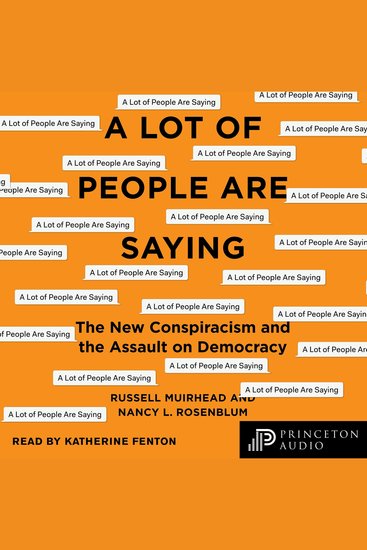
    This audiobook narrated by Katherine Fenton reveals how the new conspiracists are undermining democracy—and explains what can be done about it
    
    Conspiracy theories are as old as politics. But conspiracists today have introduced something new—conspiracy without theory. And the new conspiracism has moved from the fringes to the heart of government with the election of Donald Trump. In A Lot of People Are Saying, Russell Muirhead and Nancy Rosenblum show how the new conspiracism differs from classic conspiracy theory, why so few officials speak truth to conspiracy, and what needs to be done to resist it.
    
    Classic conspiracy theory insists that things are not what they seem and gathers evidence—especially facts ominously withheld by official sources—to tease out secret machinations. The new conspiracism is different. There is no demand for evidence, no dots revealed to form a pattern, no close examination of shadowy plotters. Dispensing with the burden of explanation, the new conspiracism imposes its own reality through repetition (exemplified by the Trump catchphrase "a lot of people are saying") and bare assertion ("rigged!").
    
    The new conspiracism targets democratic foundations—political parties and knowledge-producing institutions. It makes it more difficult to argue, persuade, negotiate, compromise, and even to disagree. Ultimately, it delegitimates democracy.
    
    Filled with vivid examples, A Lot of People Are Saying diagnoses a defining and disorienting feature of today's politics and offers a guide to responding to the threat.
    Show book
  • Lincoln - A Very Short Introduction - cover

    Lincoln - A Very Short Introduction

    Allen C. Guelzo

    • 0
    • 0
    • 0
    Beneath the surface of the apparently untutored and deceptively frank Abraham Lincoln ran private tunnels of self-taught study, a restless philosophical curiosity, and a profound grasp of the fundamentals of democracy. Now, in Lincoln: A Very Short Introduction, the award-winning Lincoln authority Allen C. Guelzo offers a penetrating look into the mind of one of our greatest presidents. 


    Guelzo takes us on a wide-ranging exploration of problems that confronted Lincoln and liberal democracy—equality, opportunity, the rule of law, slavery, freedom, peace, and his legacy. The Lincoln we meet here is an Enlightenment figure who struggled to create a common ground between a people focused on individual rights and a society eager to establish a certain moral, philosophical, and intellectual bedrock. Lincoln insisted that liberal democracy had a higher purpose, which was the realization of a morally right political order. But how to interject that sense of moral order into a system that values personal self-satisfaction—"the pursuit of happiness"—remains a fundamental dilemma even today. 


    Guelzo paints a marvelous portrait of this Lincoln—Lincoln the man of ideas—providing new insights into one of the giants of American history.
    Show book
  • Willingness to Learn - The Open Mindset - cover

    Willingness to Learn - The Open...

    Esther Jameson

    • 0
    • 0
    • 0
    The journey begins with the simple act of curiosity, a spark that drives us to explore the vast realm of knowledge and self-improvement. In every life, there exists a turning point where the desire to learn outweighs the comfort of the familiar. This chapter explores the early stages of that transformative journey, when individuals decide to step beyond their comfort zones and embrace the challenges of growth. It is a time filled with both excitement and uncertainty, where every question asked becomes a stepping stone toward a deeper understanding of oneself and the world. 
    At the heart of this journey is the recognition that learning is not a finite process. Instead, it is an ongoing adventure that demands patience, persistence, and an open mind. The decision to learn often comes after moments of reflection, when past experiences—both successes and failures—combine to illuminate the need for change. This process involves shedding limiting beliefs and accepting that each setback is a valuable lesson in disguise. The willingness to embrace the unknown, even when the outcome is uncertain, becomes the foundation upon which a richer, more informed life is built. 
    In this early stage, individuals frequently encounter obstacles that test their resolve. It is in overcoming these barriers that the true value of the learning journey is revealed. The initial steps may be filled with self-doubt, yet every challenge conquered reinforces the commitment to personal growth. This chapter emphasizes that every small victory contributes to a greater sense of purpose and capability. The gradual accumulation of knowledge and experience leads to a newfound confidence that empowers learners to tackle more complex questions and explore diverse fields of inquiry.
    Show book
  • The Thriving Self - A New Paradigm for Healing Trauma in the Mind Body and Spirit and Moving Beyond It - cover

    The Thriving Self - A New...

    Karen Sprinkel Ancelet

    • 0
    • 0
    • 0
    Do you feel stuck in your life? Have you been in therapy for a long time and wonder why you aren’t feeling better? This book will show you how to break out of stuck patterns. You will create your own pathway to healing, first by identifying your survival override, and using self-guided reflections and assessments to help you move forward. It provides guidance about deciding which mental health treatment is needed to heal your core wounds and grow towards a thriving self. 
    Are you a clinician looking to be more trauma-informed? This book will guide you through the new diagnostic dimension of the three ways individuals store or locate trauma - in the mind, body, or spirit - and how to use that knowledge to help your clients heal from suffering, as well as major trauma.
    Show book
  • Understandable Economics - Because Understanding Our Economy Is Easier Than You Think and More Important Than You Know - cover

    Understandable Economics -...

    Howard Yaruss

    • 0
    • 0
    • 0
    In this entertaining and informative guide, author Howard Yaruss breaks down our economic system in a straightforward way, avoiding jargon, formulas, graphs, and other technical material so common in books on this subject. Instead, he creates a compelling and comprehensive picture of our economy using accessible analogies, real-world observations, and entertaining anecdotes. 


    Understandable Economics will enable listeners to answer questions such as: Why is inequality soaring and what can we do about it?; Do tax cuts for the wealthy create jobs or just create more inequality?; Where does money come from, why does it have value, and who controls it?; What does the Fed do and how does it affect our lives?; Could alternative currencies like Bitcoin replace the dollar?; Is our national debt a threat?; Why do so many people believe free trade is good if it causes some people to lose jobs?; Why does the economy regularly turn down and how can we get it back on track?; and many more. 


    Understandable Economics provides the context, tools, and foundational knowledge listeners need to thoroughly understand our economy, determine which policies would work best, and champion those policies effectively.
    Show book