Begleiten Sie uns auf eine literarische Weltreise!
Buch zum Bücherregal hinzufügen
Grey
Einen neuen Kommentar schreiben Default profile 50px
Grey
Jetzt das ganze Buch im Abo oder die ersten Seiten gratis lesen!
All characters reduced
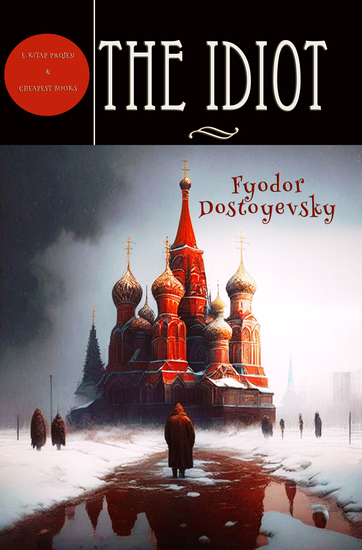
The Idiot - cover

The Idiot

Fyodor Dostoyevsky

Verlag: E-Kitap Projesi & Cheapest Books

  • 0
  • 0
  • 0

Beschreibung

Towards the end of November, during a thaw, at nine o'clock one morning, a train on the Warsaw and Petersburg railway was approaching the latter city at full speed. The morning was so damp and misty that it was only with great difficulty that the day succeeded in breaking; and it was impossible to distinguish anything more than a few yards away from the carriage windows.
Some of the passengers by this particular train were returning from abroad; but the third-class carriages were the best filled, chiefly with insignificant persons of various occupations and degrees, picked up at the different stations nearer town. All of them seemed weary, and most of them had sleepy eyes and a shivering expression, while their complexions generally appeared to have taken on the colour of the fog outside.

When day dawned, two passengers in one of the third-class carriages found themselves opposite each other. Both were young fellows, both were rather poorly dressed, both had remarkable faces, and both were evidently anxious to start a conversation. If they had but known why, at this particular moment, they were both remarkable persons, they would undoubtedly have wondered at the strange chance which had set them down opposite to one another in a third-class carriage of the Warsaw Railway Company.

One of them was a young fellow of about twenty-seven, not tall, with black curling hair, and small, grey, fiery eyes. His nose was broad and flat, and he had high cheek bones; his thin lips were constantly compressed into an impudent, ironical—it might almost be called a malicious—smile; but his forehead was high and well formed, and atoned for a good deal of the ugliness of the lower part of his face. A special feature of this physiognomy was its death-like pallor, which gave to the whole man an indescribably emaciated appearance in spite of his hard look, and at the same time a sort of passionate and suffering expression which did not harmonize with his impudent, sarcastic smile and keen, self-satisfied bearing. He wore a large fur—or rather astrachan—overcoat, which had kept him warm all night, while his neighbour had been obliged to bear the full severity of a Russian November night entirely unprepared. His wide sleeveless mantle with a large cape to it—the sort of cloak one sees upon travellers during the winter months in Switzerland or North Italy—was by no means adapted to the long cold journey through Russia, from Eydkuhnen to St. Petersburg.

Copyright, Illustrated version of "the Idiot" by e-Kitap Projesi, 2024
Verfügbar seit: 30.01.2024.
Drucklänge: 800 Seiten.
Weitere Bücher, die Sie mögen werden

  • The House of the Dead - Or Prison Life in Siberia - cover

    The House of the Dead - Or...

    Fyodor Dostoyevsky

    • 0
    • 0
    • 0
    The semiautobiographical prison account of convict Aleksandr Petrovich Goryanchikov, from the author of Crime and Punishment.   Originally published in 1862, The House of the Dead is based on Fyodor Dostoyevsky’s own four-year imprisonment in Siberia for his involvement in the Petrashevsky Circle. This masterpiece of Russian literature begins with a nameless narrator coming upon former convict Aleksandr Petrovich Goryanchikov in a remote Siberian town. Previously a nobleman and landowner, Goryanchikov had been given a ten-year sentence of hard labor for the murder of his wife, a crime of passion sparked by jealousy. After Goryanchikov’s death, the narrator finds a handwritten record of his decade of penal servitude. From his first days in the barracks, friendless and broken in spirit, to the removal of his shackles and freedom, Goryanchikov portrays the experiences of a “lost tribe of men,” and the horrors and degradation they experienced.  “Episodic, rambling, full of keen and deliberately stretched-out character sketches, the book is the drama of a person working out how to reproduce prison life in prose: its longueurs, its diversions, its pleasures, traumas, and inurements  . . . If Dostoyevsky’s captors had found the ribald, cacophonous commonplace book he assembled out of overheard insults and tossed-off sayings during his time in prison, they would have recognized that they were dealing with a spirit not easily suppressed.” —The Paris Review  “I know no better book in all modern literature.” —Leo Tolstoy
    Zum Buch
  • Pudd'nhead Wilson - cover

    Pudd'nhead Wilson

    Mark Twain

    • 0
    • 0
    • 0
    At the beginning of Pudd'nhead Wilson a young female slave, fearing for her infant son's life, exchanges her light-skinned child with her master's, leading to a novel whose plot rages as a savage indictment of racial prejudice and slavery. Written in 1894, Pudd'nhead Wilson is full of characteristic Twain humor and stands as a gem among the author's later works.
    
    Mark Twain, whose real name was Samuel Clemens, was the celebrated author of several novels, including two major classics of American literature: The Adventures of Tom Sawyer and Adventures of Huckleberry Finn. He was also a riverboat pilot, journalist, lecturer, entrepreneur, and inventor.
    Zum Buch
  • Traffic and Rebuilding (Unabridged) - cover

    Traffic and Rebuilding (Unabridged)

    H. G. Wells

    • 0
    • 0
    • 0
    Herbert George Wells (21 September 1866 - 13 August 1946) was an English writer. Prolific in many genres, he wrote dozens of novels, short stories, and works of social commentary, history, satire, biography and autobiography. His work also included two books on recreational war games. Wells is now best remembered for his science fiction novels and is often called the "father of science fiction", along with Jules Verne and the publisher Hugo Gernsback.
    TRAFFIC AND REBUILDING: The London traffic problem is just one of those questions that appeal very strongly to the more prevalent and less charitable types of English mind.
    Zum Buch
  • Metamorphosis - Audiobook - cover

    Metamorphosis - Audiobook

    Franz Kafka, English Audiobooks,...

    • 0
    • 0
    • 0
    The Metamorphosis by Franz Kafka is a haunting and thought-provoking novella that delves into themes of alienation, identity, and the human condition. The story begins with Gregor Samsa, a traveling salesman, waking up one morning to find himself transformed into a giant insect. This surreal event triggers a cascade of personal and familial upheavals as Gregor struggles to adapt to his new reality.As Gregor's condition isolates him from society and his family, Kafka masterfully explores the fragility of human relationships and the burden of societal expectations. The novella's sparse, yet evocative prose immerses readers in a world where the absurd becomes a lens for examining profound existential questions.The Metamorphosis remains one of the most celebrated works of modernist literature, offering a timeless exploration of the boundaries of humanity, the nature of compassion, and the search for meaning in an indifferent world.
    Zum Buch
  • The Piazza - cover

    The Piazza

    Herman Melville

    • 0
    • 0
    • 0
    The Piazza published by Herman Melville in 1856. The sketch describes Melville's farmhouse, called Arrowhead, in Pittsfield, Mass. Supposedly, the other tales in the collection, including "Bartleby the Scrivener" and "Benito Cereno," were narrated on the piazza of the farmhouse.
    Zum Buch
  • Les Misérables: Volume 4: The Idyll in the Rue Plumet and the Epic in the Rue St Denis - Book 7: Slang (Unabridged) - cover

    Les Misérables: Volume 4: The...

    Victor Hugo

    • 0
    • 0
    • 0
    Victor-Marie Hugo (26 February 1802 - 22 May 1885) was a French poet, novelist, essayist, playwright, and dramatist of the Romantic movement. During a literary career that spanned more than sixty years, he wrote abundantly in an exceptional variety of genres: lyrics, satires, epics, philosophical poems, epigrams, novels, history, critical essays, political speeches, funeral orations, diaries, and letters public and private, as well as dramas in verse and prose.
    BOOK 7: SLANG: Pigritia is a terrible word. It engenders a whole world, la pègre, for which read theft, and a hell, la pègrenne, for which read hunger.
    Zum Buch