Join us on a literary world trip!
Add this book to bookshelf
Grey
Write a new comment Default profile 50px
Grey
Subscribe to read the full book or read the first pages for free!
All characters reduced
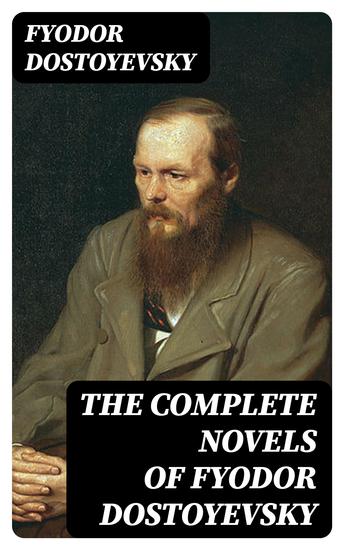
The Complete Novels of Fyodor Dostoyevsky - cover

The Complete Novels of Fyodor Dostoyevsky

Fyodor Dostoyevsky

Translator Constance Garnett

Publisher: DigiCat

  • 0
  • 0
  • 0

Summary

The Complete Novels of Fyodor Dostoyevsky presents a monumental collection of works that delve into the human psyche and explore existential themes through a distinctive literary style characterized by deep psychological insight and complex characterizations. Spanning from the morally ambiguous realms of "Crime and Punishment" to the philosophical musings of "The Brothers Karamazov," Dostoyevsky's oeuvre grapples with the intricacies of faith, free will, and moral ambiguity within the context of 19th-century Russian society. The interweaving of various narrative techniques, such as stream of consciousness and philosophical dialogues, enriches the reading experience, inviting readers to engage critically with the ethical dilemmas faced by his characters. Fyodor Dostoyevsky, a key figure in Russian literature, drew upon his tumultuous life experiences—including imprisonment, exile, and personal tragedy—to inform his writings. His time in a Siberian labor camp exposed him to the darker sides of human nature and society, which profoundly shaped his worldview. Dostoyevsky's struggles with poverty and mental illness, juxtaposed with his search for spiritual redemption, add layers of authenticity to his narratives, making them reflective of both personal and societal conflicts. Readers interested in existential philosophy and the moral quandaries of human existence will find The Complete Novels of Fyodor Dostoyevsky an essential addition to their literary canon. This collection not only showcases the author's profound understanding of faith and morality but also serves as a mirror reflecting the complexities of the human condition. It is a compelling invitation to explore the depths of inner turmoil and the quest for meaning.
Available since: 05/17/2022.
Print length: 3800 pages.

Other books that might interest you

  • Some Christmas Stories - cover

    Some Christmas Stories

    Charles Dickens

    • 0
    • 0
    • 0
    Some Christmas Stories by Charles Dickensis a collection of beautiful holiday stories first published in 1853 United Kingdom. Be inspired and moved by prose written in times long gone. Classic works of literature have memorable characters and offer profound and eternal reflections about the human condition.
    Contents: A Christmas Tree / What Christmas is as We Grow Older / The Poor Relation's Story / The Child's Story / The Schoolboy's Story / Nobody's Story
    Show book
  • History of Tom Jones a Foundling The - Book 8 (Unabridged) - cover

    History of Tom Jones a Foundling...

    Henry Fielding

    • 0
    • 0
    • 0
    A foundling of mysterious parentage brought up by Mr. Allworthy on his country estate, Tom Jones is deeply in love with the seemingly unattainable Sophia Western, the beautiful daughter of the neighboring squire though he sometimes succumbs to the charms of the local girls. When Tom is banished to make his own fortune and Sophia follows him to London to escape an arranged marriage, the adventure begins. A vivid Hogarthian panorama of eighteenth-century life, spiced with danger and intrigue, bawdy exuberance and good-natured authorial interjections, Tom Jones is one of the greatest and most ambitious comic novels in English literature.
    BOOK 8: As we are now entering upon a book in which the course of our history will oblige us to relate some matters of a more strange and surprizing kind than any which have hitherto occurred, it may not be amiss, in the prolegomenous or introductory chapter, to say something of that species of writing which is called the marvellous.
    Show book
  • Martin Eden - cover

    Martin Eden

    Jack London

    • 0
    • 0
    • 0
    Martin Eden by Jack London is the story of a self-taught sailor turned writer who rises from poverty to literary fame. Martin Eden, a working-class dreamer, falls in love with Ruth Morse, an upper-class woman whose family initially rejects him. Driven by ambition and passion, he educates himself voraciously, transforming into a skilled writer. As his works gain recognition, Martin grapples with alienation, disillusionment, and the emptiness of success. While Ruth embraces his achievements, their class differences and evolving values drive them apart. Ultimately, Martin’s existential despair leads to a tragic conclusion, reflecting London’s exploration of ambition, individualism, and the cost of pursuing one's dreams.
    Show book
  • Anne of Avonlea - cover

    Anne of Avonlea

    Lucy Maud Montgomery

    • 0
    • 0
    • 0
    Classic novel by L. M. Montgomery, sequel to the adored 'Anne of Green Gables'.  
    Anne tries her strength as the teacher at school and local community improver, with funny and memorable adventures on the way.
    Show book
  • A Room With a View - cover

    A Room With a View

    E. M. Forster

    • 0
    • 0
    • 0
    "A Room With a View" is a novel penned by E.M. Forster, first published in 1908. Set both in England and Italy, the narrative centers on the young Lucy Honeychurch and her development from a repressed and naive woman into a more self-assured and liberated individual. The story commences with Lucy's travels in Italy, where she meets George Emerson, a man who challenges her traditional Victorian values. After returning to England, Lucy finds herself torn between her attraction to George and her engagement to the conventional Cecil Vyse. Throughout the narrative, Forster delves into themes of love, societal conventions, self-realization, and the contrast between the repressive English society and the liberating effect of the Italian landscape.
    Show book
  • About Love - From their pens to your ears genius in every story - cover

    About Love - From their pens to...

    Anton Chekhov

    • 0
    • 0
    • 0
    Anton Pavlovich Chekhov was born on 29th January 1860 in Taganrog, on the south coast of Russia.  
    His family life was difficult; his father was strict and over-bearing but his mother was a passionate story-teller, a subject Chekhov warmed to. As he later said; ‘our talents we got from our father, but our soul from our mother’.  
    At school Chekhov was distinctly average. At 16 his father mis-managed his finances and was declared bankrupt. His family fled to Moscow. Chekhov remained and eked out a living by various means, including writing and selling short sketches to newspapers, to finish his schooling. That completed and with a scholarship to Moscow University obtained he rejoined his family. 
    He was able to help support them by selling satirical sketches and vignettes of Russian lifestyles and gradually obtained further commissions. In 1884, he qualified as a physician and, although it earned him little, he often treated the poor for free, he was fond of saying ‘Medicine is my lawful wife, and literature is my mistress.’ 
    His own health was now an issue as he began to cough up blood, a symptom of tuberculosis.  Despite this his writing success enabled him to move the family into more comfortable accommodation.  
    Chekhov wrote over 500 short stories which included many, many classics including ‘The Kiss’ and ‘The Lady with a Dog’.  His collection ‘At Dusk’ won him the coveted Pushkin Prize when was only 26.  
    He was also a major playwright beginning with the huge success of ‘Ivanov’ in 1887.   
    In 1892 Chekhov bought a country estate north of Moscow. Here his medical skills and money helped the peasants tackle outbreaks of cholera and bouts of famine. He also built three schools, a fire station and a clinic.  It left him with less time for writing but the interactions with real people gained him detailed knowledge about the peasantry and their living conditions for his stories.  
    His most famous work, ‘The Seagull’ was received disastrously at its premiere in St Petersburg. It was later restaged in Moscow to highlight its psychological aspects and was a huge success. It led to ‘Uncle Vanya’, ‘The Three Sisters’ and ‘The Cherry Orchard’.  
    Chekhov suffered a major lung hemorrhage in 1897 while visiting Moscow. A formal diagnosis confirmed tuberculosis and the doctors ordered changes to his lifestyle.  
    Despite a dread of weddings the elusive literary bachelor quietly married the actress Olga Knipper, whom he had met at rehearsals for ‘The Seagull’, on 25th May 1901. 
    By May 1904 with his tuberculosis worsening and death imminent he set off for the German town of Badenweiler writing cheerful, witty letters to his family and assuring them his health was improving.  
    On 15th July 1904 Anton Chekhov died at Badenweiler.  He was 44.
    Show book