Join us on a literary world trip!
Add this book to bookshelf
Grey
Write a new comment Default profile 50px
Grey
Subscribe to read the full book or read the first pages for free!
All characters reduced
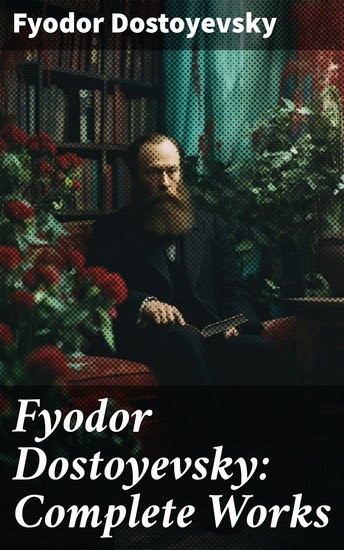
Fyodor Dostoyevsky: Complete Works - Enriched edition Exploring the Depths of Human Existence: A Collection of Psychological Masterpieces - cover

Fyodor Dostoyevsky: Complete Works - Enriched edition Exploring the Depths of Human Existence: A Collection of Psychological Masterpieces

Fyodor Dostoyevsky

Translator Constance Garnett, C.J. Hogarth, Ethel Colburn Mayne, John Middleton Murry, S.S. Koteliansky, Frederick Whishaw

Publisher: Good Press

  • 0
  • 0
  • 0

Summary

Fyodor Dostoyevsky: Complete Works is an invaluable compendium that encapsulates the profound depths of the human psyche explored through a myriad of literary forms, including novels, novellas, and short stories. Dostoyevsky's distinctive style'—characterized by philosophical dialogue, rich psychological insight, and an intricate portrayal of moral dilemmas'—reaches its zenith in this anthology. Placed within the context of the 19th-century Russian literary renaissance, his works reflect the tumultuous socio-political landscape of the time and the author's preoccupation with existential themes, the nature of free will, and the struggle between faith and doubt. This collection allows readers to traverse the spectrum of his thought, from the tormented convictions in "Crime and Punishment" to the spiritual awakening in "The Brothers Karamazov. Fyodor Dostoyevsky, a key figure in Russian literature, experienced a tumultuous life marked by poverty, exile, and personal loss, all of which heavily influenced his writing. A former political prisoner, Dostoyevsky's encounters with suffering allowed him to delve deeply into the moral complexities of humanity. His exploration of themes such as redemption, guilt, and the search for meaning often stem from his own struggles with faith and doubt, making his works deeply personal and universally significant. For those keen on understanding the intricacies of the human condition and the philosophical questions that haunt our existence, this complete works collection is indispensable. It serves not only as an introduction to Dostoyevsky's masterpieces but also as a profound exploration of the moral questions that resonate throughout time. This anthology invites readers to engage with timeless themes and reflects the continually relevant discourse on ethics, spirituality, and the human experience.

In this enriched edition, we have carefully created added value for your reading experience:
- A comprehensive Introduction outlines these selected works' unifying features, themes, or stylistic evolutions.
- The Author Biography highlights personal milestones and literary influences that shape the entire body of writing.
- A Historical Context section situates the works in their broader era—social currents, cultural trends, and key events that underpin their creation.
- A concise Synopsis (Selection) offers an accessible overview of the included texts, helping readers navigate plotlines and main ideas without revealing critical twists.
- A unified Analysis examines recurring motifs and stylistic hallmarks across the collection, tying the stories together while spotlighting the different work's strengths.
- Reflection questions inspire deeper contemplation of the author's overarching message, inviting readers to draw connections among different texts and relate them to modern contexts.
- Lastly, our hand‐picked Memorable Quotes distill pivotal lines and turning points, serving as touchstones for the collection's central themes.
Available since: 12/28/2023.
Print length: 5930 pages.


Other books that might interest you

  • Pride and Prejudice - cover

    Pride and Prejudice

    Jade Monroe

    • 0
    • 0
    • 0
    "Pride and Prejudice" is a classic novel written by Jane Austen, first published in 1813. The story is set in rural England in the early 19th century and follows the life of Elizabeth Bennet, the intelligent and spirited second daughter of the Bennet family. The novel explores themes of love, marriage, social class, and individual character. 
    Elizabeth navigates the challenges of her era, particularly the expectations placed on women regarding marriage and propriety. The central plot revolves around her evolving relationship with the wealthy and initially aloof Mr. Fitzwilliam Darcy. Their interactions are marked by misunderstandings, prejudices, and eventual personal growth, as both characters learn to look beyond their first impressions. 
    "Pride and Prejudice" is celebrated for its witty dialogue, keen observations of social manners, and richly developed characters. It remains one of the most beloved works in English literature, often noted for its timeless exploration of human relationships and society.
    Show book
  • The Poison Belt - cover

    The Poison Belt

    Arthur Conan Doyle

    • 0
    • 0
    • 0
    A follow up to Arthur Conan Doyles well known novel, The Lost World, the Poison Belt is a short story set over a single 24 hour span of time.On the Anniversary of their momentous trip to the Plateau, as depicted in The Lost World, the irascible Professor Challenger calls his companions to his home in Rochester with a curious directive: "Bring Oxygen". What can it mean? Does it have anything to do with his dire warnings printed in the Times that morning? Can it truly be, as he says... The End of the World?Written by Arthur Conan Doyle in 1913 and Narrated here by Michael Ward.
    Show book
  • Bartleby The Scrivener - A Story of Wall Street - cover

    Bartleby The Scrivener - A Story...

    Herman Melville

    • 0
    • 0
    • 0
    Bartleby, the Scrivener: A Story of Wall Street is a novella by the American novelist Herman Melville (1819–1891). It first appeared anonymously in two parts in the November and December 1853 editions of Putnam's Magazine, and was reprinted with minor textual alterations in his The Piazza Tales in 1856. 
     
    Among Melville's best-known works are Moby-Dick; Typee , a romanticized account of his experiences in Polynesia; and Billy Budd, Sailor, a posthumously published novella. Although his reputation was not high at the time of his death, the 1919 centennial of his birth was the starting point of a Melville revival, and Moby-Dick grew to be considered one of the great American novels. 
     
    During his last years, he privately published two volumes of poetry, and left one volume unpublished. The novella Billy Budd was left unfinished at his death, but was published posthumously in 1924. Melville died from cardiovascular disease in 1891.
    Show book
  • Candide - cover

    Candide

    Voltaire

    • 0
    • 0
    • 0
    Candide, ou l'Optimisme is a French satire first published in 1759 by Voltaire, a philosopher of the Age of Enlightenment. The novella has been widely translated, with English versions titled Candide: or, All for the Best (1759); Candide: or, The Optimist (1762); and Candide: Optimism (1947). It begins with a young man, Candide, who is living a sheltered life in an Edenic paradise and being indoctrinated with Leibnizian optimism by his mentor, Professor Pangloss. The work describes the abrupt cessation of this lifestyle, followed by Candide's slow and painful disillusionment as he witnesses and experiences great hardships in the world. Voltaire concludes Candide with, if not rejecting Leibnizian optimism outright, advocating a deeply practical precept, "we must cultivate our garden", in lieu of the Leibnizian mantra of Pangloss, "all is for the best" in the "best of all possible worlds".
    Candide is characterized by its tone as well as by its erratic, fantastical, and fast-moving plot. A picaresque novel with a story similar to that of a more serious coming-of-age narrative (Bildungsroman), it parodies many adventure and romance clichés, the struggles of which are caricatured in a tone that is bitter and matter-of-fact. Still, the events discussed are often based on historical happenings, such as the Seven Years' War and the 1755 Lisbon earthquake. As philosophers of Voltaire's day contended with the problem of evil, so does Candide in this short theological novel, albeit more directly and humorously. Voltaire ridicules religion, theologians, governments, armies, philosophies, and philosophers. Through Candide, he assaults Leibniz and his optimism.
    Candide has enjoyed both great success and great scandal. Immediately after its secretive publication, the book was widely banned to the public because it contained religious blasphemy, political sedition, and intellectual hostility hidden under a thin veil of naïveté. However, with its sharp wit and insightful portrayal of the human condition, the novel has since inspired many later authors and artists to mimic and adapt it. Today, Candide is considered as Voltaire's magnum opus and is often listed as part of the Western canon. It is among the most frequently taught works of French literature. The British poet and literary critic Martin Seymour-Smith listed Candide as one of the 100 most influential books ever written.
    Show book
  • Man and the Cannon The (Unabridged) - cover

    Man and the Cannon The (Unabridged)

    Victor Hugo

    • 0
    • 0
    • 0
    Victor-Marie Hugo 26 February 1802 - 22 May 1885) was a French poet, novelist, essayist, playwright, and dramatist of the Romantic movement. During a literary career that spanned more than sixty years, he wrote abundantly in an exceptional variety of genres: lyrics, satires, epics, philosophical poems, epigrams, novels, history, critical essays, political speeches, funeral orations, diaries, and letters public and private, as well as dramas in verse and prose.
    THE MAN AND THE CANNON: One of the carronades of the battery, a twenty-four pounder, had broken loose. This is the most dangerous accident that can possibly take place on shipboard. Nothing more terrible can happen to a sloop of war in open sea and under full sail.
    Show book
  • Meditations - cover

    Meditations

    Marcus Aurelius

    • 0
    • 0
    • 0
    Written in Greek by the only Roman emperor who was also a philosopher, without any intention of publication, the Meditations of Marcus Aurelius offer a remarkable series of challenging spiritual reflections and exercises developed as the emperor struggled to understand himself and make sense of the universe. While the Meditations were composed to provide personal consolation and encouragement, Marcus Aurelius also created one of the greatest of all works of philosophy: a timeless collection that has been consulted and admired by statesmen, thinkers and readers throughout the centuries.
    Show book