Junte-se a nós em uma viagem ao mundo dos livros!
Adicionar este livro à prateleira
Grey
Deixe um novo comentário Default profile 50px
Grey
Assine para ler o livro completo ou leia as primeiras páginas de graça!
All characters reduced
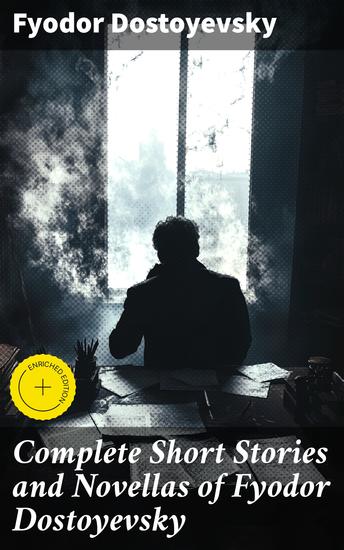
Complete Short Stories and Novellas of Fyodor Dostoyevsky - Enriched edition Exploring Existentialism and Morality in Dostoyevsky's Lesser-Known Works - cover
LER

Complete Short Stories and Novellas of Fyodor Dostoyevsky - Enriched edition Exploring Existentialism and Morality in Dostoyevsky's Lesser-Known Works

Fyodor Dostoyevsky

Tradutor Constance Garnett

Editora: Good Press

  • 0
  • 0
  • 0

Sinopse

In "Complete Short Stories and Novellas of Fyodor Dostoyevsky," the reader is invited to explore the rich tapestry of human experience as depicted through Dostoyevsky's masterful prose. This collection showcases the author's signature style, characterized by profound psychological insight, existential queries, and an exploration of morality within the human soul. Spanning various themes such as redemption, suffering, and the duality of good and evil, these short stories and novellas articulate the turbulent socio-political landscape of 19th century Russia, while delving deeply into the innermost thoughts and conflicts of his characters. Fyodor Dostoyevsky, a seminal figure in Russian literature, faced personal trials that profoundly shaped his literary voice. His experiences with poverty, imprisonment, and existential despair fueled his exploration of complex human emotions and moral dilemmas. Dostoyevsky's own confrontations with faith and nihilism are reflected in these stories, offering a glimpse into the tumultuous life that influenced his writing and the philosophical underpinnings of his work. This compilation is an essential read for anyone interested in the fundamental questions of existence and the human condition. It stands as a testament to Dostoyevsky's unparalleled ability to weave intricate narratives that challenge readers to confront their own beliefs and values, making it a cornerstone of literary exploration that remains relevant today.

In this enriched edition, we have carefully created added value for your reading experience:
- A comprehensive Introduction outlines these selected works' unifying features, themes, or stylistic evolutions.
- The Author Biography highlights personal milestones and literary influences that shape the entire body of writing.
- A Historical Context section situates the works in their broader era—social currents, cultural trends, and key events that underpin their creation.
- A concise Synopsis (Selection) offers an accessible overview of the included texts, helping readers navigate plotlines and main ideas without revealing critical twists.
- A unified Analysis examines recurring motifs and stylistic hallmarks across the collection, tying the stories together while spotlighting the different work's strengths.
- Reflection questions inspire deeper contemplation of the author's overarching message, inviting readers to draw connections among different texts and relate them to modern contexts.
- Lastly, our hand‐picked Memorable Quotes distill pivotal lines and turning points, serving as touchstones for the collection's central themes.
Disponível desde: 06/01/2024.
Comprimento de impressão: 2560 páginas.

Outros livros que poderiam interessá-lo

  • The Land That Time Forgot - cover

    The Land That Time Forgot

    Edgar Rice Burroughs

    • 0
    • 0
    • 0
    A group of intrepid explorers stumbles upon a hidden, prehistoric land trapped in a time warp. Led by the brave and resourceful scientist, Dr. Hath, they soon find themselves under attack by ferocious creatures and a ruthless tribe of dinosaurs. As the explorers struggle to survive and escape, they learn that the land is governed by an ancient, mysterious force that can reshape time itself. Along the way, they encounter a surprising ally, a young woman named Thora, who holds the key to their escape. This gripping adventure explores the power of nature and the resilience of the human spirit, as the explorers fight to return to their own time and save Thora from the dinosaurs' clutches.
    Ver livro
  • Candide - cover

    Candide

    Voltaire

    • 0
    • 0
    • 0
    Candide, ou l'Optimisme is a French satire first published in 1759 by Voltaire, a philosopher of the Age of Enlightenment. The novella has been widely translated, with English versions titled Candide: or, All for the Best (1759); Candide: or, The Optimist (1762); and Candide: Optimism (1947). It begins with a young man, Candide, who is living a sheltered life in an Edenic paradise and being indoctrinated with Leibnizian optimism by his mentor, Professor Pangloss. The work describes the abrupt cessation of this lifestyle, followed by Candide's slow and painful disillusionment as he witnesses and experiences great hardships in the world. Voltaire concludes Candide with, if not rejecting Leibnizian optimism outright, advocating a deeply practical precept, "we must cultivate our garden", in lieu of the Leibnizian mantra of Pangloss, "all is for the best" in the "best of all possible worlds".
    Candide is characterized by its tone as well as by its erratic, fantastical, and fast-moving plot. A picaresque novel with a story similar to that of a more serious coming-of-age narrative (Bildungsroman), it parodies many adventure and romance clichés, the struggles of which are caricatured in a tone that is bitter and matter-of-fact. Still, the events discussed are often based on historical happenings, such as the Seven Years' War and the 1755 Lisbon earthquake. As philosophers of Voltaire's day contended with the problem of evil, so does Candide in this short theological novel, albeit more directly and humorously. Voltaire ridicules religion, theologians, governments, armies, philosophies, and philosophers. Through Candide, he assaults Leibniz and his optimism.
    Candide has enjoyed both great success and great scandal. Immediately after its secretive publication, the book was widely banned to the public because it contained religious blasphemy, political sedition, and intellectual hostility hidden under a thin veil of naïveté. However, with its sharp wit and insightful portrayal of the human condition, the novel has since inspired many later authors and artists to mimic and adapt it. Today, Candide is considered as Voltaire's magnum opus and is often listed as part of the Western canon. It is among the most frequently taught works of French literature. The British poet and literary critic Martin Seymour-Smith listed Candide as one of the 100 most influential books ever written.
    Ver livro
  • Metropolis - cover

    Metropolis

    Thea von Harbou

    • 0
    • 0
    • 0
    This book is not of today or of the future. It tells of no place. It serves no cause, party or class. It has a moral which grows on the pillar of understanding: The mediator between brain and muscle must be the Heart. — Thea von Harbou, in the novel's original epigraph Originally published in German in 1925, this expressionist epic tells a story about class difference and love in a city that boasts technological growth at the expense of exploited laborers, contending with the relationship between advances in technology and social progress. Written in tandem with the 1927 science-fiction film of the same name, which was directed by Thea von Harbou's husband Fritz Lang, the story, through both the novel and the film, has inspired and influenced countless works of art, creating a legacy that extends across the science-fiction genre and beyond it.
    Ver livro
  • A Piece of Steak - American author of The Call Of The Wild & White Fang brings a biting story about a poverty stricken aging boxer and his plight - cover

    A Piece of Steak - American...

    Jack London

    • 0
    • 0
    • 0
    John Griffith Chaney was born on January 12th, 1876 in San Francisco.   
     
    His father, William Chaney, was living with Flora Wellman when she became pregnant.  Chaney insisted she have an abortion.  Flora's response was to turn a gun on herself.  Although her wounds were not severe the trauma made her temporarily deranged. 
     
    In late 1876 his mother married John London and the young child was brought to live with them as they moved around the Bay area, eventually settling in Oakland where now, calling himself Jack, he completed grade school. 
     
    Jack worked hard at several jobs, sometimes 12-18 hours a day, but his dream was university.  He studied hard and borrowed the money to enrol in the summer of 1896 at the University of California in Berkeley. 
     
    In 1897, at 21, Jack searched out newspaper accounts of his mother's suicide attempt and for the name of his biological father. He wrote to Chaney, then living in Chicago, who claimed he could not be Jack’s father because he was impotent and casually asserted that London's mother had relations with other men.  Jack, devastated by the response, quit Berkeley and went to the Klondike. Other accounts suggest that his dire finances presented Jack with the excuse he needed to leave. 
     
    In the Klondike Jack began to gather material for his writing but also accumulated many health problems, including scurvy, which together with hip and leg problems he would carry for the rest of his life. 
     
    During the late 1890's Jack was regularly publishing short stories and by the turn of the century full blown novels. 
     
    By 1904 Jack had married, fathered two children and was now in the process of divorcing.  A stint as a reporter on the Russo-Japanese war of 1904 was equal amounts trouble and experience. But that experience was always put to good use in a continuing and remarkable output of work. 
     
    In 1905 he married Charmian Kittredge who at last was a soul and companion who brought him some semblance of peace despite his advancing alcoholism and his incurable wanderlust. 
     
    Twelve years later Jack had amassed both wealth and a literary reputation through such classics as ‘The Call of the Wild’, ‘White Fang’ and many others. He had a reputation as a social activist and was a tireless friend of the workers.   
     
    Jack London died suffering from dysentery, late-stage alcoholism and uremia, aged only 40, on November 22nd 1916 at his property in Glen Elen in California 
     
    In ‘A piece of Steak’ an ageing prizefighter seeks one last win. Not for glory, or to revisit fame, but simply to put food on the table and keep his family together.  But to do that he must beat a highly rated up and coming adversary.
    Ver livro
  • The Vengeance of Nitocris - Short story from the dramatic great written when he was 16 years old - cover

    The Vengeance of Nitocris -...

    Tennessee Williams writing as...

    • 0
    • 0
    • 0
    The bookshelves of American literature are incredible collections that have gathered together centuries of very talented authors.  From this continent their fame spread and whilst among their number many are now forgotten or neglected their talents endure.  Among them is Clark Ashton Smith.
    Ver livro
  • Ella D'Arcy - A Short Story Collection - An anthology from underrated female author D'Arcy her sparkling psychologically realist style covered themes such as marriage family and society - cover

    Ella D'Arcy - A Short Story...

    Ella D'Arcy

    • 0
    • 0
    • 0
    Ella D'Arcy was born on 23rd August 1857 in London, one of nine children.  
     
    Her education spanned London, Germany, France and the Channel Islands. A student of fine art, her poor eyesight meant a switch to literature was needed and with this she had hopes to be an author. 
     
    She worked as a contributor and unofficial editor, alongside Henry Harland, to The Yellow Book, Aubrey Beardsley’s sensational quarterly magazine that combined art, stories, poetry, essays and much else besides.  D'Arcy wrote several stories for the magazine and her stories have an undeniable psychological and realist style through her engagement with various themes from marriage, the family, imitation through to deception.  
     
    Recognition of her talents grew after the publication of ‘Irremediable’, in the Yellow Book, where it received much praise from critics.   
     
    She also wrote and published in the Argosy, Blackwood's Magazine, and Temple Bar.  
     
    However, D’Arcy’s canon was small and, apart from her magazine stories, her book publishing was limited to ‘Monochromes’ (1895), ‘Modern Instances’ and ‘The Bishop’s Dilemma’ (1898). She also translated André Maurois's biography of Percy Bysshe Shelley entitled ‘Ariel’ (1924). 
     
    Her diligence with work aside she was notorious for her inability to maintain relationships with friends.  When she did appear to them it was often unannounced.  This earned her the sobriquet 'Goblin Ella.' 
     
    D'Arcy spent much of her life living alone, though she had a constant urge to travel, but usually she resided on the edge of poverty. Her writing was often motivated by this need. 
     
    Much of her later life was spent in Paris before returning to London in 1937, where she died, in hospital, on 5th September 1937. 
     
    01 - Ella D'Arcy - A Short Story Collection - An Introduction 
    02 - At Twickenham by Ella D'Arcy 
    03 - White Magic by Ella D'Arcy 
    04 - Irremediable by Ella D'Arcy 
    05 - The Death Mask by Ella D'Arcy 
    06 - Sir Julian Garve by Ella D'Arcy
    Ver livro