Join us on a literary world trip!
Add this book to bookshelf
Grey
Write a new comment Default profile 50px
Grey
Subscribe to read the full book or read the first pages for free!
All characters reduced
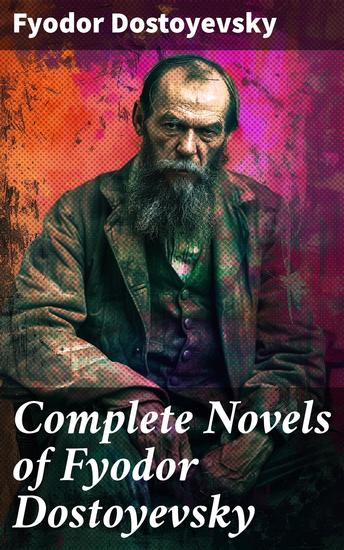
Complete Novels of Fyodor Dostoyevsky - Exploring Human Nature and Moral Dilemmas in Russian Literary Masterpieces - cover

Complete Novels of Fyodor Dostoyevsky - Exploring Human Nature and Moral Dilemmas in Russian Literary Masterpieces

Fyodor Dostoyevsky

Translator Constance Garnett

Publisher: Good Press

  • 0
  • 0
  • 0

Summary

The "Complete Novels of Fyodor Dostoyevsky" collates the intricate tapestry of a master storyteller, who delves deeply into the labyrinth of the human psyche. Spanning iconic works such as "Crime and Punishment," "The Brothers Karamazov," and "Demons," this collection showcases Dostoyevsky's exceptional capacity for blending philosophical inquiry with gripping narrative style. His unique approach, characterized by intense character studies and moral dilemmas, situates his novels within the broader context of 19th-century Russian literature and its exploration of existentialism, faith, and societal disintegration. Fyodor Dostoyevsky (1821-1881) emerged from the shadows of hardship and personal turmoil, experiences that intricately shaped his literary vision. His encounters with poverty, imprisonment, and profound spiritual crisis informed his fascination with the complexities of human nature, morality, and redemption. This comprehensive anthology allows readers to appreciate Dostoyevsky's transformative period as he evolved from a sociopolitical critic to a profound psychologist of the soul, influencing generations of writers and thinkers. For readers seeking a profound engagement with the intricacies of human emotion and moral conflict, the "Complete Novels of Fyodor Dostoyevsky" is indispensable. This collection not only offers a gateway into the turbulent minds of its characters but also invites reflection on the universal struggles of existence, making it essential for both literary scholars and casual readers alike.
Available since: 01/06/2024.
Print length: 3800 pages.

Other books that might interest you

  • O Pioneers! - cover

    O Pioneers!

    Willa Cather

    • 0
    • 0
    • 0
    "O Pioneers!" is one of Willa Cather's most celebrated novels, published in 1913. It's the first book in her "Great Plains Trilogy" and is set in the rural farming community of Hanover, Nebraska, at the turn of the 20th century. The story focuses on the life of Alexandra Bergson, a strong-willed young woman who inherits her father's farm and must navigate the challenges of frontier life. Cather paints a rich portrait of the American Midwest, exploring themes of immigration, the relationship between people and the land they inhabit, and the enduring spirit of the pioneers who sought to tame it.
    Show book
  • The Diary Of A Dead Officer - The Classic Tale - cover

    The Diary Of A Dead Officer -...

    Arthur Graeme West

    • 0
    • 0
    • 0
    Published posthumously in 1919, this collection of diary entries presents a scathing picture of army life and is said to be one of the most vivid accounts of daily life in the trenches. It chronicles West's increasing disillusion with war and his move toward pacifist and atheist beliefs. The final part consists of his powerful war poems, including God, How I Hate You, You Young Cheerful Men, and Night Patrol. West was killed by a sniper in 1917. In view of some of his poems, one wonders if death was not unwelcome. Arthur Graeme West was a British writer and war poet. West was born in Eaton, Norfolk, educated at Highgate School, then Blundell's School and Balliol College, Oxford, and killed by a sniper in 1917.
    Show book
  • The Tragedy of a Comic Song - Hilarious story written in the early 20th century - cover

    The Tragedy of a Comic Song -...

    Leonard Merrick

    • 0
    • 0
    • 0
    The bookshelves of British literature are incredible collections that have gathered together centuries of very talented authors.  From these Isles their fame spread and whilst among their number many are now forgotten or neglected their talents endure.  Among them is Walter Besant.
    Show book
  • Conscience - A Judith Lee Detective Story - cover

    Conscience - A Judith Lee...

    Richard Marsh

    • 0
    • 0
    • 0
    Richard Bernard Heldmann was born on 12th October 1857, in St Johns Wood, North London.  
     
    By his early 20’s Heldmann began publishing fiction for the myriad magazine publications that had sprung up and were eager for good well-written content.  
     
    In October 1882, Heldmann was promoted to co-editor of Union Jack, a popular magazine, but his association with the publication ended suddenly in June 1883.  It appears Heldman was prone to issuing forged cheques to finance his lifestyle.  In April 1884 he was sentenced to 18 months hard labour. 
      
    In order to be well away from the scandal and the damage that this had caused to his reputation Heldmann adopted a pseudonym on his release from jail.  Shortly thereafter the name ‘Richard Marsh’ began to appear in the literary periodicals.  The use of his mother’s maiden name as part of it seems both a release and a lifeline. 
     
    A stroke of very good fortune arrived with his novel ‘The Beetle’ published in 1897.  This would turn out to be his greatest commercial success and added some much-needed gravitas to his literary reputation.   
     
    Marsh was a prolific writer and wrote almost 80 volumes of fiction as well as many short stories, across many genres from horror and crime to romance and humour.   His unusual characters, plotting devices and other literary developments have identified his legacy as one of the best British writers of his time.   
     
    Richard Marsh died from heart disease in Haywards Heath in Sussex on 9th August 1915.  He was 57.
    Show book
  • Aloysha the Pot - From their pens to your ears genius in every story - cover

    Aloysha the Pot - From their...

    Leo Tolstoy

    • 0
    • 0
    • 0
    Leo Tolstoy was born in 1828 in the Russian province of Tula to a wealthy noble family. As a child, he had private tutors but he showed little interest in any formal education. When he went to the University of Kazan in 1843 to study oriental languages and law, he left without completing his courses.  Life now was relaxed and idle but with some writing also taking place.  Gambling debts forced an abrupt change of path and he joined the army to fight in the Crimean War.  He was commended for his bravery and promoted but was appalled at the brutality and loss of life.  He recorded these and other earlier experiences in his diaries which formed the basis of several of his works. 
    In 1852 ‘Childhood’ was published to immediate success and was followed by ‘Boyhood’ and ‘Youth’. 
    His experience in the army and the horrors he witnessed resulted in ‘The Cossacks’ in 1862 and the trilogy ‘Sevastopol Tales’. After the war he travelled around Europe, visiting London and Paris and meeting such luminaries as Victor Hugo and Charles Darwin.  
    It was now that Tolstoy began his masterpiece, ‘War and Peace’. Published in 1869 it was an epic work that changed literature. He quickly followed this with ‘Anna Karenina’.  
    These successes made Tolstoy rich and helped him accomplish many of his dreams but also brought problems as he grappled with his faith and the lot of the oppressed poor. These revolutionary views became so popular that the authorities now kept him under surveillance.  
    He led a life of asceticism and vegetarianism and put his socialist ideals into practice by establishing numerous schools for the poor and food programmes. He also believed in giving away his wealth, which caused much discord with his wife.  
    His writing continued to bring forth classics such as ‘The Death of Ivan Ilyich’ and many brilliant and incisive short stories such as ‘How Much Land Does A Man Need’.  
    In 1901 Tolstoy was excommunicated from the Church and controversially deselected for the Nobel Prize for Literature. 
    Whilst undertaking a pilgrimage by train in October 1910 with his daughter Aleksandra he caught pneumonia in the nearby town of Astapovo.  Leo Tolstoy died on November 9th, 1910, he was 82.
    Show book
  • Tempest The (Unabridged) - cover

    Tempest The (Unabridged)

    Charles Dickens

    • 0
    • 0
    • 0
    Charles Dickens was a writer and social critic who created some of the world's best-known fictional characters and is regarded as the greatest novelist of the Victorian era. His works enjoyed unprecedented popularity during his lifetime, and by the twentieth century critics and scholars had recognised him as a literary genius. His novels and short stories enjoy lasting popularity.
    THE TEMPEST: It was a murky confusion here and there blotted with a color like the color of the smoke from damp fuel of flying clouds tossed up into most remarkable heaps, suggesting greater heights in the clouds than there were depths below them to the bottom of the deepest hollows in the earth, through which the wild moon seemed to plunge headlong, as if, in a dread disturbance of the laws of nature, she had lost her way and were frightened.
    Show book