Join us on a literary world trip!
Add this book to bookshelf
Grey
Write a new comment Default profile 50px
Grey
Subscribe to read the full book or read the first pages for free!
All characters reduced
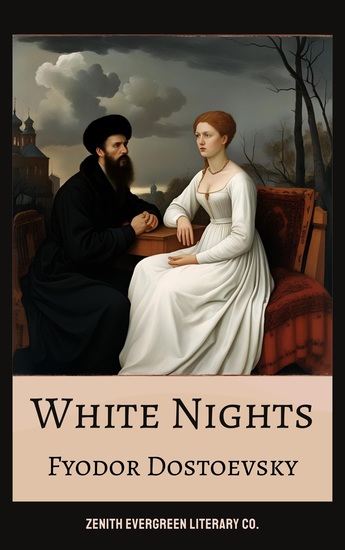
White Nights - A Dreamlike Tale of Love Loneliness and Ephemeral Hope - cover

White Nights - A Dreamlike Tale of Love Loneliness and Ephemeral Hope

Fyodor Dostoevsky, Zenith Evergreen Literary Co.

Publisher: Zenith Evergreen Literary Co.

  • 0
  • 0
  • 0

Summary

What if the most beautiful moment of your life lasted only four nights?

White Nights by Fyodor Dostoevsky is a poetic and tender story of an unnamed dreamer in St. Petersburg who meets a lonely young woman, Nastenka, over the course of four magical evenings. As their confessions unfold beneath the twilight skies, Dostoevsky crafts a delicate exploration of hope, heartbreak, and the fragile bonds of human connection.

A moving tale of longing and imagination, this early work showcases Dostoevsky's emotional depth and literary grace—long before his darker philosophical novels.

💬 "A soft, sorrowful symphony for solitary souls—a timeless reflection on love and what could have been."

🌌 Why Readers Are Drawn to It:
Perfect for fans of The Little Prince, Notes from Underground, and The Yellow Wallpaper

A brilliant introduction to Dostoevsky's romantic and humanist side

Widely studied in courses on Russian literature, romanticism, and modernist fiction

📣 Four Nights. One Connection. A Lifetime Remembered.
Buy White Nights today and immerse yourself in a story where emotion glows as gently as the midnight sun.
Available since: 04/25/2025.
Print length: 70 pages.
Other books that might interest you

  • The Prince and the Pauper - cover

    The Prince and the Pauper

    Mark Twain

    • 0
    • 0
    • 0
    Step into the cobbled streets of 16th-century London in The Prince and the Pauper, Mark Twain’s classic tale of mistaken identity, compassion, and the contrast between privilege and poverty. When two boys—Tom Canty, born in the slums of Offal Court, and Edward Tudor, heir to the English throne—meet and discover their uncanny resemblance, they impulsively swap clothes... and lives. What begins as a game leads to a life-altering adventure as each must navigate a world utterly foreign to them. Through hardship and revelation, they gain a deeper understanding of justice, dignity, and humanity. 
    This abridged edition, narrated with heartfelt nuance by Joe Reeder, brings Twain’s sharp wit and deep empathy to new and seasoned listeners alike. A timeless reflection on class and character, this story speaks just as powerfully today as it did over a century ago.
    Show book
  • Sheridan Le Fanu - Six of the Best - Their legacy in 6 classic stories - cover

    Sheridan Le Fanu - Six of the...

    Sheridan Le Fanu

    • 0
    • 0
    • 0
    Six has always been a number we group things around – Six of the best, six of one half a dozen of another, six feet under, six pack, six degrees of separation and a sixth sense are but a few of the ways we use this number. 
     
    Such is its popularity that we thought it is also a very good way of challenging and investigating an author’s work to give width, brevity, humour and depth across six of their very best. 
     
    In this series we gather together authors whose short stories both rivet the attention and inspire the imagination to visit their gems in a series of six, to roam across an author’s legacy in a few short hours and gain a greater understanding of their writing and, of course, to be lavishly entertained by their ideas, their narrative and their way with words. 
     
    These stories can be surprising and sometimes at a tangent to what we expected, but each is fully formed and a marvellous adventure into the world and words of a literary master.
    Show book
  • The Chamomile Drops - From their pens to your ears genius in every story - cover

    The Chamomile Drops - From their...

    Jaroslav Hašek

    • 0
    • 0
    • 0
    The bookshelves of European literature are incredible collections that have gathered together centuries of very talented authors.  From this continent their fame spread and whilst among their number many are now forgotten or neglected their talents endure.  Among them is Jaroslav Hasek.
    Show book
  • Ben Pitcher's Elly - Mann delves into the human psyche with great touch in this story of murder and parenting - cover

    Ben Pitcher's Elly - Mann delves...

    Mary E. Mann

    • 0
    • 0
    • 0
    Mary Rackham was born in Norwich on 14th August 1848 to a merchant family.  Little is known of her early life and her biography only re-appears in September 1871 with marriage to Fairman Joseph Mann, a farmer with 800 acres.   
     
    Mary moved to Shropham, Norfolk and became involved with the workhouse, visiting the sick and other unfortunates of the parish, her observations and experiences a valuable source for her later stories.  
     
    She took up writing, partly to offset the dreary village life of her surroundings, in the 1880s and published her first novel, ‘The Parish of Hilby’ (1883) at her own expense. It was well received by the critics.  
     
    Thus began a career that spanning three decades provided thirty-three novels, hundreds of short stories, and fourteen plays.  Her work was largely focused on rural life in Norfolk and centered on the fictional town of Dulditch, with grim but authentic accounts of poverty and deprivation.  
     
    Her marriage produced one boy and three girls. With her husband's death in 1913, she moved to Sheringham.  
     
    She is regarded as a major contributor to East Anglian literature with particular praise given to her short stories. 
     
    Mary E Mann died on 19th May 1929.  She was 80.  Her grave-marker is a carved open book with the epitaph ‘We bring our years to an end, as if it were a tale that is told’. 
     
    Life in ‘Ben Pitcher's Elly’ is degrading, awful and unvarnished.  The chances of this young girl having a happy life are remote but her story must be heard.
    Show book
  • A Hero of our Time - Abridged for Intermediate English-Language Students (B1+ B2) - cover

    A Hero of our Time - Abridged...

    Mikhail Lermontov, Gerhard Symons

    • 0
    • 0
    • 0
    This is an abridged audiobook of A Hero of our Time in English. It is intended for intermediate English-language students (CEFR: level B1+/B2). 
    This audiobook is a simplified version of the classic story by nineteenth-century author Mikhail Lermontov (1814-1841). 
    It is abridged and narrated by Gerhard Symons, a native English speaker with a neutral English accent. 
    The audiobook run time is seven hours and five minutes (425 minutes). The audiobook is enhanced with appropriate sound effects throughout. 
    -- 
    A FIGHTER AND A LOVER. A HERO OR A VILLAIN? 
    It is a time of war. A young army officer, Pechorin, has arrived in the Caucasus. Pechorin is a nobleman who is handsome, charming, and rich. He enjoys hunting wild pigs, 16-year-old Circassian princesses, and power. He is also selfish, violent, and rather bored with life. Whoever he meets is changed forever... 
    You will follow him through five stories. You will read his private diary. You will penetrate the secrets of a human soul. And you will ask yourself, “who is Pechorin?” 
    © 2022 Three Thrushes
    Show book
  • Philosopher's Public Library The (Unabridged) - cover

    Philosopher's Public Library The...

    H. G. Wells

    • 0
    • 0
    • 0
    Herbert George Wells (21 September 1866 - 13 August 1946) was an English writer. Prolific in many genres, he wrote dozens of novels, short stories, and works of social commentary, history, satire, biography and autobiography. His work also included two books on recreational war games. Wells is now best remembered for his science fiction novels and is often called the "father of science fiction", along with Jules Verne and the publisher Hugo Gernsback.
    THE PHILOSOPHER'S PUBLIC LIBRARY: Suppose a philosopher had a great deal of money to spend-though this is not in accordance with experience, it is not inherently impossible-and suppose he thought, as any philosopher does think, that the British public ought to read much more and better books than they do, and that founding public libraries was the way to induce them to do so, what sort of public libraries would he found? That, I submit, is a suitable topic for a disinterested speculator.
    Show book