Join us on a literary world trip!
Add this book to bookshelf
Grey
Write a new comment Default profile 50px
Grey
Subscribe to read the full book or read the first pages for free!
All characters reduced
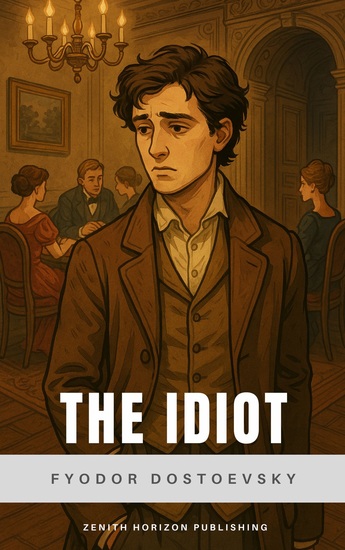
The Idiot - Fyodor Dostoevsky's Masterpiece of Innocence and Tragedy - cover

The Idiot - Fyodor Dostoevsky's Masterpiece of Innocence and Tragedy

Fyodor Dostoevsky, Zenith Horizon Publishing

Publisher: Zenith Horizon Publishing

  • 0
  • 0
  • 0

Summary

🧠💔 What happens when the most innocent man enters the most corrupt society?
The Idiot by Fyodor Dostoevsky is one of the greatest novels ever written—an unforgettable journey into the soul of a man too good for the world around him. Prince Myshkin, a gentle and open-hearted nobleman, returns to Russian high society only to face cruelty, betrayal, and manipulation at every turn ⚔️🎭.

With philosophical depth, emotional weight, and a tragic resonance that rivals Hamlet or Othello, The Idiot explores questions of morality, mental health, and spiritual redemption with unmatched power.

Why this book continues to move readers around the world:
✔ "A character study of moral brilliance and spiritual grace."
✔ "An epic tale of love, madness, and loss."
✔ For fans of Tolstoy, Camus, Kafka, and Nabokov 💡📚🔥

This premium edition includes:
🖼️ Illustrations and a clean layout
📜 A preface and reading guide
📱 Kindle-enhanced formatting for seamless navigation

📥 Download The Idiot today and immerse yourself in Dostoevsky's most moving and provocative novel.
Available since: 06/06/2025.
Print length: 720 pages.

Other books that might interest you

  • A Midsummer Night's Dream - cover

    A Midsummer Night's Dream

    William Shakespeare

    • 0
    • 0
    • 0
    "Midsummer Night's Dream" is Shakespeare's classic tale of two couples who can't quite pair up to everyone's satisfaction. Demetrius and Lysander love Hermia. Hermia loves Lysander but has been promised to Demetrius by her father. Hermia's best friend Helena loves Demetrius, but in his obsession for Hermia Demetrius barely even notices her smitten friend. When Hermia and Lysander plan to elope all four find themselves in the forest late at night where the fairy Puck and his lord Oberon wreck havoc on the humans with a love potion that causes the victim to fall in love with the first thing they see upon waking. -     Some Books of Shakespeare:    - Romeo and Juliet (1597)    - Hamlet (1599)    - Macbeth (1606)    - Julius Caesar (1599)    - Othello (1603)    - The Merchant of Venice (1598)    - Much Ado About Nothing (1600)    - King Lear (1606    - The Taming of the Shrew (1594)    - The Comedy of Errors (1594)
    Show book
  • Sense and Sensibility - cover

    Sense and Sensibility

    Jane Austen

    • 0
    • 0
    • 0
    Sense and Sensibility tells the story of the Dashwood sisters, Elinor and Marianne. Left almost penniless and homeless on the death of their father, each needs to resolve their problems by marrying well. But fate takes them on a bumpy road as impetuous Marianne falls for the duplicitous Willoughby while Elinor seems to be unlucky in love. As ever, Austen resolves her heroines' fortunes in her inimitable and witty way.
    Show book
  • King Pest - cover

    King Pest

    SAMPI Books, Edgar Allan Poe

    • 0
    • 0
    • 0
    "King Pest" is a short story by Edgar Allan Poe in which two drunken sailors, Legs and Hugh, enter a strange house during a plague in London. There, they encounter a bizarre court led by King Pest and his grotesque entourage, resulting in strange and darkly funny events.
    Show book
  • Rikki-Tikki-Tavi - The First Jungle Book - cover

    Rikki-Tikki-Tavi - The First...

    Rudyard Kipling

    • 0
    • 0
    • 0
    "Rikki-Tikki-Tavi" is a short story in the 1894 anthology The Jungle Book by Rudyard Kipling about the adventures of a valiant young Indian mongoose.
    An English family have just moved to a house in India. They find Rikki-Tikki-Tavi the mongoose flooded out of his burrow. A pair of large cobras, Nag and Nagaina, attempt unsuccessfully to kill him. He hears the cobras plotting to kill the father in the house, and attacks Nag in the bathroom. The sound of the fight attracts the father, who shoots Nag. Rikki-Tikki-Tavi destroys Nagaina's eggs and chases her into her "rat-hole" where he kills her too.
    Show book
  • Diplomacy - From their pens to your ears genius in every story - cover

    Diplomacy - From their pens to...

    Lafcadio Hearn

    • 0
    • 0
    • 0
    Lafcadio Hearn was born on the 27th June 1850 on the Ionian isle of Levkás in Greece to a British Army officer and a Greek Mother. 
    His father, fearing for his career prospects at being married to a Greek Orthodox wife, sent them to Dublin whilst he continued to advance his career with further postings.  Life there was difficult for mother and son.  His father returned, wounded and traumatised, when Lafcadio was three.  He annulled the marriage and she remarried but had to give up care of Lafcadio to her sister-in law.   
    After brief periods for Catholic education in England and France he emigrated to Ohio in the United States when he was 19, taking on a series of casual jobs before embarking on a career as a journalist, publishing poems and essays in Cincinnati.  It was whilst here that he began a side-line in translating, starting with Gautier and Flaubert.  He married in 1874 to a 20 year old African-American woman in violation of Ohio's anti-miscegenation law.  The marriage soon failed. 
    In 1877 he relocated to New Orleans to write on a variety of themes before picking up a two year assignment from Harper’s to write in the West Indies, where he also wrote his first novel. 
    In 1890 Harper’s sent him to Japan.  Here he left journalism and took the remarkable decision to become a schoolteacher in the north of Japan.   Enraptured by the culture he was driven to explain it in various Western publications to those who had little, if any, knowledge of its culture.  Within the year he had fallen in love with, and married, a high-born Japanese lady, together they would have four children.   
    In 1895 he became a Japanese national and took the name Koizumi Yakumo, Koizumi being his wife’s family name. 
    The following few years, whilst a professor of Literature at the Imperial University of Japan, were his most creative and admired period.   
    Lafcadio Hearn died of heart failure on the 26th of September 1904, in Tokyo, Japan shortly before leaving to deliver a series of lectures at Cornell University in New York State.  He was 54.
    Show book
  • Buddenbrooks - The Decline of a Family - cover

    Buddenbrooks - The Decline of a...

    Thomas Mann

    • 0
    • 0
    • 0
    Buddenbrooks is a 1901 novel by Thomas Mann, chronicling the decline of a wealthy north German merchant family over the course of four generations, incidentally portraying the manner of life and mores of the Hanseatic bourgeoisie in the years from 1835 to 1877. Mann drew deeply from the history of his own family, the Mann family of Lübeck, and their milieu.
    It was Mann's first novel, published when he was twenty-six years old. With the publication of the second edition in 1903, Buddenbrooks became a major literary success. Its English translation by Helen Tracy Lowe-Porter was published in 1924. The work led to a Nobel Prize in Literature for Mann in 1929; although the Nobel award generally recognises an author's body of work, the Swedish Academy's citation for Mann identified "his great novel Buddenbrooks" as the principal reason for his prize.
    Mann began writing the book in October 1897, when he was twenty-two years old. The novel was completed three years later, in July 1900, and published in 1901. His objective was to write a novel on the conflicts between businessman and artist's worlds, presented as a family saga, continuing in the realist tradition of such 19th-century works as Stendhal's Le Rouge et le Noir (1830; The Red and the Black). Buddenbrooks is his most enduringly popular novel, especially in Germany, where it has been cherished for its intimate portrait of 19th-century German bourgeois life.
    Before Buddenbrooks Mann had written only short stories, which had been collected under the title Der kleine Herr Friedemann (1898, Little Herr Friedemann). They portrayed spiritually challenged figures who struggle to find happiness in (or at the margins of) bourgeois society. Similar themes appear in the Buddenbrooks, but in a fully developed style that already reflects the mastery of narrative, subtle irony of tone, and rich character descriptions of Mann's mature fiction.
    The exploration of decadence in the novel reflects the influence of Schopenhauer's The World as Will and Representation (1818, 1844) on the young Mann. The Buddenbrooks of successive generations experience a gradual decline of their finances and family ideals, finding happiness increasingly elusive as values change and old hierarchies are challenged by Germany's rapid industrialisation. The characters who subordinate their personal happiness to the welfare of the family firm encounter reverses, as do those who do not.
    The city where the Buddenbrooks live shares so many street names and other details with Mann's native town of Lübeck that the identification is unmistakable, although the novel makes no mention of the name. The young author was condemned for writing a scandalous, defamatory roman à clef about (supposedly) recognisable personages. Mann defended the right of a writer to use material from his own experience.
    The years covered in the novel were marked by major political and military developments that reshaped Germany, such as the Revolutions of 1848, the Austro-Prussian War, and the establishment of the German Empire. Historic events nevertheless generally remain in the background, having no direct bearing on the lives of the characters.
    Show book