Join us on a literary world trip!
Add this book to bookshelf
Grey
Write a new comment Default profile 50px
Grey
Subscribe to read the full book or read the first pages for free!
All characters reduced
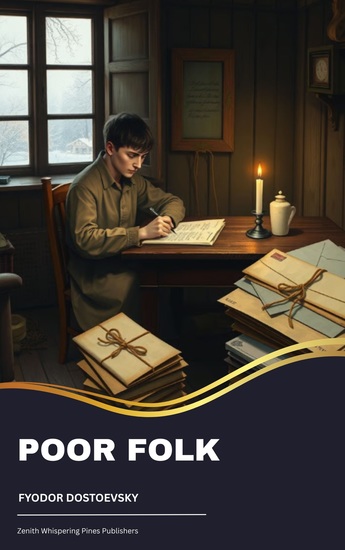
Poor Folk - cover

Poor Folk

Fyodor Dostoevsky

Translator CJ Hogarth

Publisher: Zenith Whispering Pines Publishers

  • 0
  • 0
  • 0

Summary

Two lonely souls. One shared hardship. A love written in letters that reveal everything they fear to say aloud.
Told through intimate correspondence, Poor Folk follows humble clerk Makar Devushkin and young Varenka Dobroselova as they struggle against poverty, humiliation, and the quiet sorrow of life on society's margins. Their letters—filled with hope, shame, affection, and unspoken longing—create a portrait of human dignity that glows even in the darkest circumstances.

Praised as "a stunning debut that announced Dostoevsky's genius," this novel blends social critique with deep emotional insight. Readers cherish its tenderness, realism, and the aching beauty of two people trying to comfort each other when the world offers them nothing.

If you love heartfelt stories, powerful character voices, and classics that illuminate the resilience of the human spirit, this novel will move you deeply.

Open the letters—and witness a love sustained by hope when everything else seems lost.
Available since: 12/08/2025.
Print length: 172 pages.
Other books that might interest you

  • The Flax - cover

    The Flax

    H. C. Andersen

    • 0
    • 0
    • 0
    Classic short story by H. Ch. Andersen, written from the perspective of the flax.
    Show book
  • Twenty-Six Men and a Girl - From their pens to your ears genius in every story - cover

    Twenty-Six Men and a Girl - From...

    Maxim Gorky

    • 0
    • 0
    • 0
    Alexei Maximovich Peshkov was born on 28th March 1868, in Nizhny Novgorod, Russia. 
    Better known as Maxim Gorky he was orphaned at 11 and ran away from home at 12.  At 19 he had already attempted suicide and thereafter travelled, by foot, across the Russian Empire for 5 years. 
    His first book ‘Essays & Stories’ in 1898 was a sensation and so began a long career as an author of short stories, novels and plays.  Gorky saw writing as a moral and political act that would help to change the unjust world around him.  He was an ardent early advocate of the emerging Marxist movement and publicly opposed the Tsarist regime leading several times to his arrest.  
    In 1904 he began his own theatre but the censor banned every play and Gorky was forced to abandon the project. 
    But Gorky was a financially successful author, editor, and playwright and gave monies to political parties as well as for civil rights and social reform.  The brutal shooting of workers, which set in motion the Revolution of 1905, pushed Gorky more decisively toward radical solutions.  
    In 1906 he went to the United States to raise funds for the Bolsheviks. Those experiences including a scandal over travelling with his lover and not his wife deepened his contempt for the ‘bourgeois soul.’ 
    Gorky now moved to Capri in Italy, both for health reasons and to escape the increasingly repressive times in Russia.  
    An amnesty for the 300th anniversary of the Romanov dynasty saw him return to Russia in 1914. His politics remained close to the Bolshevik cause.  But soon, after the 1918 revolution, his essays referred to Lenin as a tyrant for his senseless arrests and repression.  He was soon appealing to the outside world for food aid after the catastrophic crop failure. 
    In October 1921 Gorky returned to Italy, now in Fascist hands, and settled in Sorrento until 1932.  His health worsened with the onset of tuberculosis. 
    He wrote several successful books there but now decided to find an understanding with the communist regime. Stalin invited him home and his return was hailed as a major propaganda victory.  He was decorated with the Order of Lenin, and a province, a park, and various streets re-named in his honour. 
    But he had his faults too.  In 1933, Gorky co-edited a book on the White Sea-Baltic Canal and denied even a single prisoner died during its construction, but thousands had. As well, knowing that some Nazis were homosexual, a phrase was attributed to him that said ‘exterminate all homosexuals and fascism will vanish’.  Although he was himself was quoting another he was decidedly homophobic. 
    With the increase of Stalinist repression in 1935 Gorky was placed under unannounced house arrest. 
    Maxim Gorky died on the 18th June 1936 from pneumonia.  He was 68. 
    Stalin and Molotov were among those who carried Gorky's urn of ashes at his funeral.
    Show book
  • Will the Empire Live? (Unabridged) - cover

    Will the Empire Live? (Unabridged)

    H. G. Wells

    • 0
    • 0
    • 0
    Herbert George Wells (21 September 1866 - 13 August 1946) was an English writer. Prolific in many genres, he wrote dozens of novels, short stories, and works of social commentary, history, satire, biography and autobiography. His work also included two books on recreational war games. Wells is now best remembered for his science fiction novels and is often called the "father of science fiction", along with Jules Verne and the publisher Hugo Gernsback.
    WILL THE EMPIRE LIVE?: What will hold such an Empire as the British together, this great, laxly scattered, sea-linked association of ancient states and new-formed countries, Oriental nations, and continental colonies? What will enable it to resist the endless internal strains, the inevitable external pressures and attacks to which it must be subjected This is the primary question for British Imperialism; everything else is secondary or subordinated to that.
    Show book
  • Flatland - cover

    Flatland

    Edward Abbott

    • 0
    • 0
    • 0
    Edwin A. Abbott's droll and delightful 'romance of many dimensions' explores this conundrum in the experiences of his protagonist, A Square, whose linear world is invaded by an emissary Sphere bringing the gospel of the third dimension on the eve of the new millennium.
    
    Part geometry lesson, part social satire, this classic work of science fiction brilliantly succeeds in enlarging all readers' imaginations beyond the limits of our 'respective dimensional prejudices. In a world where class is determined by how many sides you possess, and women are straight lines, the prospects for enlightenment are boundless, and Abbott's hypotheses about a fourth and higher dimensions seem startlingly relevant today.
    Show book
  • Seven Keys to Baldpate - cover

    Seven Keys to Baldpate

    George M. Cohan

    • 0
    • 0
    • 0
    Introducing the captivating digital audiobook version of "Seven Keys to Baldpate," the timeless play by the legendary George M. Cohan!  
     
    Unlock a world of suspense, mystery, and intrigue as you immerse yourself in this thrilling tale. With our high-quality audio production, you'll be transported to the enigmatic Baldpate Inn, where secrets lurk around every corner. 
     
    Listen as the masterful storytelling of George M. Cohan unfolds, weaving a web of unexpected twists and turns. Lose yourself in the richly crafted characters and feel the tension mount as they chase after the elusive seven keys that hold the inn's secrets. 
     
    The digital audiobook version adds an extra layer of depth to the experience, as talented narrators breathe life into the dialogue and expertly convey the play's emotions. You'll find yourself on the edge of your seat, eagerly following the characters on their thrilling journey.
    Show book
  • A Man Could Stand Up — - cover

    A Man Could Stand Up —

    Ford Madox

    • 0
    • 0
    • 0
    There are not many English novels which deserve to be called great: Parade's End is one of them. — W. H. Auden  
    A Man Could Stand Up — is the third of four installments in Ford Madox Ford's Parade's End tetralogy, which follows Christopher Tietjens, a wealthy British landowner and the last British Tory; his unfaithful wife, Sylvia; and his mistress, Valentine Wannop.   
    Opening on Armistice Day (November 11, 1918), A Man Could Stand Up — serves as the climax of the series. Highlighting the tension between traditional values and a rapidly changing social order, the novel details Christopher and Valentine's trials as the post-war world takes shape around them.  
    Unique among other war fiction of the time, the Parade's End tetralogy privileges not the conflict of World War I itself, but the impact the war had on its participants and upon society writ large. With it's publication, Ford hoped to contribute to the obviating of all future wars. Parade's End is often referred to as one of the greatest 20th century novels, and one of the best depictions of war in literature. The 2012 television adaptation, written by Tom Stoppard and starring Benedict Cumberbatch and Rebecca Hall, was nominated for two Primetime Emmy Awards and seven BAFTA Television Awards.
    Show book