Join us on a literary world trip!
Add this book to bookshelf
Grey
Write a new comment Default profile 50px
Grey
Subscribe to read the full book or read the first pages for free!
All characters reduced
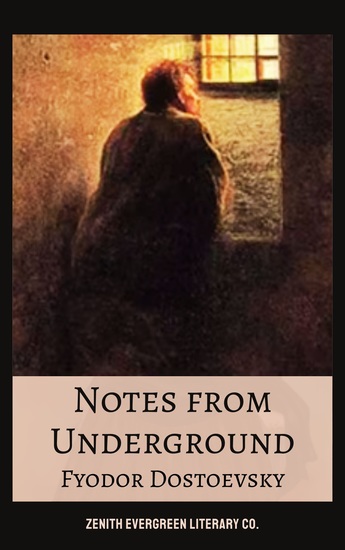
Notes from Underground - Fyodor Dostoevsky's Profound Exploration of Human Nature - cover

Notes from Underground - Fyodor Dostoevsky's Profound Exploration of Human Nature

Fyodor Dostoevsky, Zenith Evergreen Literary Co.

Publisher: Zenith Evergreen Literary Co.

  • 0
  • 0
  • 0

Summary

🌌 Step into the mind of the Underground Man with Notes from Underground, Fyodor Dostoevsky's groundbreaking novella that challenges societal norms and delves into the contradictions of human nature. This philosophical masterpiece is a journey into existential despair and rebellion. 🕯️

📖 Follow the unnamed narrator, a bitter and isolated former civil servant, as he reflects on his life, thoughts, and interactions with society. Through his erratic and introspective monologue, Dostoevsky critiques rationalism, determinism, and the quest for meaning, creating a seminal work of realist literature. 💔

🏆 First published in 1864, Notes from Underground remains one of Dostoevsky's most celebrated works, offering profound insights into the human psyche and the complexities of modern existence. 🌟

👉 Click "Buy Now" to experience a literary classic that will challenge your perceptions and leave you pondering life's deepest questions.
Available since: 04/11/2025.
Print length: 136 pages.


Other books that might interest you

  • Hamlet | Shakespeare for kids - Shakespeare in a language kids will understand and love - cover

    Hamlet | Shakespeare for kids -...

    Jeanette Vigon

    • 0
    • 0
    • 0
    Embark on a magical journey into the heart of Denmark with "Hamlet," adapted from the legendary William Shakespeare's masterpiece by Jeanette Vigon. This book breathes new life into the classic tale, making it accessible and captivating for young readers. Dive into a world where castles hold whispered secrets, jesters offer riddles that spark the imagination, and young Prince Hamlet confronts mysteries that will test his courage and reveal the essence of true friendship. 
    Key Highlights:Simplified for Young Minds: Jeanette Vigon masterfully adapts Shakespeare's intricate language and complex themes into a format that's engaging and understandable for children.A World of Intrigue and Adventure: Explore the foggy kingdom of Denmark through the eyes of Prince Hamlet, reimagined for kids with ghostly encounters, playful jesters, and secret plots.Lessons in Courage and Integrity: Amidst the adventure, young readers will find valuable lessons about bravery, honesty, and staying true to oneself. 
    Whether you're a parent seeking to introduce your child to the wonders of Shakespeare, or a young reader eager for a tale of mystery and adventure, "Hamlet" offers a perfect blend of education and entertainment. Join Hamlet, Horatio, and a memorable cast of characters in an unforgettable exploration of friendship, loyalty, and the quest for truth.
    Show book
  • Importance of Being Reliable The (Unabridged) - cover

    Importance of Being Reliable The...

    Booker T. Washington

    • 0
    • 0
    • 0
    Booker Taliaferro Washington (April 5, 1856 - November 14, 1915) was an American educator, author, orator, and adviser to several presidents of the United States. Between 1890 and 1915, Washington was the dominant leader in the African American community and of the contemporary black elite. Washington was from the last generation of black American leaders born into slavery and became the leading voice of the former slaves and their descendants. They were newly oppressed in the South by disenfranchisement and the Jim Crow discriminatory laws enacted in the post-Reconstruction Southern states in the late 19th and early 20th centuries.
    THE IMPORTANCE OF BEING RELIABLE :I am going to call your attention this evening to a tendency of the people of our race which I had occasion to notice in the course of a visit recently made to certain portions of North Carolina and South Carolina.
    Show book
  • Three Sundays in a Week - cover

    Three Sundays in a Week

    Edgar Allan Poe

    • 0
    • 0
    • 0
    “Three Sundays in a Week,” published in 1841, was written by Edgar Allan Poe. Poe, best known for his tales of ratiocination, fantastical horror, and genre-founding detective stories, tells the story of Bobby, who wants to marry cousin Kate. Uncle Rumgudgeon says he can—when there are three Sundays in a week.
    Show book
  • Eyes for the Blind - From their pens to your ears genius in every story - cover

    Eyes for the Blind - From their...

    Frederick Cowles

    • 0
    • 0
    • 0
    Frederick Ignatius Cowles was born in 1900 in Cambridge, England. 
    This unfamiliar name is one of the gems of English supernatural fiction as well as several other works of travelogues, history, folklore, and children's books.  
    When his supernatural short stories, and some are very short indeed, were first published they were compared to the works of M R James and EF Benson, yet unlike those two authors he fell, unfairly, into obscurity. 
    In all he wrote perhaps 60 short stories with weird and supernatural themes. 
    Frederick Cowles died in 1948 although some accounts offer that it was 1949.
    Show book
  • Before the Supreme Court - From their pens to your ears genius in every story - cover

    Before the Supreme Court - From...

    Lafcadio Hearn

    • 0
    • 0
    • 0
    Lafcadio Hearn was born on the 27th June 1850 on the Ionian isle of Levkás in Greece to a British Army officer and a Greek Mother. 
    His father, fearing for his career prospects at being married to a Greek Orthodox wife, sent them to Dublin whilst he continued to advance his career with further postings.  Life there was difficult for mother and son.  His father returned, wounded and traumatised, when Lafcadio was three.  He annulled the marriage and she remarried but had to give up care of Lafcadio to her sister-in law.   
    After brief periods for Catholic education in England and France he emigrated to Ohio in the United States when he was 19, taking on a series of casual jobs before embarking on a career as a journalist, publishing poems and essays in Cincinnati.  It was whilst here that he began a side-line in translating, starting with Gautier and Flaubert.  He married in 1874 to a 20 year old African-American woman in violation of Ohio's anti-miscegenation law.  The marriage soon failed. 
    In 1877 he relocated to New Orleans to write on a variety of themes before picking up a two year assignment from Harper’s to write in the West Indies, where he also wrote his first novel. 
    In 1890 Harper’s sent him to Japan.  Here he left journalism and took the remarkable decision to become a schoolteacher in the north of Japan.   Enraptured by the culture he was driven to explain it in various Western publications to those who had little, if any, knowledge of its culture.  Within the year he had fallen in love with, and married, a high-born Japanese lady, together they would have four children.   
    In 1895 he became a Japanese national and took the name Koizumi Yakumo, Koizumi being his wife’s family name. 
    The following few years, whilst a professor of Literature at the Imperial University of Japan, were his most creative and admired period.   
    Lafcadio Hearn died of heart failure on the 26th of September 1904, in Tokyo, Japan shortly before leaving to deliver a series of lectures at Cornell University in New York State.  He was 54.
    Show book
  • Crime and Punishment - The Original Manuscript - cover

    Crime and Punishment - The...

    Fyodor Dostoyevsky

    • 0
    • 0
    • 0
    Crime and Punishment is the second of Fyodor Dostoyevsky's full-length novels following his return from 5 years of exile in Siberia, and is considered the first great novel of his "mature" period of writing. The novel focuses on the mental anguish and moral dilemmas of Rodion Raskolnikov, an impoverished ex-student in St. Petersburg who formulates and executes a plan to kill an unscrupulous pawnbroker for her cash. Raskolnikov, in an attempt to defend his actions, argues that with the pawnbroker's money he can perform good deeds to counterbalance the crime while ridding the world of a vermin, and to test a theory of his that some people are naturally superior and have the right to commit crimes if it is in pursuit of a higher purpose. 
    Show book