Join us on a literary world trip!
Add this book to bookshelf
Grey
Write a new comment Default profile 50px
Grey
Subscribe to read the full book or read the first pages for free!
All characters reduced
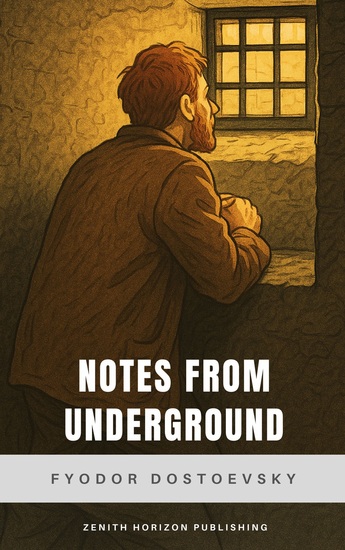
Notes from the Underground - Fyodor Dostoevsky's Existential Manifesto on Free Will Suffering and Human Contradiction - cover

Notes from the Underground - Fyodor Dostoevsky's Existential Manifesto on Free Will Suffering and Human Contradiction

Fyodor Dostoevsky, Zenith Horizon Publishing

Publisher: Zenith Horizon Publishing

  • 0
  • 0
  • 0

Summary

🕳️ "I am a sick man... I am a spiteful man."
So begins one of the most unsettling and powerful monologues in literature. Notes from Underground is Fyodor Dostoevsky's philosophical tour de force—a bold rejection of rationalism and utopian thinking, narrated by an unnamed, bitter, and self-loathing narrator 💬💥🧠.

Set in St. Petersburg, this novella shatters Enlightenment optimism and dives deep into the irrational human psyche. It's a psychological warzone of contradiction, freedom, and suffering—laying the groundwork for modern existentialism.

Why thinkers and readers keep coming back:
✔ "The blueprint of existential thought before Sartre and Camus."
✔ "Unmatched psychological depth and philosophical daring."
✔ A vital read for those who question society, logic, and even themselves 🧩📚🕯️

This enhanced edition includes:
📜 Introductory essay on Dostoevsky's philosophical context
🎨 Minimalist illustrations to enhance the atmosphere
📱 Kindle-smart navigation for a seamless reading experience

📥 Download Notes from Underground now and confront the twisted brilliance of a mind at war with itself.
Available since: 06/06/2025.
Print length: 144 pages.
Other books that might interest you

  • The Story of Joan of Arc - cover

    The Story of Joan of Arc

    Andrew Lang

    • 0
    • 0
    • 0
    Joan of Arc’s tale is one of faith, courage, and destiny. In The Story of Joan of Arc, Andrew Lang recounts the extraordinary life of the young peasant girl who, guided by divine visions, led the French army to victory during the Hundred Years’ War. From her humble beginnings in Domrémy to her triumphant leadership in battle, and ultimately, her tragic trial and martyrdom, Joan’s story remains one of the most compelling in history. 
    Blending historical fact with gripping storytelling, Lang brings Joan’s journey to life, capturing her unwavering spirit and the challenges she faced in a world dominated by war and political intrigue. The Story of Joan of Arc is an inspiring account of faith and perseverance, a timeless legend that continues to captivate readers and listeners alike. 
    This edition, narrated by Luke Oldham, immerses audiences in the grandeur of medieval France, providing a powerful and evocative experience of Joan’s life and legacy.
    Show book
  • Frazzlebrain - Break Free from Anxiety Anger and Stress Using Advanced Discoveries in Neuropsychology - cover

    Frazzlebrain - Break Free from...

    PhD Gina Simmons Schneider

    • 0
    • 0
    • 0
    If you feel frazzled, you dwell in good company. Racing between the demands of work, health, family, and friends, many people report feelings of worry, irritability, and increasing stress. While we often cannot control stressful life events, we can learn to control our brain's response to those circumstances and reduce our suffering. 


    Drawing from the latest research and more than twenty-five years of clinical experience, Dr. Gina Simmons Schneider explains the link between anxiety, anger, and stress and shares groundbreaking remedies from neuropsychology. These tools will strengthen your resilience and expand your capacity for happiness. 


    In Frazzlebrain, you'll discover how to: 


    ● Soften your response to stress 


    ● Overcome toxic self-criticism 


    ● Tame hostile and cynical thinking 


    Each chapter offers exercises, case examples, and self-improvement skills to help you achieve a calmer, happier, healthier lifestyle.
    Show book
  • Nazca Civilization - The Enigmatic Lines and the Desert Kingdom of Peru - cover

    Nazca Civilization - The...

    Rolf Hedger

    • 0
    • 0
    • 0
    The Nazca civilization emerged along the southern coast of present-day Peru, a harsh and arid region that required ingenuity and adaptation for survival. Flourishing between approximately 100 BCE and 800 CE, the Nazca people built upon the cultural and technological advancements of their predecessors, most notably the Paracas culture. The transition from the Paracas to the Nazca was marked by shifts in artistic expression, religious practices, and innovations in agriculture that allowed the new civilization to thrive in the desert landscape. 
    One of the defining characteristics of the Nazca civilization was its ability to adapt to the unforgiving environment. The region’s climate was dry, with little rainfall, yet the Nazca found ways to harness the limited water supply to sustain their agricultural economy. They engineered underground aqueducts known as puquios, a sophisticated irrigation system that transported water from underground sources to the surface, ensuring a steady supply for crops. This ingenuity allowed them to cultivate maize, beans, squash, and cotton, which became essential to their diet and economy. 
    The Nazca culture was also shaped by its geography. The valleys of the Rio Grande de Nazca provided fertile land where the civilization’s settlements and ceremonial centers flourished. Unlike the grand urban centers of the Andean highlands, the Nazca people lived in smaller, dispersed communities that relied on a combination of agriculture and trade. These communities were connected by a shared cultural and religious framework that revolved around the worship of powerful deities linked to nature, fertility, and water.
    Show book
  • World War I on the Ground: The History and Legacy of Life in the Trenches - cover

    World War I on the Ground: The...

    Editors Charles River

    • 0
    • 0
    • 0
    World War I, also known in its time as the “Great War” or the “War to End all Wars”, was an unprecedented holocaust in terms of its sheer scale. Fought by men who hailed from all corners of the globe, it saw millions of soldiers do battle in brutal assaults of attrition which dragged on for months with little to no respite. Tens of millions of artillery shells and untold hundreds of millions of rifle and machine gun bullets were fired in a conflict that demonstrated man’s capacity to kill each other on a heretofore unprecedented scale, and as always, such a war brought about technological innovation at a rate that made the boom of the Industrial Revolution seem stagnant. 
    The enduring image of World War I is of men stuck in muddy trenches, and of vast armies deadlocked in a fight neither could win. It was a war of barbed wire, poison gas, and horrific losses as officers led their troops on mass charges across No Man’s Land and into a hail of bullets. While these impressions are all too true, they hide the fact that trench warfare was dynamic and constantly evolving throughout the war as all armies struggled to find a way to break through the opposing lines. 
    There was another war going on beneath the trenches, a war of tunnels and mines fought by men who didn’t see sunlight for days at a time and who lived in constant fear of cave-ins and enemy detection. These men, who had mostly been miners in civilian life, lived a twilight existence, working long hours in silence and near darkness while great battles raged overhead. They suffered from fatigue, stress, and the knowledge that they could be killed at any time by an unseen enemy. Despite this, they persevered, and the mines they laid under enemy trench systems turned the tide of at least one major battle.
    Show book
  • Title IX Pat Summitt and Tennessee's Trailblazers - 50 Years 50 Stories - cover

    Title IX Pat Summitt and...

    Mary Ellen Pethel

    • 0
    • 0
    • 0
    In June 1972, President Richard Nixon put pen to paper and signed the Educational Amendments of 1972 into law. The nearly 150-page document makes no mention of “gender,” “athletics,” “girls,” or “women.” The bill did not appear to contain anything earth shattering. But tucked into its final pages, a heading appears, “Title IX—Prohibition of Sex Discrimination.” These 37 words would change the world for girls and women across the United States. On its face, Title IX legally guaranteed equal opportunity in education. In time, Title IX would serve as the tipping point for the modern era of women’s sport. Slowly but surely, women’s athletics at the high school and collegiate levels grew to prominence, and Tennessee fast emerged as a national leader. 
    In Title IX, Pat Summitt, and Tennessee’s Trailblazers, Mary Ellen Pethel introduces readers to past and present pioneers—each instrumental to the success of women’s athletics across the state and nation. Through vibrant profiles, Pethel celebrates the lives and careers of household names like Pat Summitt and Candace Parker, as well as equally important forerunners such as Ann Furrow and Teresa Phillips. Through their lived experiences, these fifty individuals laid the foundation for athletic excellence in Tennessee, which in turn shaped the national landscape for women’s sports. 
    With interviewees ranging from age 20 to 93, Pethel artfully combines storytelling with scholarship. Guided by the voices of the athletes, coaches, and administrators, Pethel vividly documents achievement and adversity, wins and losses, and advice for the next generation. This book represents the first statewide compilation of its kind—offering readers a behind-the- scenes perspective of Tennessee women who dedicated their lives to the advancement of sport and gender equality. Readers will delight in Title IX, Pat Summitt, and Tennessee’s Trailblazers: 50 Years, 50 Stories. For more follow @drpethel.
    Show book
  • Andrew Jackson - American Lawyer Soldier and 7th President of the United States - cover

    Andrew Jackson - American Lawyer...

    Kelly Mass

    • 0
    • 0
    • 0
    Andrew Jackson was an American attorney, soldier, and statesman who acted as the seventh president of the U.S. from 1829 to 1837. Jackson rose to prominence as a basic in the US Army and served in both homes of Congress before being chosen to the presidency. 
    Jackson, an expansionist president, defended the rights of the "commoner" and the Union against a "corrupt upper class." 
    Jackson ended up being a frontier attorney and married Rachel Donelson Robards after being born in the settler Carolinas an entire decade before the American Revolutionary War. He belonged to the US Legislature and the US Senate from Tennessee for a brief time. After giving up, he served on the Tennessee Supreme Court as a justice from 1798 till 1804. 
    Jackson ended up being a rich, slave-owning planter after buying a residential or commercial property referred to as The Hermitage. In the year 1801, he was selected colonel of the Tennessee militia, and the following year, he was chosen its leader. Throughout the Creek War of 1813 to 1814, he led forces to success in the Battle of Horseshoe Bend. 
    Let’s take a look at what else Andrew Jackson did in his life.
    Show book