Join us on a literary world trip!
Add this book to bookshelf
Grey
Write a new comment Default profile 50px
Grey
Subscribe to read the full book or read the first pages for free!
All characters reduced
Schopenhauer as Educator - cover

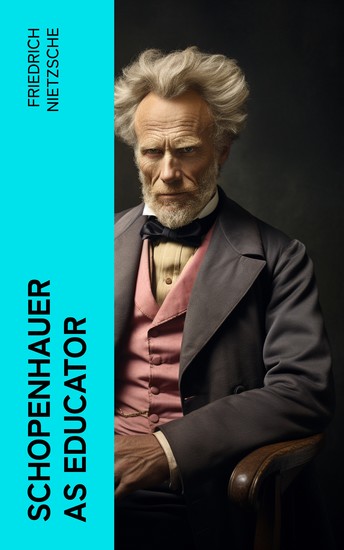
Schopenhauer as Educator

Friedrich Nietzsche

Translator Adrian Collins

Publisher: e-artnow

  • 0
  • 0
  • 0

Summary

Friedrich Nietzsche's 'Schopenhauer as Educator,' published in 1876, is an extended but lively philosophical work that is thought-provoking. In this extended essay, Nietzsche describes education as knowing oneself--a task requiring almost herculean effort.
Available since: 12/08/2023.
Print length: 70 pages.

Other books that might interest you

  • Rise Fall and Rebirth of Chicago The: The History and Legacy of America’s Third Largest City - cover

    Rise Fall and Rebirth of Chicago...

    Editors Charles River

    • 0
    • 0
    • 0
    Though it started as a 300 person settlement in 1832, Chicago’s location near the Great Lakes and its access to the Mississippi River turned it into a major trading city overnight. The city became even more important when railroads were constructed to connect the country, making it the first major city in the “West” during the mid-19th century. By 1871, the original 300 person settlement was now home to about 300,000 people, and Chicago had become the first major city built by Americans rather than European colonial powers  
    	Thus, it had taken less than 40 years for the new settlement of 300 to become a city of nearly 300,000, but it only took two days in 1871 for much of it to be destroyed. On the night of October 8, 1871, a blaze in the southwestern section of Chicago began to burn out of control. The popular legend is that a cow in Mrs. Catherine O’Leary’s barn had kicked over a lantern and started a fire. The story blaming the cow was a colorful fabrication, but the fire itself was very real, lasting almost two whole days and devouring several square miles of the city. The fire was so powerful that firefighters could not put it out, due to dry conditions, stiff winds, and the fact the city was mostly made of wood. 
    	Walking around Chicago today, it’s easy to forget about its past as a rural frontier. That’s due in no small part to the way Chicago responded to the Great Fire of 1871. Immediately after the fire, Chicago encouraged inhabitants and architects to build over the ruins, spurring creative architecture with elaborate designs. Architects descended upon the city for the opportunity to rebuild the area, and over the next few decades they had rebuilt Chicago with the country’s most modern architecture and monuments.  
    	Chicago recovered well enough within 20 years to win the right to host the World’s Fair in 1893.
    Show book
  • Nazi ufo - cover

    Nazi ufo

    Raphael Terra

    • 0
    • 0
    • 0
    This audiobook has been recorded using Text to speech (TTS). 
     
    From the onset, the Nazi party were obsessed with the world of the occult. They scoured the globe in search of the weapons that would enable them to conquer the world and build their 1000 Year Reich. 
     
    From the Holy Grail to the lance that pierced the side of Christ... From Tibet to the Antarctic... no region or mythological device was ignored. 
     
    They turned the planet inside out looking for something ancient, something the Nazi elite called "the most powerful weapon"... a weapon that would instill such awe that it would cause the entire world to surrender overnight. 
     
    And then suddenly during the Second World War and perhaps even years before, the Nazi's achieved a massive leap in technology, so great that many have questioned where this Nazi science originated.
    Show book
  • From the Core - A New Masculine Paradigm for Leading with Love Living Your Truth & Healing the World - cover

    From the Core - A New Masculine...

    John Wineland

    • 0
    • 0
    • 0
    Men today face a crisis of identity. While we can see how the old paradigm of patriarchal dominance needs to go, is the solution really to deconstruct the very idea of masculinity out of existence? No—that's not the answer. With From the Core, Wineland sets out a clear roadmap for men who want to live, love, and lead from the most profound places within them. 


    The techniques in From the Core will help you adapt to a changing world while staying in touch with your masculine essence. If you're willing to spend at least thirty minutes a day, you can transform your entire approach to love, success, and relationships. Here you'll learn how to: 


    ● Get strong—go beyond building your muscles to strengthening your nervous system, awareness, and ability to conduct energy 


    ● Become masterful in the art of sexual and energetic polarity 


    ● Align with the Sacred Feminine—operate in harmony and trust with the feminine forces within you and in others 


    ● Take responsibility for the life you've created, the legacy of manhood, and your personal role in healing our damaged world 


    ● Prioritize depth over comfort—becoming highly attuned to the truth of your heart and the power of your intention
    Show book
  • The World War That Changed the Story of Women - cover

    The World War That Changed the...

    Maximilian Natal

    • 0
    • 0
    • 0
    The World War That Changed the Story of Women explores the seismic shifts in women's roles brought on by the First World War. It delves into the pivotal moment in history when the seeds of modernity were planted and women stepped into the public sphere. It was the watershed event that inaugurated passports to travel, daylight-saving’s time, central banks in every country, and, alas, women in the workforce. From mothers and housewives, they became secretaries and factory workers, nurses and organizers. The reader is invited to witness a penetrating exploration of how a global conflict became a turning point in the story of women's rights and their transformation into an emerging economic powerhouse.
    Show book
  • Liberal Tradition in America The: Book Summary & Analysis - cover

    Liberal Tradition in America...

    Briefly Summaries

    • 0
    • 0
    • 0
    This is a concise summary and analysis of The Liberal Tradition in America, by Louis Hartz.
     
    It is not the original book and is not affiliated with or endorsed by Louis Hartz.
    Ideal those seeking a quick and insightful overview.
     
    The Liberal Tradition in America is a profound exploration of the unique development of liberal thought in the United States. This seminal work examines the absence of a feudal past and its impact on the country's ideological trajectory, arguing that America's political culture has been defined by an enduring commitment to individualism, property rights, and liberal values. Through incisive historical analysis, the book sheds light on the nation's distinct political identity, its influence on domestic and foreign policy, and the limitations of liberalism in addressing social inequalities. Essential for students of American history and political philosophy, this work offers an enduring framework for understanding the nation's intellectual heritage.
    Show book
  • While we Sleep - cover

    While we Sleep

    Sam Dickinson

    • 0
    • 0
    • 0
    Whether you remember them or not, dreams are a normal part of sleep. Everyone dreams for about two hours per night, and dreams can occur during any stage of sleep, although they're most vivid during the REM phase. Suppose you've ever woken up from a happy dream feeling relaxed and rested or a scary one feeling on edge. In that case, you might have wondered whether the content of your shut-eye reveries can make a difference in your overall sleep quality.Dream content often relates back to what's happening in your waking life. If you're experiencing low stress and plenty of satisfaction in your day-to-day life, you may have more positive dreams. By contrast, if you're depressed or anxious during the day, you may have more unpleasant dreams and compromised sleep quality at night.The good news is that while you cannot control your dreams directly, you can work on improving your state of mind during the day.This book investigates theories concerning the function of dreams and dreams, starting with Freud's contributions to the present day. Several ideas within psychodynamic, evolutionary, and neurocognitive perspectives are presented and discussed in light of relevant empirical research. These include theories that postulate that the function of dreaming is to guard sleep and approaches which propose that dreaming poses an adaptive advantage either by allowing for the simulation and rehearsal of threat avoidance behaviors, practicing social skills, solving emotional or intellectual problems, or aids us in the consolidation of memories.
    Show book